
ⓘ Educational Disclosure:
This article is for educational and informational purposes only. It does not constitute financial, legal, tax, lending, or investment advice. SaveXpert and its authors are not licensed financial advisors, CPAs, attorneys, or tax advisors. All data comes from publicly available government and institutional sources. Always consult a qualified professional before making investment decisions.
How do you check your credit report for free in 2026? The only federally authorized method is through AnnualCreditReport.com. Federal law guarantees every U.S. consumer at least one free annual credit report from each of the three major bureaus — Equifax, Experian, and TransUnion. All three bureaus have continued weekly free access through this portal since September 2023. No credit card is needed. You can also request it by phone at 1-877-322-8228 or by mail. Checking your own report is a soft inquiry and does not affect your credit score.
Key Takeaways
- Problem: Many Americans don’t know where to safely get their credit report for free — or get tricked into paid subscriptions by sites mimicking the official portal.
- Solution: The only federally authorized source is AnnualCreditReport.com — no credit card required, no subscription, free weekly access to reports from all three bureaus.
- Result: Regular report reviews help identify errors that can limit access to credit — and the FCRA dispute process gives consumers a federally backed path to fix them within 30 to 45 days.
- Source: CFPB — Credit Reports and Scores, FTC — Free Credit Reports
- Time To Read: 7 Minutes
Table of Contents
1. The Surprising State of Free Credit Reports in 2026
2. Why Checking a Credit Report Still Confuses Many Americans
3. How to Check Your Credit Report for Free in 2026
4. How Many Free Checks Do You Actually Get?
5. Credit Report vs. Credit Score: What’s the Difference?
6. Does Checking Your Own Report Hurt Your Score?
7. What to Look for When Reviewing Your Report
8. What to Do When You Find an Error
9. What Changed in 2025 and 2026?
10. What the Research Shows Works (and What Doesn’t)
11. Bottom Line: 5 Steps to Check Your Credit Report in 2026
Most Americans think they get one free credit report a year. The actual number is 156. That’s 52 weeks times three bureaus — and every one of those reports is free, official, and requires no credit card. The question isn’t whether you can check your credit report for free in 2026. It’s whether you know exactly where to do it safely.

The Surprising State of Free Credit Reports in 2026
The “once a year” assumption comes from the Fair Credit Reporting Act’s original baseline: one free annual report per bureau per 12-month period. That’s still the federal statutory floor — and it’s still guaranteed.
But the three bureaus expanded well beyond that during the pandemic. All three made weekly free access permanent in September 2023. The CFPB and FTC both confirm this program continues through 2026. It’s not a promotional offer — it’s been incorporated into how the official portal operates.
The result: up to 52 free Equifax reports, 52 free Experian reports, and 52 free TransUnion reports annually — all in one place. ConsumerAffairs calculates the potential total at 156. You don’t need all 156. But knowing they’re available completely changes the strategy for monitoring your credit file.
💡 Research note: Equifax offers an additional benefit through 2026: six extra free credit reports per year under a settlement-related policy, on top of the weekly access through AnnualCreditReport.com. That means Equifax alone can provide up to 58 free reports in 2026 if a consumer uses both channels.
Why Checking a Credit Report Still Confuses Many Americans
There are two persistent problems. First, many people still believe the old once-a-year rule is the only access they have. That was never the whole story under the FCRA, and it’s even less accurate now that weekly access is permanent.
Second — and this one has real financial consequences — a lot of websites advertise “free credit reports” while quietly pushing consumers toward paid products. Some ask for a credit card. Some start free trials that convert to monthly subscriptions. The FTC and the CFPB both identify AnnualCreditReport.com as the only website authorized by federal law for the free statutory reports. Sites that look similar are not the same thing.
⚠️ Impostor site warning: If a “free credit report” site asks for a credit card number before showing you a report, that’s a red flag. The FTC and state attorneys general have flagged several non-official sites for misleading practices. The official site — AnnualCreditReport.com — never requires payment to access the federally guaranteed free reports.
How to Check Your Credit Report for Free in 2026
I went through the CFPB, FTC, and AnnualCreditReport.com guidance in detail. Here’s what the official process actually looks like.
| Method | How to Access | Processing Time | Credit Card Required? |
|---|---|---|---|
| Online | AnnualCreditReport.com | Immediate | No |
| Phone | Call 1-877-322-8228 | Same session | No |
| Request form at AnnualCreditReport.com | Up to 15 days | No |
Source: AnnualCreditReport.com · CFPB — Credit Reports and Scores
Special situations that create additional free-report rights
The FCRA provides extra free-report rights beyond the standard annual and weekly access in several situations. These are separate from the regular AnnualCreditReport.com entitlement — and many consumers don’t know they exist.
| Situation | FCRA Section | What It Covers |
|---|---|---|
| Adverse action on credit, insurance, or employment | Section 615 | Free report after denial based on credit file information |
| Identity theft or fraud victim | Section 605B | Free reports related to fraud investigation |
| Unemployed and seeking work | Section 612(b) | Free report when job searching |
| Public assistance recipient | Section 612(b) | Free report for qualifying recipients |
Source: FTC — Fair Credit Reporting Act
Can you get a free report without a credit card?
Yes — and this is non-negotiable at the official portal. AnnualCreditReport.com doesn’t ask for payment information to provide the free statutory reports. If a site asks for a credit card before displaying your report, you’re not at the official portal.

How Many Free Checks Do You Actually Get?
The answer has two layers — and most people only know the first one.
Layer 1 — Federal statutory baseline:
One free report every 12 months from each of the three nationwide consumer reporting agencies. That’s three reports per year under FCRA Section 612. This is the legal floor.
Layer 2 — Permanent weekly access:
Since September 2023, all three bureaus have provided free weekly reports through AnnualCreditReport.com. That expands potential access to 52 reports per bureau per year — 156 total across all three.
The CFPB recommends checking at least once a year for errors. But the research also describes a practical quarterly pattern: check one bureau every four months. That spaces three checks evenly across the year, giving coverage at Equifax, Experian, and TransUnion in rotation without overwhelming yourself.
💡 Research note: Weekly access is most useful before major financial decisions — a mortgage application, a car loan, a job offer with an employment credit check — or after a data breach. You don’t need 156 reports in a typical year. But knowing they’re available means you can check more frequently when the stakes are higher.
Credit Report vs. Credit Score: What’s the Difference?
These aren’t the same thing — and mixing them up leads to a common disappointment at the AnnualCreditReport.com portal.
A credit report is the full file: your account history, payment records, credit inquiries, public records, and personal information that the bureaus maintain. It’s what lenders, landlords, and employers review when they pull your credit.
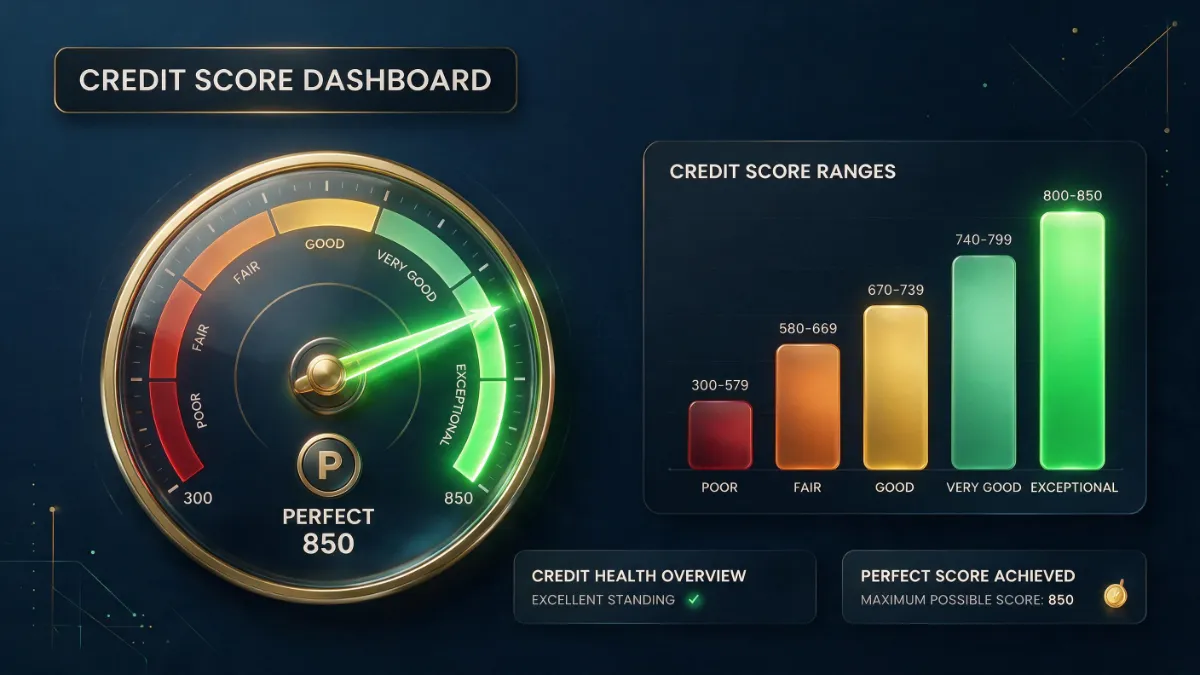
A credit score is a number derived from the data in that report. FICO and VantageScore are the two main scoring models. Neither the FCRA reports nor AnnualCreditReport.com automatically provides a free score alongside the free report. The report and the score are separate products.
| Item | What It Is | Free at AnnualCreditReport.com? |
|---|---|---|
| Credit Report | Full account history file from each bureau | Yes — free weekly access |
| Credit Score (FICO) | 3-digit number derived from report data | No — separate product |
| Credit Score (VantageScore) | Alternative scoring model, same data | No — often available via card issuers |
Source: CFPB — Credit Reports and Scores
Many credit card issuers now provide free score access as an account benefit. Some banks and credit unions do too. The report and the score serve different purposes: the report shows what’s on file, while the score tells you how lenders are likely to react to it.
Estimate your score from the two most important factors.
Does Checking Your Own Report Hurt Your Score?
No — and this is one of the most stubborn myths in consumer credit.
Checking your own credit report through AnnualCreditReport.com is a soft inquiry. Soft inquiries are visible on your credit file but don’t affect your score. The CFPB and the three bureaus all confirm this. You can check weekly without any score impact.
The inquiry type that can affect scores is a hard inquiry — which happens when a lender or creditor pulls your report as part of an application decision. That’s a different action entirely from you reviewing your own file. The research notes this distinction specifically because the concern about “hurting the score” keeps some consumers from checking — which means errors go undetected longer.
💡 Research note: Hard inquiries — from credit applications — typically affect scores by 5 to 10 points per inquiry. Your own report review creates no such impact. The two types of inquiries look different on your file and serve different functions.
What to Look for When Reviewing Your Report
The CFPB says to check for mistakes that could affect your access to credit or the terms offered on a loan. Here’s what that means in practice.
The most common errors worth finding
| Error Type | Why It Matters | What to Do |
|---|---|---|
| Accounts you don’t recognize | May indicate identity theft or mixed files | Dispute immediately with bureau and data furnisher |
| Incorrect payment status | A “late” payment you actually made on time raises red flags for lenders | Dispute with bureau; contact creditor for payment records |
| Duplicate accounts | Can inflate total debt figures and utilization | Dispute the duplicate entry |
| Wrong personal information | Wrong name, address, or SSN can indicate file mixing | Request correction through bureau |
| Outdated negative items | Most negatives must be removed after 7 years; bankruptcies after 10 | Dispute if the item has passed its reporting window |
| Credit limit listed too low | A lower reported limit artificially raises your utilization ratio | Contact creditor to confirm and update the reported limit |
Source: CFPB · FTC — Free Credit Reports
This is where reviewing the full report beats relying on a monitoring service that only shows a score. A score can shift without telling you why. The report shows you the actual data behind that shift — and gives you something concrete to dispute if it’s wrong.
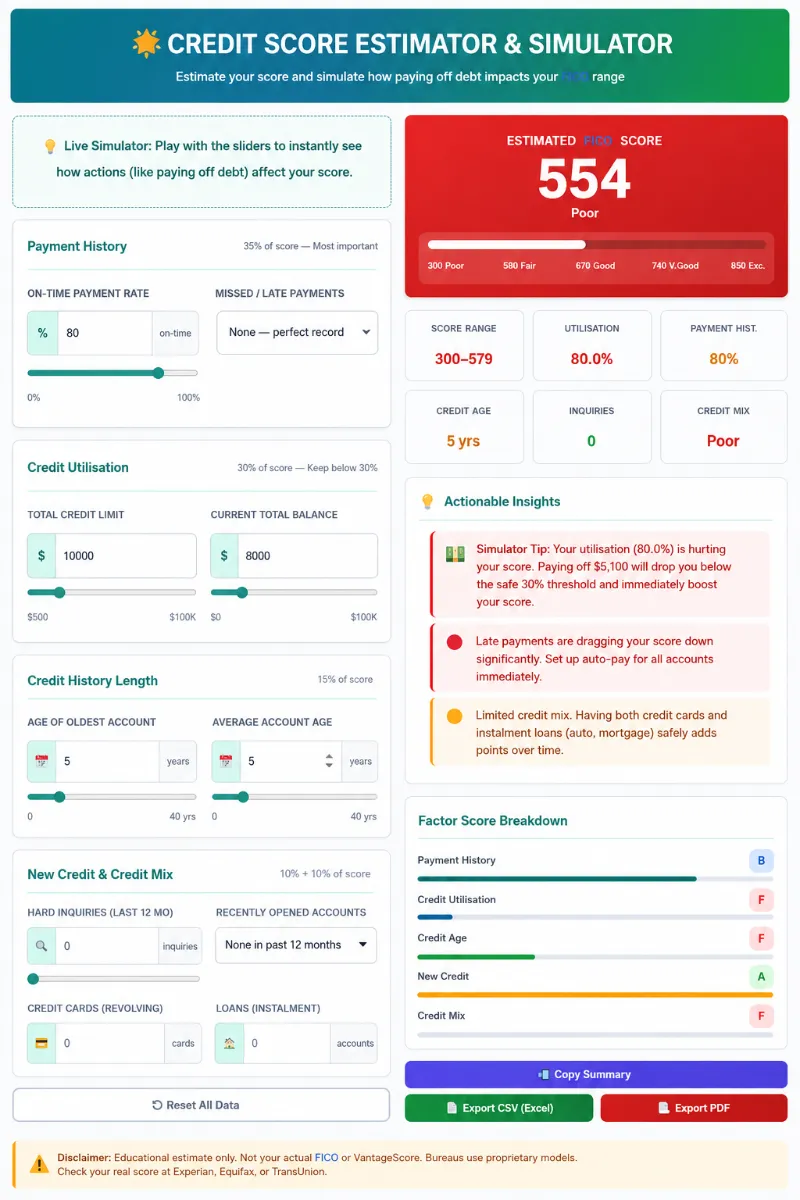
💳 Connect Your Report to Your Score: SaveXpert Credit Score Estimator
I ran a scenario through the Credit Score Estimator looking at what happens when credit utilization drops after a report error gets corrected. The exercise showed why reading the report matters more than just watching a score number — the report is what you can actually dispute and change. If you’ve just reviewed your report and want to model how specific items affect your score, the estimator is the natural next step.
Educational note: This calculator models credit scenarios for informational purposes only and does not provide personalized financial advice. Source: CFPB — Credit Reports and Scores
What to Do When You Find an Error
The FCRA gives consumers a formal dispute process — and it has specific legal deadlines the bureaus must meet.
The formal dispute process
When you find an error, the research points to a two-track approach: dispute it with both the credit bureau and the data furnisher (the creditor or company that supplied the information). Disputing with only one may not be enough to resolve the issue, because both parties have separate obligations under the FCRA.
| Step | What to Do | FCRA Deadline |
|---|---|---|
| 1. File dispute with the bureau | Submit online, by phone, or by mail to Equifax, Experian, or TransUnion | The bureau must investigate within 30 days |
| 2. Contact the data furnisher | Write to the creditor or business that reported the error | The furnisher must investigate and correct it if inaccurate |
| 3. Submit additional evidence | Include supporting documents — statements, receipts, letters | The bureau gets up to 45 days when you send new information |
| 4. Review the result | The bureau must notify you of the outcome and any changes | Within 5 days of completing the investigation |
Source: AnnualCreditReport.com · FTC — FCRA
What about adverse action notices?
Here’s a part of the FCRA that many consumers overlook. When a lender, insurer, or employer denies an application — or offers worse terms than standard — based on credit file information, they’re typically required to send an adverse action notice under FCRA Section 615.
That notice contains two important things: the specific reason for the decision and information about your right to a free credit report. Many people receive these notices and throw them away. But the free report right they reference is separate from the regular AnnualCreditReport.com entitlement — and it gives you a direct look at the specific file the decision-maker used.
💡 Research note: An adverse action notice isn’t just a rejection letter. The research says consumers who ignore these notices can miss the opportunity to review exactly what information was used to deny them — and to dispute anything inaccurate before the next application.

What Changed in 2025 and 2026?
A few specific developments in the past two years are worth knowing about.
Fee increase for paid FCRA disclosures
The CFPB announced an increase to the maximum fee for paid credit file disclosures — the reports consumers can purchase beyond their free entitlement. The maximum went from $15.50 to $16.00, effective from the CFPB’s December 15, 2025 announcement. This doesn’t affect the free reports at AnnualCreditReport.com — those remain free under federal law.
Weekly access remains in place
The weekly free-report program — permanent since September 2023 — continues through 2026. The research confirms there’s no new 2026 legislation behind it. All three bureaus have kept the expanded program running, and the CFPB treats it as the current standard for consumer access.
CFPB regulatory changes
The research brief notes that the CFPB withdrew 67 regulatory guidance documents in May 2025 — part of broader changes to agency policy and enforcement priorities. The core statutory rights under the FCRA (the annual report entitlement, the dispute process, the adverse action notice requirements) come from federal statute, not guidance documents. Those rights remain in place regardless of the guidance changes.
⚠️ Important distinction: Regulatory guidance documents shape how agencies enforce rules. The underlying consumer rights — annual free reports, the dispute process, adverse action notice requirements — come from the FCRA itself. Changes to CFPB guidance don’t eliminate statutory rights Congress wrote into law.
What the Research Shows Works (and What Doesn’t)
What the data consistently supports
Using AnnualCreditReport.com as the only free-report source.
The FTC and CFPB both identify it as the only federally authorized portal. Third-party sites that look similar can redirect consumers into paid products or subscription traps.
Reviewing all three bureaus — not just one.
The three bureaus maintain separate files. An error at Experian may not appear at Equifax or TransUnion. Creditors choose which bureau to report to, and they don’t always report to all three. A comprehensive review requires checking all three.
Disputing errors with both the bureau and the data furnisher.
The FCRA assigns obligations to both parties. Filing with the bureau alone may not be enough if the furnisher continues sending inaccurate data. Contacting both gives the dispute the best chance of a full correction.
Spacing checks quarterly across bureaus.
One bureau every four months gives year-round coverage under the annual entitlement without over-monitoring. Weekly access is available when you need closer review — before a loan application, after a breach notice, when you suspect fraud.
What the data says doesn’t work
Using unofficial “free report” websites.
The FTC and state attorneys general have flagged multiple sites that advertise free reports while collecting payment details or pushing subscription sign-ups. The official portal is one address.
Relying only on a credit monitoring service.
Monitoring services typically show a score and limited alerts — not the full file available through AnnualCreditReport.com. A score moving 10 points doesn’t tell you what changed in your file. The full report does.
Ignoring adverse action notices.
These notices contain specific information about why a decision was made and a separate right to a free report. The research says ignoring them can leave inaccurate information unaddressed — and in place for the next application cycle.
Bottom Line: 5 Steps to Check Your Credit Report in 2026
1. Go to AnnualCreditReport.com — the only official source:
No credit card. No subscription. No lookalike sites. The only federally authorized portal for the free statutory reports is that one address. Online access is immediate; phone takes the same session; mail takes up to 15 days.
2. Pull all three bureaus — they keep separate files:
A creditor error at TransUnion won’t automatically appear at Equifax or Experian. Checking just one bureau leaves two-thirds of your credit file unreviewed. Pull all three, even if you space them quarterly.
3. Review for the six most common errors:
Accounts you don’t recognize, incorrect payment status, duplicate accounts, wrong personal information, outdated negative items past their reporting window, and credit limits listed lower than your actual limit. Each can affect borrowing terms.
4. Dispute errors with BOTH the bureau and the data furnisher:
One alone isn’t enough. The FCRA assigns obligations to both parties. File with the bureau, then write to the creditor or company that submitted the inaccurate data. Bureaus have 30 days to investigate — 45 days when you provide additional evidence.
5. Space checks quarterly — and increase frequency when the stakes are high:
One bureau every four months gives year-round coverage under your annual entitlement. Use the weekly access before any major loan application, after a data breach notice, or anytime you suspect something is wrong with your file.
“The number that caught my attention when I went through the CFPB and FTC research wasn’t the fee schedule or the dispute timelines. It was 156 — the potential number of free credit report pulls available to every American in a single year. Most people don’t know that. Most people are still thinking once a year. The access changed in 2023, and it hasn’t gone back.”
— Kevin Brown, Lead Researcher at SaveXpert.com
Frequently Asked Questions
Ans: The only federally authorized method is through AnnualCreditReport.com. You can access it online (immediate), by phone at 1-877-322-8228, or by mail (up to 15 days). Federal law guarantees one free annual report from each of the three major bureaus. All three bureaus have also continued weekly free access through the same portal since September 2023. No credit card is required at any step.
Ans: Federal law guarantees at least three free reports per year — one from each bureau annually. But weekly access through AnnualCreditReport.com expands that to up to 156 reports per year (52 weeks × 3 bureaus). Equifax provides an additional six free reports annually through 2026 under a separate settlement-related program. The CFPB recommends checking at least once a year; quarterly spacing across bureaus gives broader coverage without overwhelming yourself.
Ans: A credit report is the full historical file maintained by each bureau — your account history, payment records, credit inquiries, and personal information. A credit score is a three-digit number calculated from that data by scoring models like FICO or VantageScore. The free reports at AnnualCreditReport.com do not automatically include a credit score. Scores are separate products, often available through credit card issuers or bank accounts as a free benefit.
Ans: No. Checking your own report is a soft inquiry, which doesn’t affect your credit score at all. The CFPB and all three bureaus confirm this. Only hard inquiries — triggered when a lender or creditor pulls your report for an application decision — can affect your score, typically by 5 to 10 points per inquiry. You can check your report weekly without any impact on your credit.
Ans: Dispute it with both the credit bureau and the data furnisher — the creditor or company that reported the error. File the dispute with the bureau online, by phone, or by mail. Then write to the data furnisher directly. Include supporting evidence such as statements or receipts. Bureaus have 30 days to investigate — or 45 days when you submit additional information. The bureau must notify you of the result and any changes to your file.
Ans: The quarterly strategy involves spacing your three annual free reports — one bureau every four months. For example: Equifax in January, Experian in May, TransUnion in September. This gives year-round visibility across all three files under your annual statutory entitlement, rather than pulling all three at once and having no coverage for the rest of the year. When stakes are higher — before a major loan application or after a data breach — weekly access through AnnualCreditReport.com allows more frequent checks at no additional cost.