

ⓘ Educational Disclosure:
This article is for educational and informational purposes only. It does not constitute financial, legal, tax, lending, or investment advice. SaveXpert and its authors are not licensed financial advisors, CPAs, attorneys, or tax advisors. All data comes from publicly available government and institutional sources. Savings figures from cited research reflect study results — individual outcomes vary. FDIC coverage depends on specific account structures; always verify with your provider. App availability and features may have changed since publication. Always consult a qualified professional before making investment decisions.
Do automatic savings apps actually work? They can — but the automation rule determines the result, not the app’s brand or interface. CFPB research using Qapital app data found that guaranteed rules (fixed schedules and payday-based transfers) produced 1.5 to 3.5 times larger increases in maximum savings balances within one year than contingent spending rules like round-ups. Each guaranteed rule adopted was associated with approximately $333 in additional maximum balance in the first year. FDIC insurance coverage depends on the underlying account structure — not the app’s name. Regulation E (12 CFR Part 1005) provides consumer protections for automatic electronic transfers. And the CFPB’s action against Hello Digit shows that automated transfers can still cause overdrafts when the transfer logic is flawed.
Key Takeaways
- Problem: Most Americans struggle to build emergency funds consistently. Automatic savings apps promise to solve this, but their effectiveness varies dramatically based on which automation rule drives the transfers.
- Solution: CFPB research — the only peer-reviewed government study found that directly tested automatic savings app effectiveness — found that guaranteed, fixed-schedule transfers build 1.5 to 3.5 times more savings than contingent round-up rules within one year. Each guaranteed rule adopted was associated with approximately $333 in additional maximum balance in the first year.
- Result: The research consistently points to the same lesson: the rule matters more than the app. FDIC coverage, overdraft risk, and Regulation E protections all depend on the specific account structure and transfer setup — not the app’s marketing language.
- Source: CFPB Consumer Savings App Strategies Report (2022) · FDIC · Regulation E
- Time To Read: 7 Minutes
Table of Contents
1. Automatic Savings Apps Can Work — But the Rule Matters More Than the App
2. Do Round-Up Savings Apps Actually Help You Save Money?
3. A Closer Look at the Numbers: What $333 Per Rule Means
4. FDIC Insurance and What Happens If a Savings App Shuts Down
5. Regulation E: Consumer Protections for Automatic Transfers
6. Automatic Transfers Don’t Eliminate Overdraft Risk
7. Fees, Features, and How Apps Compare to High-Yield Savings Accounts
8. I Ran an Emergency-Fund Example Through SaveXpert’s Calculator
9. The Broader Savings Picture in 2026
11. Realistic Expectations for Automatic Savings Apps
12. Bottom Line: 5 Steps to Use Automatic Savings Apps Effectively
The feature most people associate with automatic savings apps is the round-up. Spend $4.25 on coffee, save $0.75. The habit feels painless. The CFPB’s research on consumer savings app strategies — the only peer-reviewed government study I found that directly tested automatic savings app effectiveness — found that round-ups (called “contingent rules” in the study) represented 81% of savings goals in the data. Yet guaranteed rules like fixed payday transfers produced 1.5 to 3.5 times larger increases in maximum savings balances over the same year. The app matters less than the rule running inside it.
Automatic Savings Apps Can Work — But the Rule Matters More Than the App
The CFPB’s 2022 research report on consumer savings app strategies used real Qapital app data to compare two types of automation. The study found that guaranteed saving rules — fixed schedules and payday-based transfers — were associated with 1.5 to 3.5 times larger increases in maximum savings balances within one year than contingent spending rules like round-ups.
| Rule Type | How It Triggers | Share of Savings Goals in Study | CFPB Finding |
|---|---|---|---|
| Guaranteed rule (fixed schedule, payday transfer) | Calendar or payroll event fires the transfer regardless of spending | 41% of savings goals | Associated with 1.5–3.5× larger increases in maximum savings balance over 1 year; linked to higher likelihood of reaching $500 and $1,000 milestones |
| Contingent rule (round-up, save-with-purchase) | A purchase must occur first; saving is calculated from the transaction | 81% of savings goals | Most popular rule type; lower savings accumulation than guaranteed rules in the same study period |
Source: CFPB Consumer Savings App Strategies and Savings Outcomes (2022). Note: some savings goals used both rule types simultaneously, so percentages can exceed 100%.
One word to get right here: “guaranteed” in the CFPB study refers to the saving rule — the rule fires on a fixed schedule. It doesn’t mean a guaranteed financial outcome. The app moves a set amount because the calendar or a payroll event triggers it. That’s different from a guarantee about what the account balance will reach.
The distinction between the two rule types matters specifically because spending-based rules depend on spending volume. A person who makes fewer purchases generates fewer round-ups. A fixed payday transfer doesn’t depend on whether any purchases happen at all. That independence from daily spending behaviour is what the research links to the larger savings accumulation.

Do Round-Up Savings Apps Actually Help You Save Money?
The data doesn’t show that round-up apps fail completely. It shows they accumulated less savings than the guaranteed rules in the CFPB study. That’s a more specific finding than a pass/fail verdict — and worth understanding precisely before choosing an automation strategy.
Consider two consumers. One saves through a round-up rule. The other uses a fixed transfer after every payday. The first person’s savings depend on purchase frequency and the size of each transaction’s leftover cents. In a week with fewer transactions, less is saved automatically. In a week with more transactions, more is saved. The output is variable by design.
The second person’s savings follow a fixed schedule. Whether or not they spend anything that week, the transfer fires after each payday. That creates a consistent, predictable pattern of deposits. The CFPB data found that pattern — not the round-up variability — was linked to larger balance increases over the year studied.
Private analysis from Bankrate (a financial media company, not a government source) describes direct-deposit splits as one of the simplest forms of automation: fixed dollar amounts or percentages routed to savings before the remainder reaches checking. That framing aligns with what the CFPB’s data found most effective — a transfer that fires before the money becomes available for spending.
A Closer Look at the Numbers: What $333 Per Rule Means
The CFPB research provides a concrete figure alongside the multiplier: each guaranteed rule adopted was associated with approximately $333 in additional maximum savings balance within the first year of use.
| CFPB Finding | Figure | What It Means Practically |
|---|---|---|
| Savings balance increase per guaranteed rule adopted | ~$333 (first year) | Each fixed-schedule rule added to a savings app was associated with this additional maximum balance increase — giving the 1.5–3.5× multiplier a concrete real-world scale |
| Balance milestone likelihood | Higher for guaranteed rules | Fixed rules were associated with greater probability of reaching $500 and $1,000 within one year |
| Study scope | 2021–2022 Qapital app data | The only peer-reviewed government research found that directly tested automatic savings app effectiveness; verified as of September 25, 2026 |
The $333 figure is useful as a planning reference — not a promise. It reflects averages from the study population, not every individual user’s experience. A household with larger payday transfers could accumulate more; one making very small transfers could accumulate less. The value of the number is that it shifts the question from “does this app work?” to “how much can a fixed rule realistically add in year one given my transfer size?”
FDIC Insurance and What Happens If a Savings App Shuts Down
The “savings app” label doesn’t determine FDIC coverage
The FDIC insures deposits at FDIC-insured banks up to $250,000 per depositor, per ownership category. That coverage can apply when a savings app places customer funds in an FDIC-insured bank account. It doesn’t automatically apply because an app calls itself a savings tool.
The research brief identifies a specific structural detail worth knowing: some apps initially hold money in non-interest-bearing accounts before moving funds into interest-paying “pockets.” That intermediate holding structure can affect both FDIC coverage and whether the balance earns interest during the transition period. Two apps can both market themselves as savings tools while using fundamentally different underlying account arrangements.
| Scenario | FDIC Coverage | What to Verify |
|---|---|---|
| App places funds in FDIC-insured partner bank account in your name | Typically covered up to $250,000 per depositor, per ownership category | Name of the partner bank; confirm the account is titled in your name |
| App holds funds in a non-bank account or pooled structure | May differ from standard FDIC deposit coverage | Ask the app specifically: “Where are my funds held? Is that account FDIC-insured?” |
| App uses an intermediate non-interest-bearing holding account | Depends on the specific arrangement | Whether your balance is in an FDIC-insured account at any given moment — not just at final destination |
Source: FDIC Consumer Resource Center — Mobile Banking. The FDIC does not publish a universal rule covering every savings app arrangement — verify with your specific app and its disclosed partner bank.
What happens if a savings app shuts down?
The research brief doesn’t provide a single shutdown rule that applies to every automatic savings app. The answer depends entirely on the legal structure of where the funds are held at the time of shutdown.
When money sits in an FDIC-insured bank deposit account at the time an app closes, FDIC deposit insurance can apply within the stated limits. The app’s brand discontinuing doesn’t affect the underlying bank deposit. When funds sit in a non-bank structure at shutdown, the protections differ — and may be lower. The practical rule the research points to: verify the underlying account structure before depositing, not after a shutdown announcement.

Regulation E: Consumer Protections for Automatic Transfers
Automatic savings apps move money electronically between accounts — which means federal consumer-protection rules apply. The Electronic Fund Transfer Act and Regulation E (12 CFR Part 1005), implemented by the CFPB, cover automatic and preauthorized transfers from consumer accounts.
| Regulation E Provision | What It Means | Source |
|---|---|---|
| Consumer liability for unauthorized EFT | Limited to $50 if reported within 2 business days; higher limits apply when reporting happens later | 12 CFR Part 1005 |
| Error investigation timeframe | Financial institution must investigate within 10 business days; extensions up to 45 days in certain cases | CFPB EFT FAQs |
| Required disclosures before first transfer | Fees, transfer limits, and terms must be disclosed before the first electronic transfer occurs | 12 CFR Part 1005 |
| Preauthorized electronic debits | Require consumer authorisation and disclosure of authorisation terms; consumer can stop payment with 3 business days’ advance notice | CFPB Regulation E Final Rule |
Source: CFPB Regulation E · CFPB EFT FAQs
The Regulation E disclosures requirement is the one most relevant before setting up an automatic transfer: the app must tell you the fees, the limits, and the transfer terms before your first transfer. If you can’t find those disclosures before authorising the first transfer, that’s a gap worth investigating directly with the provider.
See your target safety net and how close you are.
Automatic Transfers Don’t Eliminate Overdraft Risk
This finding from the research brief deserves more attention than it usually gets in savings app coverage. Automation doesn’t remove the risk of poorly timed transfers — it relocates the decision-making from the consumer to the algorithm.
The CFPB took enforcement action against Hello Digit after finding that its automated savings algorithm caused overdrafts. The action resulted in a $2.7 million penalty and more than $68,145 in required consumer redress tied to denied overdraft reimbursement.
| Hello Digit Enforcement Details | Finding |
|---|---|
| Issue identified by CFPB | Automated savings algorithm caused overdrafts in linked checking accounts |
| Penalty imposed | $2.7 million |
| Consumer redress required | More than $68,145 — tied specifically to denied overdraft reimbursements |
| Regulatory basis | CFPB enforcement — prohibition on deceptive acts involving financial products |
The Hello Digit case doesn’t mean every savings app causes overdrafts. It establishes that automated transfer logic can fail — and when it does, the overdraft consequences fall on the consumer. The automation depends on the transfer logic, the account balance at the time of each transfer, the transfer timing, and the safeguards built into the system. None of those are visible to the consumer once the automation is set up and running.
⚠️ Practical implication: For the first three months of any new savings automation, manually check your linked checking account balance after each automatic transfer to confirm it processed without triggering an overdraft or overdraft fee. The algorithm doesn’t know your balance dipped lower than expected between paychecks. You do.
See how long it takes to reach your target.
Fees, Features, and How Apps Compare to High-Yield Savings Accounts
What the research does and doesn’t say about fees
The sources reviewed don’t establish one universal fee amount for automatic savings apps. What they do establish are the disclosure requirements. Regulation E requires disclosures of applicable fees, limits, and transfer terms before the first electronic transfer — so the research’s answer to “are there fees?” is: check the disclosures you’re entitled to receive before your first transfer. If the app doesn’t provide them, ask.
One important distinction from Bankrate’s private analysis: some AI-powered financial apps reportedly save users $80–$500 annually. The research brief specifically flags that those savings primarily come from subscription cancellation and deal-finding features — not from automatic savings transfers. A tool that finds a streaming subscription to cancel and a tool that moves $50 per payday into savings are different types of automation. Both can help, but they produce different kinds of output.
Apps vs. high-yield savings accounts: what the research actually compares
The research brief doesn’t establish a universal “better” choice between an automatic savings app and a high-yield savings account. What it does show is that automation can operate through very different account structures. Some tools move money into savings accounts. Others sweep spare change into investment portfolios. Some temporarily hold balances in non-interest-bearing accounts before moving them to interest-paying pockets. The comparison isn’t straightforward because the two aren’t always the same type of product.
A savings app provides automation and behavioural tools — the system handles the transfer decision so the consumer doesn’t have to make it repeatedly. A high-yield savings account focuses on the deposit account and its interest rate. They can work together (setting up an automatic transfer from a checking account into a high-yield savings account) or separately. The research doesn’t supply a rate comparison across these options — that depends on current interest rates, the specific app’s fee structure, and the household’s specific situation.
I Ran an Emergency-Fund Example Through SaveXpert’s Calculator
The Federal Reserve’s 2025 economic well-being report found that 55% of US adults had three months of emergency expenses saved. That figure held unchanged from 2024 and remained below the 59% recorded in 2021. It’s a useful benchmark — but “55% had three months saved” means different things to different households depending on what three months of their expenses actually equals.
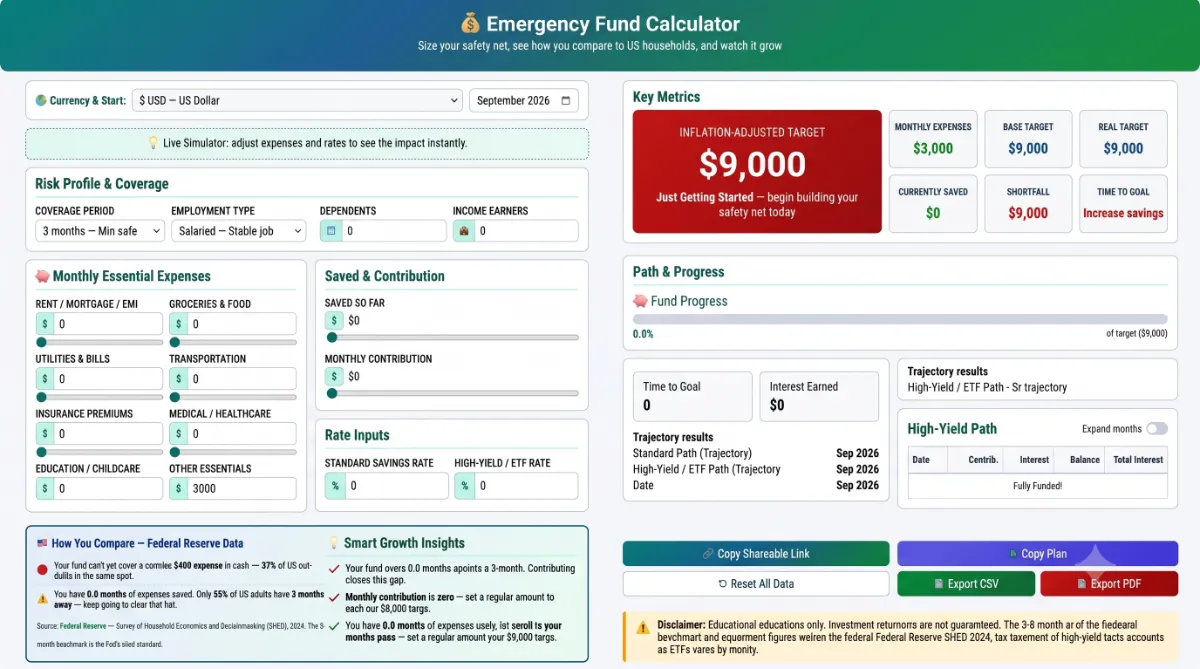
I ran a simple scenario: $3,000 in monthly expenses, which is a rough midpoint figure below the BLS average household spending of $6,545/month. A three-month emergency fund for that household comes to $9,000. That gives the Federal Reserve’s 55% statistic a concrete meaning — a household in this position is working toward a $9,000 goal, not an abstract “three months.”
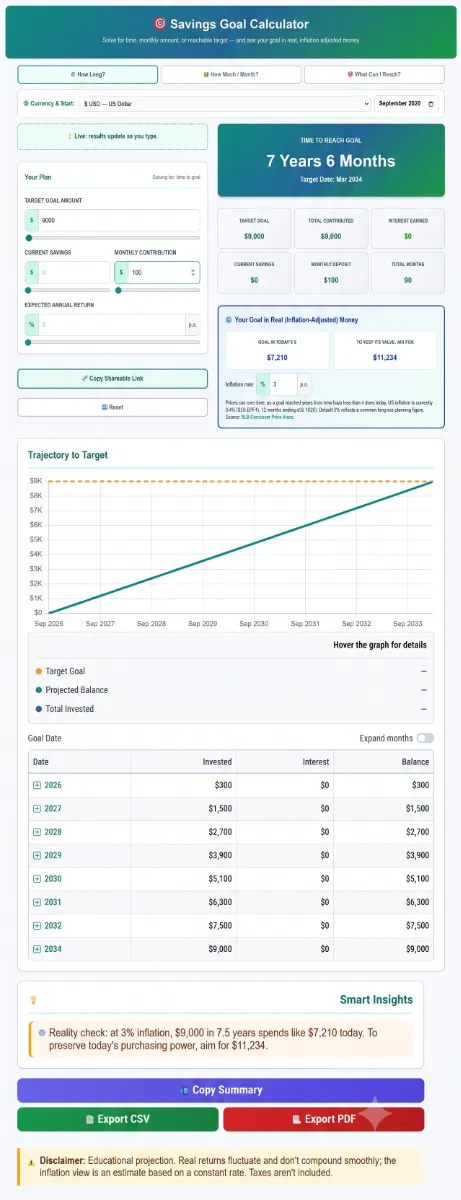
The CFPB research connects the goal to the automation: specific savings milestones ($500, $1,000) were reached more often with guaranteed rules. Setting up a fixed payday transfer of $50 bi-weekly toward a $9,000 emergency fund goal gives the automation a specific destination — which the CFPB data links to better outcomes than open-ended round-up accumulation.
🧮 SaveXpert Emergency Fund & Savings Goal Calculators — Free & No Signup
The Emergency Fund Calculator takes your actual monthly expenses and outputs the three-month and six-month targets — turning the Federal Reserve’s benchmark percentage into a specific dollar figure you can automate toward. The Savings Goal Calculator connects to the CFPB’s milestone finding: set a specific goal ($500, $1,000, full emergency fund), enter a weekly or monthly transfer amount, and the calculator shows how long the automation takes to reach it.
Educational note: Calculators model scenarios for informational purposes only. Source benchmarks: Federal Reserve 2025 SHED · CFPB Savings App Research
The Broader Savings Picture in 2026
App adoption has grown substantially. Consumer Reports (private) found that 75% of Americans use one or more banking apps. Private market research estimated approximately 95 million monthly active US personal finance app users in early 2026, excluding brokerages. Of those, 38% reportedly use personal finance apps weekly — and adults under 35 are roughly twice as likely as adults over 55 to do so.
Yet the national emergency-savings picture hasn’t tracked the same direction.
| Federal Reserve / BEA Data Point | Figure | Source |
|---|---|---|
| Adults with 3 months of emergency savings, 2025 | 55% — unchanged from 2024; below 59% in 2021 | Federal Reserve 2025 SHED Report |
| Personal saving rate, July 2026 | 3.0% — down from 3.6% in March 2026 | Bureau of Economic Analysis |
Source: Federal Reserve 2025 Economic Well-Being Report · BEA Personal Saving Rate
These figures don’t prove that savings apps produced no benefit for individual users. They show that growing app adoption at the population level hasn’t translated into a return to the 2021 emergency-savings peak. Individual users can still benefit from fixed-rule automation. The population-wide data simply establishes that app availability alone doesn’t automatically move aggregate emergency savings rates.
What the Research Shows Works
Fixed, guaranteed saving rules outperform round-ups in the only government study that directly tested both.
The CFPB’s 1.5 to 3.5× multiplier for guaranteed rules isn’t anecdotal — it comes from real Qapital user data. The $333 per guaranteed rule figure makes the multiplier concrete. If an app offers a payday-based fixed transfer option, the research points toward using that rather than defaulting to round-ups.
Payday-triggered automation removes the decision from the spending environment.
The behavioural case for payday transfers is the same as the statistical one: the transfer fires when money arrives, not when spending happens. Private payroll-split features — routing part of a direct deposit to savings before the rest reaches checking — produce the same structure without a dedicated app. The CFPB research supports this transfer type regardless of the platform that implements it.
Specific savings goals improve milestone-reaching odds.
The CFPB linked both automation and defined dollar targets to a greater likelihood of reaching $500 and $1,000 within one year. “Save something” without a specific target produces a different outcome than “save $1,000 by March.” The Savings Goal Calculator helps convert a target into a required weekly or monthly transfer amount.
Account structure determines FDIC protection — not the app’s name.
Two apps with similar marketing may use different underlying account arrangements with different FDIC coverage implications. The research brief is specific: verify the partner bank, verify the account is titled in your name, and verify whether an intermediate holding account exists before your funds reach the final destination.
Automation can produce overdraft risk when transfer timing fails.
The Hello Digit enforcement case documents $2.7 million in penalties and consumer harm from an algorithm that caused overdrafts. Automation doesn’t monitor your real-time checking balance — it fires on schedule. The practical safeguard is monitoring the first several months of transfers manually before trusting the automation entirely.

Realistic Expectations for Automatic Savings Apps
The CFPB’s strongest savings-app evidence covers a one-year period. Within that year, guaranteed rules were associated with larger increases in maximum savings balances, including roughly $333 per guaranteed rule adopted. That’s a meaningful one-year starting contribution toward a $9,000 three-month emergency fund — but it’s also a starting point, not a completion guarantee.
At the national level, the Federal Reserve’s 55% emergency-savings figure — unchanged from 2024 despite growing app adoption — establishes the broader context. Individual households can benefit from fixed-rule automation without that translating into a population-wide improvement in the statistic.
The research was verified as of September 25, 2026. The CFPB identified the 2021–2022 Qapital study as the only peer-reviewed government research that directly tested automatic savings app effectiveness. That means the evidence base is real but narrow — one study, one app platform, one time period. The directional findings (fixed rules outperform round-ups, specific goals improve milestone odds) are consistent with how similar financial behaviour research works, but they come from a specific study population rather than the entire US app market.
Bottom Line: 5 Steps to Use Automatic Savings Apps Effectively
1. Choose a fixed-schedule or payday-based transfer rule, not a round-up rule as your primary automation:
The CFPB’s 2022 research is direct: guaranteed rules produced 1.5 to 3.5 times larger increases in maximum savings balances than contingent rules over one year, with each rule adding approximately $333 in maximum balance. Round-ups are popular — 81% of savings goals in the study used them — but they depend on spending volume. A fixed payday transfer fires regardless of whether you spent anything that week. If your savings app offers both rule types, set up the fixed transfer first and let the round-up run as supplementary, not primary.
2. Verify FDIC insurance status and the partner bank name before depositing:
FDIC coverage applies to deposits at FDIC-insured banks — up to $250,000 per depositor, per ownership category. It doesn’t automatically apply because an app uses the word “savings.” Ask the app specifically: Which bank holds my funds? Is that account in my name? Is there an intermediate holding account before funds reach the final destination? If the app can’t clearly answer all three, that’s a gap to resolve before linking your accounts. The FDIC’s consumer resource centre explains what to look for.
3. Set a specific dollar target using the Emergency Fund Calculator before activating the automation:
The CFPB research links defined savings milestones — $500, $1,000 — with better goal-reaching outcomes than open-ended accumulation. The Federal Reserve’s 55% emergency-savings benchmark means “three months of expenses” — which is a different dollar amount for every household. Run the Emergency Fund Calculator with your actual monthly expenses to get the specific three-month target. That number becomes the goal the automation works toward, not an abstract aspiration.
4. Read the Regulation E disclosures before authorising your first transfer:
Under Regulation E (12 CFR Part 1005), the app must disclose fees, transfer limits, and terms before your first electronic transfer. Your liability for unauthorised transfers is limited to $50 if you report within two business days — but that protection requires you to notice and report the problem. Keep the transfer amount small enough that an overdraft from a mis-timed transfer doesn’t cause cascading consequences before you can catch it.
5. Monitor the first three months of transfers manually — don’t assume the automation is working correctly until you’ve verified it:
The CFPB’s Hello Digit enforcement action — $2.7 million in penalties, $68,145+ in consumer redress — shows that automated savings algorithms can cause overdrafts when the transfer logic misjudges account balances. After each of the first three months’ transfers, check your linked checking account balance to confirm the transfer processed without triggering a fee. Once you’ve confirmed the automation works correctly with your specific income and spending pattern, the monitoring overhead drops significantly.
“The research finding that most changed how I think about automatic savings tools is the 81%/41% split. The CFPB’s 2022 Qapital study found that 81% of savings goals used contingent spending rules — round-ups, save-with-purchase features — while only 41% used guaranteed rules like fixed payday transfers. Those numbers show the gap between what’s popular and what produced larger balance increases in the study. Round-ups are popular because they fit invisibly into spending. But their output depends on spending volume — fewer purchases mean fewer round-ups. A fixed payday transfer doesn’t care whether you bought coffee that week. The rule fires regardless. That independence from spending behaviour is what the CFPB data consistently links to larger savings accumulation.”
— Kevin Brown, Lead Researcher at SaveXpert.com
Frequently Asked Questions
Ans: CFPB research identifies two main types of automation. Guaranteed rules — like fixed payday transfers or calendar-scheduled transfers — move a set amount on a fixed schedule regardless of spending activity. Contingent rules — like round-ups or save-with-purchase features — move money based on transaction activity: a purchase must occur first, then the rule calculates what to save. The CFPB found guaranteed rules produced 1.5 to 3.5 times larger increases in maximum savings balances within one year than contingent rules. Both types of automation remove the manual decision, but they produce different patterns of deposits.
Ans: It depends entirely on the underlying account structure — not the app’s name or marketing. The FDIC insures deposits at FDIC-insured banks up to $250,000 per depositor, per ownership category. If a savings app places your funds in an FDIC-insured partner bank account titled in your name, that coverage can apply. If the app uses a non-bank structure, pools funds, or holds balances in an intermediate non-interest-bearing account, coverage may differ. Always ask the specific app: which bank holds my funds, and is that account FDIC-insured?
Ans: The outcome depends on where the funds are legally held at the time of shutdown. If the money is in an FDIC-insured bank deposit account under your name, FDIC deposit insurance applies within the stated limits — the app shutting down doesn’t affect the underlying bank deposit. If funds sit in a non-bank structure, protections differ and may be lower. The research brief found no universal rule covering every app arrangement. Verifying the underlying account structure before depositing is more reliable than checking after a shutdown announcement.
Ans: The CFPB data doesn’t say round-up apps fail. It shows they accumulated less savings than fixed-transfer rules in the same study period. Round-ups depend on spending volume — fewer purchases means fewer round-ups. They represented 81% of savings goals in the CFPB study while producing smaller maximum balance increases than the 41% using guaranteed rules. They can add supplementary savings on top of a fixed-transfer primary rule. Using them as the only savings mechanism produces lower accumulation than the CFPB data links to fixed-schedule transfers.
Ans: The research doesn’t establish one universal fee structure for savings apps. Regulation E requires the app to disclose applicable fees, transfer limits, and terms before your first electronic transfer — so the disclosure must exist before you authorise the first transfer. Some apps charge monthly subscription fees; others are free but may hold funds in accounts that earn little or no interest during intermediate stages. Read the disclosures before authorising, and ask specifically whether any fee applies to the account structure holding your funds.
Ans: A guaranteed rule — as defined in the CFPB’s 2022 research — triggers a savings transfer on a fixed schedule regardless of spending activity. A payday-based transfer or calendar-triggered fixed transfer are examples: the transfer fires because a date or payroll event occurred, not because of a transaction. A contingent or round-up rule triggers a transfer based on purchase activity — a transaction must happen first, then the rule calculates what to save from it. The CFPB found 81% of savings goals used contingent rules, but guaranteed rules were associated with 1.5 to 3.5 times larger increases in maximum savings balances within one year. The core difference: a guaranteed rule saves whether or not you spend; a round-up rule saves only when you spend.