
ⓘ Educational Disclosure:
This article is for educational and informational purposes only. It does not constitute financial, legal, tax, lending, or investment advice. SaveXpert and its authors are not licensed financial advisors, CPAs, attorneys, or tax advisors. All data comes from publicly available government and institutional sources. Loan rates, fees, and approval terms vary by lender and borrower. Payday lending regulations vary by state and may have changed since publication. Always consult a qualified professional before making investment decisions.
Are holiday loans a good idea? It depends entirely on the product. A standard unsecured personal loan used for holiday spending — with a disclosed fixed APR, fixed repayment term, and Regulation Z disclosures — is a fundamentally different product from a payday loan marketed for the same purpose. CFPB research puts the median payday loan APR at 391%, with four out of five payday loans rolled over or renewed within 14 days. The Federal Reserve reported an 11.86% 24-month commercial-bank personal loan rate (September 8, 2026 G.19) and a 20.90% commercial-bank credit card APR (September 2025 G.19). Both standard products represent drastically lower borrowing costs than a 391% payday structure. “Holiday loan” is not a federal loan category — the product behind the label determines whether the borrowing makes sense.
Key Takeaways
- Problem: Holiday spending pressure leads some consumers toward short-term, high-cost borrowing. The label “holiday loan” can describe either a standard unsecured personal loan or a payday product — two very different cost structures.
- Solution: CFPB research puts the median payday loan APR at 391% — a typical $15/$100 fee on a 14-day loan. Four out of five payday loans were rolled over or renewed within 14 days. A standard personal loan at the Federal Reserve’s 11.86% 24-month benchmark or a credit card at the Fed’s 20.90% average are fundamentally different borrowing costs from a 391% payday product.
- Result: Whether a holiday loan is a good idea depends on the product. A standard personal loan used for holiday spending isn’t the same risk as a payday product. The CFPB’s rollover and fee data apply specifically to the payday market — but the rule for evaluating any offer remains the same: check the APR, not just the fee amount.
- Source: CFPB Payday Loan Research · Federal Reserve G.19
- Time To Read: 8 Minutes
Table of Contents
1. Holiday Loans vs. Payday Loans: Two Very Different Products
2. How Expensive a Payday Loan Can Become: The CFPB Numbers
3. The Rollover Pattern That Drives Most Payday Loan Costs
4. What the Research Identifies as Safer Alternatives
5. Federal Rules That Apply to Payday Loans
6. Does a Holiday Loan Affect Your Credit Score?
7. Running the Numbers Before Borrowing
8. What the Research Shows Works
9. Bottom Line: 5 Questions to Ask Before Taking a Holiday Loan
The CFPB describes payday loans as short-term products generally involving $500 or less — often due on the next payday — with fees that can translate into APRs near 400%. The median payday loan APR in CFPB research was 391%. That figure doesn’t describe every product marketed as a holiday loan. But it describes what’s available in one part of the short-term lending market — and it’s the number that most changes how any holiday financing offer should be evaluated before signing.
Holiday Loans vs. Payday Loans: Two Very Different Products
“Holiday loan” is not a federal loan category. The label is a marketing description applied to different products with very different cost structures. The research brief identifies two distinct products that can carry this label:
| Feature | Personal Loan for Holiday Spending | Payday Loan Marketed for Holidays |
|---|---|---|
| Amount | Typically $1,000–$100,000 (private lending analysis; amounts vary by lender) | Generally $500 or less per CFPB definition |
| Repayment term | Fixed monthly payments over a defined term (months to years) | Typically due on the borrower’s next payday — usually 14 days |
| Cost structure | Fixed APR disclosed under Regulation Z | Fee-based; $15/$100 fee on a 14-day term produces ~400% APR |
| Median APR | 11.86% (Federal Reserve 24-month commercial-bank benchmark, Sept 8, 2026) | 391% (CFPB median) |
| Rollover risk | Fixed schedule — no rollover mechanism | 4 out of 5 payday loans rolled over or renewed within 14 days (CFPB) |
| Federal category | Unsecured consumer instalment loan | “Holiday loan” is not a federal category — name is marketing, not a regulated product description |
Source: CFPB — What Is a Payday Loan? · Federal Reserve FRED — 24-Month Personal Loan Rate | Personal loan amount range: private lending analysis (not a federal figure)
The distinction matters because the CFPB’s research on high costs and rollover risk applies to the payday loan market specifically — not to every personal loan used for holiday purposes. Before evaluating whether a specific offer is a good idea, the first step is identifying which of these two products it actually is.

How Expensive a Payday Loan Can Become: The CFPB Numbers
The CFPB’s research on the payday loan market produces specific figures that go well beyond the headline fee.
| CFPB Data Point | Figure | What It Means |
|---|---|---|
| Median payday loan APR | 391% | A typical $15/$100 fee on a 14-day loan produces this annualised rate |
| Example fee: $300 loan at $15/$100 | $45 in fees — total repayment: $345 | The upfront cost before any rollover |
| Median payday loan amount | $350 | Most payday loans are for relatively small amounts |
| Median payday loan term | 14 days | Due date is typically the next payday |
| Median consumer fees paid over study period | $458 (excluding principal) | The median borrower paid more in fees than the typical loan balance — over 12 months |
| Median payday loan transactions per consumer over 12 months | 10 | The typical borrower returned for multiple loans within a year |
| One-quarter of payday borrowers paid in fees | At least $781 | The upper-quartile cost gives more context than the advertised single-loan fee |
Source: CFPB — Payday Loans and Deposit Advance Products · CFPB Payday Research Highlights
The $458 median figure is the one that most changes the calculation. A borrower who makes 10 payday-loan transactions over 12 months and pays a median $458 in fees — excluding principal — has paid more than a full loan balance in fees alone, while the underlying debt balance can continue to exist.
The research brief also notes that the CFPB received approximately 3,500 payday-loan complaints in 2025, a 73% increase from the monthly average of the prior two years. About 67% went to companies for review; companies responded to 95%; 86% were closed with an explanation. Those complaint figures describe the payday loan market broadly — not holiday loans specifically, and not every consumer’s experience.
The Rollover Pattern That Drives Most Payday Loan Costs
The rollover mechanism is where the 391% median APR translates into real accumulated costs. It’s the most important structural difference between a payday loan and a personal loan or credit card.
| Rollover Pattern | CFPB Finding | Cost Implication |
|---|---|---|
| Loans rolled over or renewed within 14 days | 4 out of 5 payday loans (80%+) | Most borrowers renew rather than repay — the fee applies again without reducing principal |
| Loans entering sequences of 7+ loans | More than 60% | The majority of payday loan volume goes to borrowers in extended sequences |
| Rollover fee on a $300 loan | $45 per two-week period | 7 rollovers on $300 = $315 in fees; original $300 principal still outstanding |
| Effect of rollover on principal | No reduction — CFPB confirms rollover fees don’t reduce the original principal | Fee payments buy more time; they don’t amortise the debt |
| Extended payment plans (state-required, where available) | Rollover and default rates exceeded use of extended payment plans | CFPB notes extended payment plans can fully amortise a loan — but most borrowers don’t use them |
⚠️ Rollover fees don’t reduce the principal balance — confirmed by CFPB research: A $45 rollover fee on a $300 payday loan pays the lender for another two-week period. At the end of that period, the borrower still owes $300. Seven rollovers produce $315 in fees on an original $300 balance that remains entirely unpaid. This is structurally different from a personal loan or credit card payment, where each payment reduces the outstanding balance. The CFPB confirmed this explicitly in its payday loan research.
The CFPB’s research also found that rollover and default rates consistently exceeded the use of state-required extended payment plans, where those plans existed. Extended payment plans — when available and used — can fully amortise a payday loan because payments apply to the underlying balance. A rollover fee does not.
What the Research Identifies as Safer Alternatives
The research brief frames the alternatives through Federal Reserve household data on financial capacity, not through a recommendation to take on a specific product.
Emergency savings and existing cash
The Federal Reserve’s 2024 household research found that 63% of adults could cover a hypothetical $400 emergency using cash, savings, or a credit card paid by the next statement. It also found that 55% had money set aside for three months of expenses. Those figures describe what survey respondents reported — the research doesn’t say every household has sufficient savings for holiday costs. But for households that do have savings capacity, drawing on existing funds avoids any borrowing cost entirely.
Standard personal loan vs. payday product — the rate comparison
| Product | Rate / APR | Source & Date | Context |
|---|---|---|---|
| Personal loan — 24-month commercial bank rate | 11.86% | Federal Reserve FRED, September 8, 2026 | Population average across all credit profiles |
| Credit card — all commercial-bank accounts | 20.90% | Federal Reserve G.19, September 2025 release | Different release date — don’t treat as same-day comparison with the 11.86% figure |
| Payday loan (median) | 391% | CFPB median from research database | $15/$100 fee on a 14-day loan; median across CFPB’s dataset |
Source: Federal Reserve FRED · Federal Reserve G.19 (September 2025) · CFPB payday research
The ratio between these three figures is the most useful framing: 391% is approximately 33× the personal loan benchmark and approximately 19× the credit card average. That ratio — not just the absolute numbers — is the clearest way to understand the cost difference between a payday product and standard consumer credit.
BNPL as a separate context
The research brief also covers BNPL as another form of short-term borrowing. The Federal Reserve’s 2024 household data found that 15% of adults used BNPL in the prior 12 months. Among BNPL users, 24% paid late and 57% of those late payers said they faced an extra charge. A separate finding noted that 58% of BNPL users said BNPL was the only way they could afford the purchase. Those statistics describe BNPL — not payday loans — and they carry their own risk profile distinct from both payday products and standard personal loans.
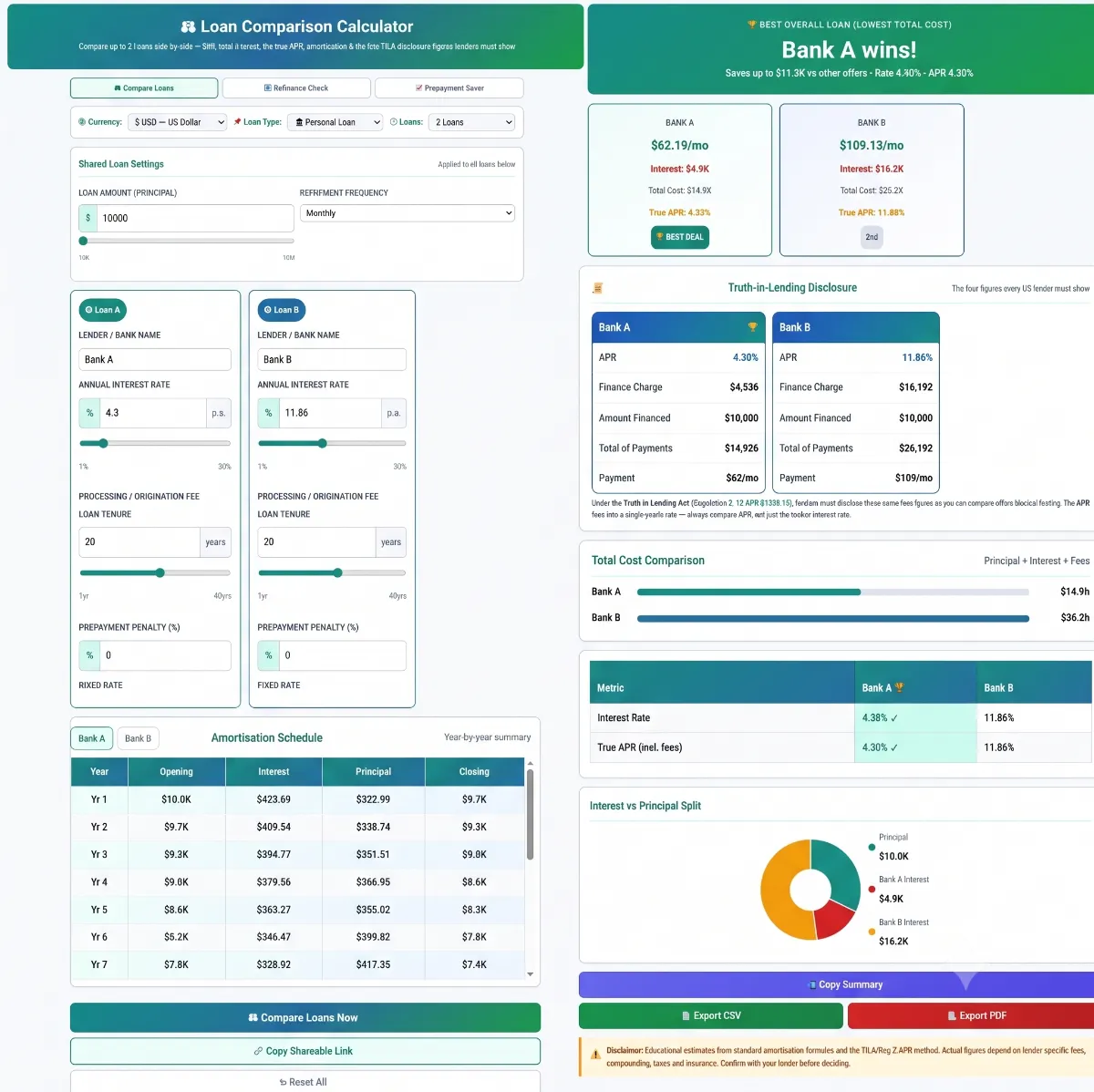
Compare two loans side-by-side to find the cheaper option.
Federal Rules That Apply to Payday Loans
Several federal rules govern how payday lenders can operate and what rights consumers have.
| Rule | What It Covers | Source |
|---|---|---|
| Truth in Lending Act / Regulation Z | Requires consumer-credit providers to disclose APR and finance charges; makes APR the standard comparison figure across credit products | Regulation Z — 12 C.F.R. § 1026 · CFPB — Regulation Z |
| CFPB Payday Lending Rule — 12 C.F.R. § 1041.3(b)(3) | Covers longer-term loans with costs above 36% APR and a leveraged payment mechanism; restricts lenders from initiating another payment withdrawal after two consecutive failed transfer attempts (without new, specific authorisation) | CFPB — Payday Lending Rule FAQs |
| Payment-withdrawal provisions — operative date | Payment-withdrawal and disclosure provisions became operative March 30, 2025 | CFPB regulatory guidance |
| Consumer credit reporting rights (FCRA) | When a lender denies credit based on a consumer report, the lender has notice obligations; consumers have rights to dispute inaccurate or incomplete information | CFPB — Denied Credit Guidance |
Source: Regulation Z · CFPB Payday Lending Rule
⚠️ Regulatory status flag — verify before relying on this protection: The research brief notes that a CFPB enforcement-priority announcement addressed penalties and fines for the payment-withdrawal provisions. The brief states that announcement did not repeal the regulation but specifically flags the legal status for verification before publication. Check current CFPB guidance at CFPB.gov for the current operative status of these provisions. State payday lending laws also vary significantly and may provide additional or different protections.
The practical effect of the two-consecutive-failed-transfer rule: if a lender attempts to withdraw a payment from a borrower’s account twice and both attempts fail, the lender generally cannot try again without obtaining new, specific authorisation from the borrower. This is a consumer protection — but it operates after two failed payment attempts, not before the loan is taken. It doesn’t change the cost structure or rollover risk of the original loan.
Enter your income and top expenses to see where you stand.
Does a Holiday Loan Affect Your Credit Score?
The research brief is specific about what the available sources do and don’t establish on this question.
| Factor | What the Research Shows | Source |
|---|---|---|
| Credit reporting by payday lenders | Not all payday lenders report to major credit bureaus; many short-term payday lenders don’t report positive payment histories | CFPB consumer guidance |
| Hard inquiry on application | A hard inquiry typically reduces a score by less than five points; visible on the credit report for two years; scoring effect lasts about 12 months | CFPB / credit bureau analysis |
| On-time payments — if reported | Positive payment history builds credit when reported to credit bureaus | CFPB credit-building guidance |
| Missed payments — if reported | Negative payment information can remain on a credit report for seven years (CFPB) | CFPB — Credit Rebuilding Guidance |
| Fixed numeric credit score impact from holiday loan | Not established — the research doesn’t support claiming a specific point change from any specific product | Research brief limitation |
The practical distinction: a personal loan that reports to credit bureaus and is paid on time builds credit history. A payday loan that doesn’t report positive history doesn’t help credit — but a defaulted payday loan that is reported negatively can damage it. Asking the specific lender about its reporting practices before taking the loan is the most direct way to understand the credit-reporting dimension of a specific offer.

Running the Numbers Before Borrowing
The CFPB says APR is the most useful comparison figure because it includes fees and other borrowing costs — not just the stated interest rate. That makes it the right number to look for before accepting any offer.
What to check before signing any holiday loan offer
| Check | Why It Matters | What to Look For |
|---|---|---|
| APR (not just the fee or rate) | APR converts fees into an annualised rate that allows comparison across products | Any offer above 36% APR enters a cost range the CFPB’s payday rule specifically targets |
| Total repayment amount | Fee-based lending can look inexpensive until total repayment is calculated | Principal + all fees + any potential rollover fees if you need more time |
| Repayment term | 14-day payday term vs. 24-month personal loan term produce very different monthly obligations | Shorter terms create larger per-period payments; confirm against your budget before accepting |
| Rollover terms | If you can’t repay on time, the fee structure kicks in immediately | Ask the lender what happens if you can’t repay on the original due date |
| Credit reporting practices | Determines whether the loan builds or risks damaging credit | Does the lender report positive payment history to the three major bureaus? |
Source: CFPB — Understanding APR
🧮 Check Your Numbers: SaveXpert Loan & Budget Planner Calculators
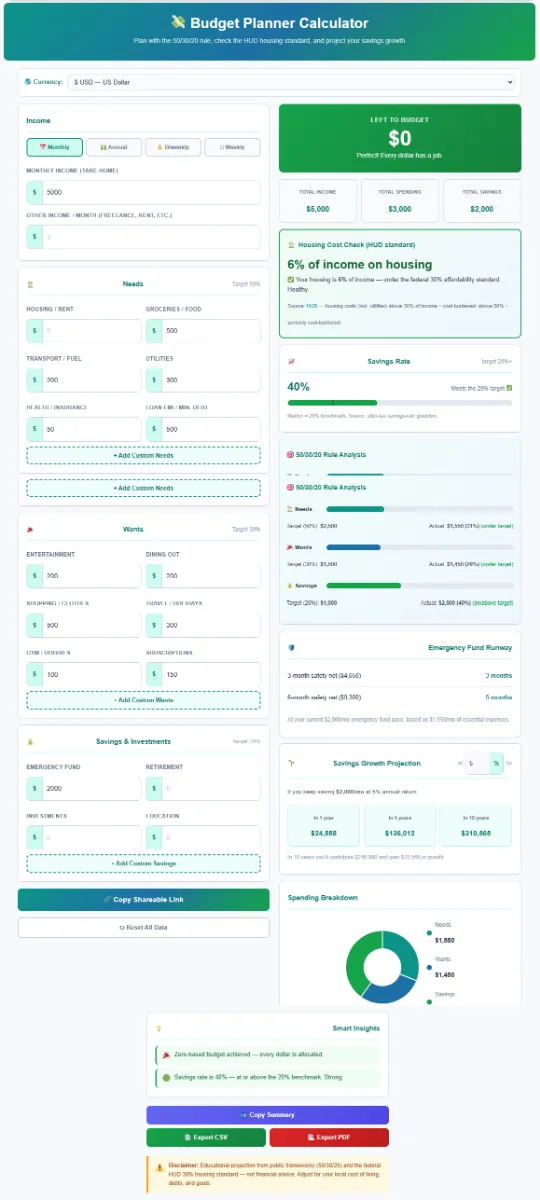
The research brief recommends two tools for this decision. The Loan Comparison Calculator puts a payday loan’s total cost (principal + all fees + any potential rollover fees) side by side with a personal loan’s total cost (principal + interest at a disclosed APR) — in the same calculation. The Budget Planner Calculator checks whether the monthly payment from any new loan fits alongside existing income and expenses before you commit to it.
Educational note: Calculators model scenarios for informational purposes only. Source: CFPB Payday Research
What the Research Shows Works
Comparing APR across products, not fee amounts.
The CFPB explicitly says APR helps consumers compare different credit products because it includes fees and other costs — not just the stated rate. A $45 fee on a $300 loan sounds different from 391% APR, but they describe the same cost. The disclosed APR is the number that makes comparison possible.
Separating the product from the marketing label.
“Holiday loan” describes the purpose, not the product structure. A personal loan used for holiday spending and a payday loan marketed for the same purpose have almost nothing in common in terms of cost, term, or risk. The product structure behind the label determines the cost — not the seasonal framing in the advertising.
Running the total-repayment calculation, not just the upfront fee.
The CFPB data showing median borrowers paid $458 in fees over 12 months — excluding principal — illustrates the gap between the advertised per-loan fee and the realised annual cost of payday borrowing. The relevant number is what the borrower actually paid in total over the period — not what the lender advertised per transaction.
Checking existing savings capacity first.
The Federal Reserve found 63% of adults could cover a $400 emergency with cash or equivalent and 55% had three months of emergency savings. For households with sufficient liquid savings, using them avoids any borrowing cost. For households without that capacity, the comparison shifts to which borrowing option carries the lowest total cost — and Regulation Z’s APR disclosure makes that comparison possible before signing.
Treating rollover capacity as a risk signal, not a benefit.
The ability to roll over a payday loan sounds like flexibility. The CFPB data shows it’s primarily a mechanism for generating additional fees: four out of five loans rolled over within 14 days, more than 60% entered sequences of seven or more loans, and rollover fees don’t reduce the principal. A fixed-payment personal loan that reduces the balance with every payment is a fundamentally different risk profile from a fee structure where non-payment generates another charge on an unchanged principal.

Bottom Line: 5 Questions to Ask Before Taking a Holiday Loan
1. Is this a personal loan or a payday product? — Find the APR before comparing anything else:
The CFPB says APR includes fees and other borrowing costs — making it the right comparison figure across products. A 391% median payday APR vs. an 11.86% personal loan benchmark (Federal Reserve, September 8, 2026) aren’t in the same cost range. Any short-term lending product above 36% APR enters the range the CFPB’s payday rules specifically target. The label “holiday loan” doesn’t tell you which you’re looking at — the APR does.
2. What is the total repayment — including all fees and any potential rollover cost?
A $300 payday loan at $15/$100 costs $45 in fees for the first two-week term. Seven rollovers at $45 each produces $315 in fees on a $300 principal that remains entirely unpaid throughout. Calculate: original amount + all upfront fees + rollover fee × number of periods you might need. Use the Loan Comparison Calculator to put that figure next to a personal loan’s total interest over the same period before accepting either offer.
3. Does the Budget Calculator show the monthly payment fits before you commit?
The Federal Reserve found that 55% of adults had three months of emergency savings and 63% could cover a $400 emergency from existing resources. Before adding a new loan payment, running the Budget Calculator confirms whether the payment fits alongside existing income and expenses. A holiday purchase that creates a monthly obligation that competes with essential expenses isn’t a holiday gift — it’s a January budget problem.
4. What are the lender’s payment withdrawal and credit reporting practices?
Federal rules under 12 C.F.R. § 1041 generally restrict another payment withdrawal after two consecutive failed attempts — but verify the current operative status of those provisions at CFPB.gov before relying on them. On credit reporting: ask the lender directly whether it reports positive payment history to the three major bureaus. Many short-term payday lenders don’t. A loan that can only hurt your credit (through negative reporting) but can’t help it is a one-sided risk.
5. Have you checked whether savings, existing credit, or a personal loan from a bank or credit union closes the gap at a lower cost first?
The Federal Reserve’s 11.86% personal loan benchmark (September 2026) and 20.90% credit card average (September 2025) both represent fundamentally different cost structures from a 391% payday product. A payday or high-fee holiday loan should be the last resort after confirming that savings, existing credit, or a standard personal loan aren’t available — not a first-choice option because it’s offered at the checkout screen.
“The CFPB finding that most changes how I read any holiday financing offer is the rollover sequence data. Most discussions of payday loan APRs focus on the 391% median as an annual number, but the real mechanism is simpler: four out of five payday loans were rolled over or renewed within 14 days, and more than 60% went to borrowers in sequences of seven or more loans. The fee charges a flat rate per two-week period — not compounding annually. A $300 payday loan at $45 per two-week rollover over seven loan sequences produces $315 in fees on a $300 original principal. The balance remains entirely unpaid throughout. That’s the math behind 391% — and it’s why the rollover pattern, not just the advertised fee, is the cost that matters.”
— Kevin Brown, Lead Researcher at SaveXpert.com
Frequently Asked Questions
Ans: A holiday loan is not a federal loan category — the term is a marketing description. It can describe either a standard unsecured personal loan used for seasonal expenses, or a high-fee short-term payday product marketed for holiday spending. According to the CFPB, payday loans typically involve $500 or less and are due on the borrower’s next payday. They’re structurally different from personal loans in term length, fee structure, and rollover risk. Whether a holiday loan is a good idea depends entirely on which product is behind the label — the APR is the most reliable indicator.
Ans: It depends on the product. A standard personal loan with a fixed APR disclosed under Regulation Z and a fixed repayment schedule is a fundamentally different product from a payday loan at 391% median APR. CFPB research found that four out of five payday loans were rolled over or renewed within 14 days — meaning most borrowers paid additional fees without reducing the original balance. Standard personal loans at the Federal Reserve’s 11.86% 24-month benchmark represent a far lower cost for the same borrowing purpose if repayment extends beyond a few weeks.
Ans: According to CFPB research, the median payday loan APR is 391%. This reflects a typical $15/$100 fee on a 14-day loan — a structure that looks modest in dollar terms but converts to an extremely high annualised rate. One-quarter of payday borrowers paid at least $781 in fees over the CFPB’s study period, and the median borrower made 10 payday loan transactions over 12 months. The research also found that approximately 3,500 payday-loan complaints were filed with the CFPB in 2025 — a 73% increase from the prior two-year monthly average.
Ans: The Federal Reserve’s 2024 household data found that 63% of adults could cover a $400 emergency using cash, savings, or a credit card paid by the next statement — making existing resources the lowest-cost option for households that have them. For households that need to borrow, the Federal Reserve reported an 11.86% average 24-month personal loan rate at commercial banks (September 8, 2026) and a 20.90% credit card APR for all accounts (September 2025 G.19). Both are far lower than the 391% payday median APR. Standard personal loans from banks or credit unions and existing credit cards represent the research-supported lower-cost alternatives.
Ans: It depends on the lender’s reporting practices. A loan reported to the major credit bureaus can build credit history through on-time payments — and damage it through missed payments, with negative information potentially remaining for seven years per CFPB guidance. However, many short-term payday lenders don’t report positive payment history to the major bureaus — meaning the loan can only hurt your credit (through negative reporting if you miss payments) but can’t help it. A single hard inquiry from the application typically reduces a score by fewer than five points, with the scoring effect lasting about 12 months and the inquiry visible on the report for two years.
Ans: The two products have fundamentally different cost structures. The Federal Reserve’s 2024 household data found that 15% of adults used BNPL in the prior 12 months; among BNPL users, 24% paid late and 57% of those late payers faced an extra charge. The CFPB classifies pay-in-four BNPL as closed-end instalment loans — real debt obligations even at 0% interest. BNPL pay-in-four structures typically carry 0% interest, which is a fundamentally different cost from a 391% payday APR. However, the CFPB also found that 58% of BNPL users said it was the only way they could afford the purchase — suggesting BNPL can create access to spending that might exceed the household’s repayment capacity. The specific BNPL offer’s terms and the household’s ability to repay on the instalment schedule determine whether it’s a lower-risk choice than other forms of short-term borrowing.