
ⓘ Educational content only:
This is not financial, tax, legal, or investment advice. Kevin Brown is a researcher, not a licensed financial advisor, CPA, or attorney. Figures come from the official sources linked in this article, can change, and may not match your situation. Calculator outputs are illustrations based on stated inputs — they are not predictions or guarantees for any individual account. Always consult a qualified professional before making investment decisions.
To pay off holiday debt fast in the 2026–2027 payoff season, start by listing each balance, its APR, and its required minimum payment. I ran an illustrative example through SaveXpert’s Credit Card Payoff Calculator: a $1,223 balance at 22.36% APR (the Federal Reserve’s August 2026 average for accounts assessed interest) takes 91 months and $1,203.40 in total interest under minimum-only payments — but the same balance clears in 15 months at just $177.86 in interest when you pay a fixed $100 monthly. The steps below walk through how those numbers work and how to compare strategies when you’re carrying more than one balance.
Key Takeaways
- Problem: Holiday credit-card balances can linger well into the next year when required minimum payments shrink alongside the debt.
- Solution: FTC guidance and Federal Reserve data show that paying more than the minimum and using a structured repayment strategy can significantly reduce total interest charges.
- What the numbers show: An illustrative $1,223 balance at 22.36% APR takes 91 months and $1,203.40 in total interest under minimum-only payments. A fixed $100 monthly payment clears the same balance in 15 months at $177.86 in interest — a difference of $1,025.54.
- Source: FTC, Federal Reserve (FRED), CFPB 12 CFR §1026.53.
- Time To Read: 6 Minutes
Table of Contents
1. How to pay off holiday debt fast (2026–2027)
2. Why minimum payments can stretch holiday debt
3. Choose a payoff method for multiple holiday balances
How to pay off holiday debt fast (2026–2027)
Start with what you actually owe. Pull up your most recent statement for each card and note three things: the current balance, the annual percentage rate (APR), and the required minimum payment. Different accounts use different minimum-payment formulas, so the number on one card’s statement won’t necessarily match what another issuer calculates.
The Federal Trade Commission explains that paying only the minimum results in more interest over time, and that paying more each month can reduce the total amount paid and help clear the balance sooner. The FTC also notes that cardholders can make more than one payment during a billing period — you don’t have to wait for a statement due date.
The extra amount doesn’t have to start large. An additional $25 a month is $300 over a year — not a prediction of how quickly any specific card will be paid off, but a concrete illustration of how even a small addition to the required minimum changes the math over time.
If the required minimum is already straining your budget, contact the card issuer before you miss a payment. The FTC says creditors may be able to offer a payment plan when a consumer is struggling. Reaching out before payments are missed typically leaves more options to discuss.

Why minimum payments can stretch holiday debt
The credit-card APR is the central reason the payment amount matters so much. The Federal Reserve’s data, published through FRED, put the average nominal finance rate for commercial-bank credit-card accounts assessed interest at 22.36% in August 2026. That figure is not seasonally adjusted, and it is not an average across every outstanding credit-card account — it covers accounts that were actually charged interest during the reporting period.
A minimum payment is the required amount under an account’s terms — not a universal fixed dollar amount. CFPB Regulation Z governs how issuers must disclose and calculate minimum payments, but individual issuers use different formulas. The result: minimum payments shrink as the balance shrinks, which extends the payoff timeline and increases the total interest paid.
Find out how long it takes to clear your card — and the interest cost.
What a minimum-only payment can look like
I ran an example through SaveXpert’s Credit Card Payoff Calculator. The inputs were a $1,223 starting balance (an illustration, not an official statistic), a 22.36% APR from the Federal Reserve’s August 2026 data, a January 2027 start date, a minimum-payment formula equal to that month’s interest plus 1% of the balance, and a $25 minimum-payment floor.
🧮 How This Was Calculated — Minimum-Only Scenario
Inputs: $1,223 starting balance (SaveXpert example) · 22.36% APR (Federal Reserve, FRED, Aug 2026) · Start date January 2027 · Minimum formula: that month’s interest + 1% of balance, floor $25.
- Month 1 interest: $1,223 × 22.36% ÷ 12 = $22.79
- 1% of starting balance: $1,223 × 1% = $12.23
- First minimum payment: $22.79 + $12.23 = $35.02 (above the $25 floor)
- Principal paid in month 1: $35.02 − $22.79 = $12.23
- Balance after month 1: $1,223 − $12.23 = $1,210.77
- The modeled minimum shrinks each month as the balance falls, repeating until payoff
Result: $1,203.40 in total interest · 91 months to payoff · $2,426.40 total paid — per SaveXpert’s Credit Card Payoff Calculator
⚖️ CARD Act Reference — 36-Month Benchmark
Under 12 CFR §1026.53(a), card issuers must disclose on each statement the monthly payment required to pay off the balance in 36 months. For this example, that disclosure payment is $46.94 per month, which the calculator estimates would clear the balance with $466.66 in total interest — saving $736.74 compared with minimum-only payments ($1,203.40 − $466.66). The rule does not require cardholders to pay that amount; it is a disclosure designed to illustrate the cost of minimum-only payments.
CARD Act Reference — 36-Month Benchmark
Fixed payments work differently from minimum payments
A fixed payment means committing to the same dollar amount each month rather than letting the required minimum shrink with the balance. Using the same starting balance and APR but switching the calculator to a fixed $100 monthly payment, the model estimated a 15-month payoff with $177.86 in total interest and $1,400.86 in total payments.
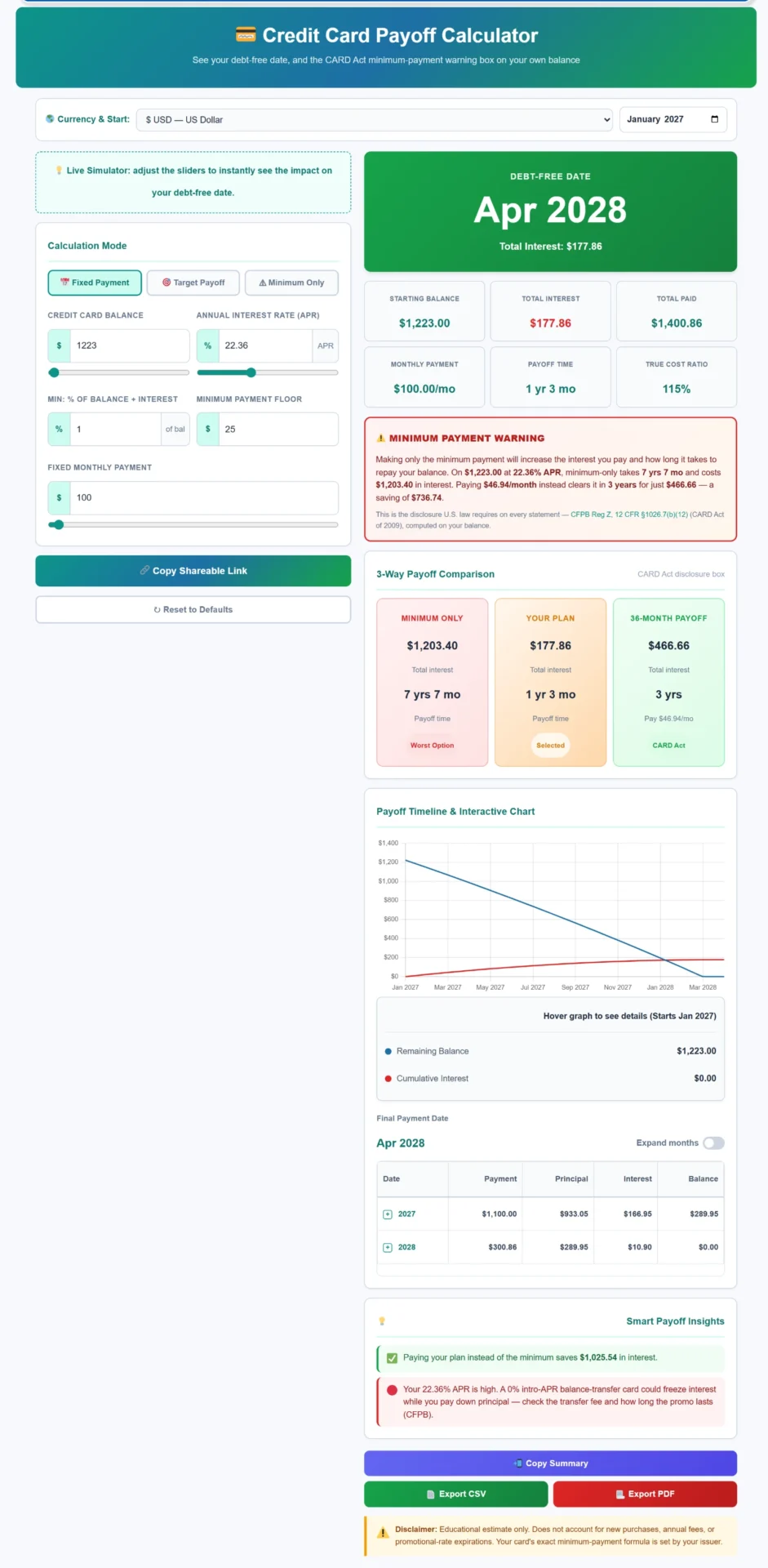
Fixed $100/month model: same $1,223 balance, same 22.36% APR. The calculator estimates 15 months to payoff and $177.86 in total interest. The three-way comparison panel shows: minimum-only $1,203.40 interest / 7 yr 7 mo; your plan $177.86 / 1 yr 3 mo; 36-month $466.66. Replace this placeholder with the actual screenshot.
🧮 How This Was Calculated — Fixed $100/Month Scenario
Inputs: Same $1,223 starting balance and 22.36% APR as above · Fixed monthly payment $100 · Balance starts January 2027, first payment February 2027.
- Month 1 interest: $1,223 × 22.36% ÷ 12 = $22.79
- Principal in month 1: $100 − $22.79 = $77.21
- Balance after month 1: $1,223 − $77.21 = $1,145.79
- Each month the balance falls → interest charge falls → more of the $100 goes to principal
- After 15 payments, the final (smaller) payment clears the remaining balance
Result: 15 months to payoff · $177.86 in total interest · $1,400.86 total paid — $1,025.54 less interest than minimum-only — per SaveXpert’s Credit Card Payoff Calculator
| Payment Strategy | Monthly Payment | Time to Pay Off | Total Interest |
|---|---|---|---|
| Minimum only | Starts $35.02, shrinks | 91 months (7 yr 7 mo) | $1,203.40 |
| 36-month CARD Act benchmark | $46.94 fixed | 36 months | $466.66 |
| Fixed $100/month | $100 fixed | 15 months (1 yr 3 mo) | $177.86 |
Source: SaveXpert Credit Card Payoff Calculator, inputs as stated above. APR: Federal Reserve FRED, Aug 2026.

Choose a payoff method for multiple holiday balances
Carrying more than one balance after the holidays is common. Two structured approaches help prioritize where extra money goes: the debt avalanche (target the highest-APR balance first) and the debt snowball (target the smallest balance first). The CFPB identifies both methods and notes that either requires making the minimum payment on every other debt while directing extra funds toward the target.
The avalanche approach minimizes total interest paid. The snowball approach produces an early payoff “win” — clearing a small balance quickly — which some people find motivating enough to stay with the plan. Neither is universally superior; the right choice depends on your balances, rates, and how you respond to early progress.
Find out exactly how long it takes to become debt-free.
Comparing three example debts
I ran three illustrative debts through SaveXpert’s Debt Payoff Calculator with both strategies selected. These are example terms — not universal rates, not required payment amounts for any real product:
- Holiday Card A: $800 balance · 22.36% APR · $25 minimum
- Holiday Card B: $1,223 balance · 28.99% APR · $35 minimum
- Holiday BNPL plan: $400 balance · 0% APR · $100 minimum
Total debt: $2,423. Combined minimums: $160/month. With an extra $100 directed toward the target debt, total monthly payments start at $260.
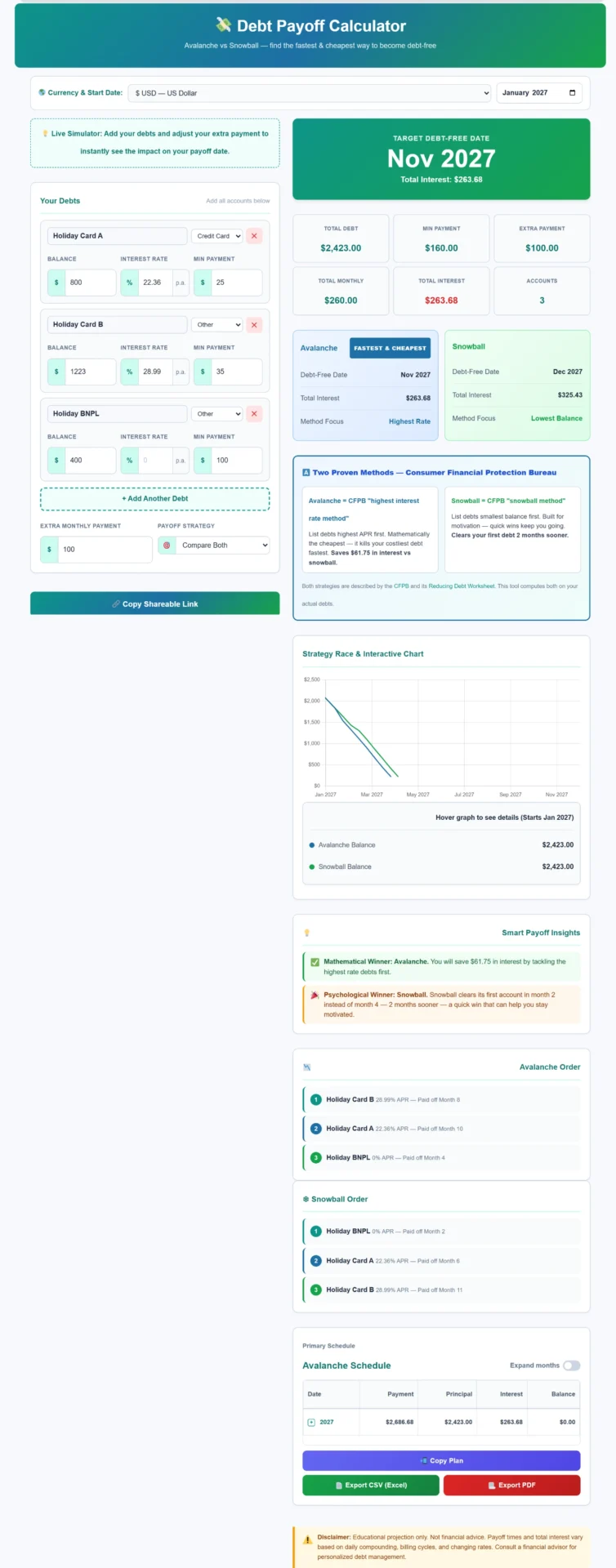
Three-debt comparison: $2,423 total, $160 combined minimums, $100 extra/month. Avalanche: November 2027 payoff, $263.68 interest. Snowball: December 2027 payoff, $325.43 interest. Replace this placeholder with the actual screenshot.
🧮 How This Was Calculated — Avalanche vs. Snowball
Inputs: Card A $800 / 22.36% / $25 min · Card B $1,223 / 28.99% / $35 min · BNPL $400 / 0% / $100 min · Extra $100/month · Start date January 2027, first payments February 2027.
- Card A month 1 interest: $800 × 22.36% ÷ 12 = $14.91
- Card B month 1 interest: $1,223 × 28.99% ÷ 12 = $29.55
- BNPL month 1 interest: $400 × 0% ÷ 12 = $0.00
- Combined minimums: $25 + $35 + $100 = $160/month
- Total monthly with extra: $160 + $100 = $260/month at start
- Avalanche: Extra $100 goes to Card B first (highest APR 28.99%). BNPL clears on its own minimum in month 4. Card B clears in month 8. Card A clears in month 10
- Snowball: Extra $100 goes to BNPL first (smallest balance $400). BNPL clears in month 2. Card A clears in month 6. Card B clears month 11.
- When each debt is paid off, its minimum payment rolls to the next target.
Avalanche: November 2027 · $263.68 total interest · 10 payments
Snowball: December 2027 · $325.43 total interest · 11 payments
Difference: $325.43 − $263.68 = $61.75 less interest with avalanche
Snowball win: first account cleared in month 2 vs. month 4 under avalanche
Compare avalanche vs. snowball for your own balances
What official sources say about reducing holiday debt
Federal payment-allocation rules add another layer worth understanding when you carry balances at different APRs on a single card. Under 12 CFR §1026.53(a), when a cardholder pays more than the required minimum on an account that has balances at different APRs, the issuer generally must apply the excess to the balance with the highest APR first, then to balances in descending APR order. This rule applies to a single covered account — it does not govern how payments are distributed across separate cards.
The FTC supports paying more than the minimum when possible to reduce total interest. The CFPB identifies avalanche and snowball as debt-reduction approaches and also describes nonprofit credit counseling, where counselors may help organize a debt-management plan that can lower monthly payments, interest charges, and fees.
On debt consolidation: the CFPB says consumers can contact creditors to ask about lower interest rates, payment reductions, fee waivers, or different due dates. The agency does not present consolidation as beneficial for everyone — those options depend on individual circumstances and what creditors are willing to discuss.
One note on BNPL debt: the actual purchase agreement controls the payment schedule, any deferred interest terms, and the consequences of missed payments. BNPL products vary widely; the 0% APR in the calculator example above reflects the inputs I specified, not a universal BNPL feature.

The Bottom Line — 5 Steps for 2027
- List every balance. Write down each card’s balance, APR, and required minimum. You can’t build a payoff plan from memory.
- Run your numbers. Use SaveXpert’s Credit Card Payoff Calculator to see how much interest your current payment pace will cost — and what a fixed payment saves.
- Pick an extra amount you can sustain. Any amount above the required minimum helps. Consistency matters more than size.
- Choose a strategy for multiple debts. Avalanche saves more interest; snowball gives early wins. Use the Debt Payoff Calculator to compare both for your actual balances.
- Call your issuer if the minimum is already tight. The FTC says hardship options may be available — but they’re easier to discuss before you miss a payment.
“What surprised me in this research wasn’t the 91-month payoff timeline — it was how small the gap is between the avalanche and snowball strategies when you’re carrying three typical holiday balances. $61.75 over roughly a year. The bigger decision is committing to a plan at all.”
— Kevin Brown, Lead Researcher at SaveXpert.com
Frequently Asked Questions
Ans: Credit card interest is typically calculated based on your outstanding balance and annual percentage rate (APR). Applied monthly, 22.36% APR on a $1,223 balance produces approximately $22.79 in interest for that month. When you pay only the required minimum, a large share of that payment covers the accrued interest charge rather than reducing the principal — which is why the balance shrinks so slowly under minimum-only payments.
Ans: According to CFPB guidance, consumers can contact creditors to ask about potential relief options — lower interest rates, payment reductions, fee waivers, or alternative due dates. Whether a creditor agrees depends on individual circumstances. The FTC notes that reaching out before missing a payment typically leaves more options to discuss.
Ans: The debt avalanche directs extra money toward the balance with the highest APR, minimizing total interest paid. The debt snowball directs extra money toward the smallest balance, producing an early payoff win that some people find motivating. Both strategies require paying the minimum on every other debt while focusing the extra payment on one target at a time. The CFPB describes both approaches in its debt-reduction guidance.
Ans: BNPL plans divide a purchase into installments, often at 0% interest, but the terms vary by provider and purchase. Missed payments can trigger late fees and, depending on the agreement, affect your credit report. When building a payoff plan, treat BNPL obligations as fixed commitments alongside credit cards — the debt payoff calculator can model them as a separate entry so they’re included in your total monthly payment picture.
Ans: Minimum payments are not fixed. They typically fluctuate based on the outstanding balance — commonly calculated as that month’s interest charge plus a percentage of the balance (often 1%), subject to a dollar floor set by the issuer. As the balance falls, the required minimum falls with it. That shrinking minimum is exactly why minimum-only payments extend the payoff timeline: the balance declines slowly because a large portion of each payment goes to interest.
Ans: Contact the card issuer before missing a payment. The FTC says creditors may be able to offer a payment plan for consumers who are struggling — but those conversations are generally easier to have before payments are missed. The CFPB also describes nonprofit credit counseling as an option, where counselors can help organize a debt-management plan that may lower monthly payments, interest rates, and fees.