

ⓘ Educational Disclosure:
This article is for educational and informational purposes only. It does not constitute financial, legal, tax, lending, or investment advice. SaveXpert and its authors are not licensed financial advisors, CPAs, attorneys, or tax advisors. All data comes from publicly available government and institutional sources. Rates, fees, and approval terms vary by borrower and lender. The interest calculations in this article are approximations for illustration — your actual costs depend on your specific card or loan terms. Always consult a qualified professional before making investment decisions.
Which costs less — a debt consolidation loan or a balance transfer card? According to CFPB research and Federal Reserve data, a balance transfer costs less if you clear the full transferred balance during the 0% promotional period (typically 12–21 months). A fixed-rate personal loan costs less if repayment extends beyond that window — because post-promotion credit card APRs (20.94%–24.1%) exceed the Federal Reserve’s reported 11.86% 24-month commercial-bank personal loan rate. The CFPB found an average balance transfer fee of 4.3% among the 25 largest issuers in H2 2024. Payoff timing, not the headline APR, determines the lower-cost option.
Key Takeaways
- Problem: Americans paid $160 billion in credit card interest in 2024 (CFPB). The choice between a balance transfer and a personal loan looks simple until fees, promotional timing, and post-promotion APRs enter the calculation.
- Solution: A 0% balance transfer costs less if you clear the full balance within the promotional window — typically 12–21 months. A fixed-rate personal loan costs less if repayment extends beyond that window. The Federal Reserve reported a 24-month commercial-bank personal loan rate of 11.86% (May 2026). Post-promotion credit card APRs average 20.94%–24.1%.
- Result: The CFPB found an average balance transfer fee of 4.3% among the 25 largest issuers in H2 2024. On a $10,000 transfer, that’s $430 upfront — paid whether you finish in 3 months or 21. Payoff timing, not the headline rate, determines which option costs less for a specific borrower.
- Source: CFPB 2025 Credit Card Market Report · Federal Reserve FRED — 24-Month Personal Loan Rate
- Time To Read: 7 Minutes
Table of Contents
1. $160 Billion in Credit Card Interest: Why This Choice Matters
2. How Debt Consolidation Loans and Balance Transfer Cards Work
3. Which Costs Less: The Numbers Behind the Comparison
4. What Happens When the 0% Promotional Period Ends
5. How Each Option Affects Your Credit Score
6. What Credit Score Do You Need for Each Option?
7. What the IRS Says About Interest Deductibility
8. Federal Disclosure Rules That Apply to Both
9. What the Research Shows Works
The CFPB reported $160 billion in credit card interest charges during 2024. That figure is the context for understanding why the choice between a debt consolidation loan and a balance transfer card matters — and why the apparent simplicity of a “0% APR for 21 months” offer deserves more scrutiny than the promotional rate alone suggests. The Federal Reserve reported a 24-month personal loan rate of 11.86% at commercial banks in May 2026. Neither rate is the whole story.
$160 Billion in Credit Card Interest: Why This Choice Matters
The CFPB’s 2025 consumer credit-card market report documented $160 billion in credit card interest charges during 2024. The same report found that about 15% of general-purpose cardholders made only the minimum payment.
For borrowers looking to reduce that interest cost, the two most common paths are a balance transfer card (moves the debt to a new card with a temporary 0% rate) and a debt consolidation personal loan (replaces revolving debt with a fixed-rate installment loan). Both can reduce interest exposure compared to carrying a balance at a high revolving APR — but through fundamentally different mechanisms and cost structures.
| Key Data Point | Figure | Source |
|---|---|---|
| Total credit card interest charges (2024) | $160 billion | CFPB 2025 Consumer Credit Card Market Report |
| Average 24-month personal loan rate — commercial banks (May 2026) | 11.86% | Federal Reserve FRED |
| Average credit card APR — general-purpose cards | 24.1% | Philadelphia Federal Reserve Bank |
| Average credit card APR — all accounts (Federal Reserve G.19) | ~20.94% | Federal Reserve via industry analysis |
| Average balance transfer fee — 25 largest issuers (H2 2024) | 4.3% | CFPB 2025 Consumer Credit Card Market Report |
| Average minimum balance transfer fee — 25 largest issuers | ~$5.51 | CFPB 2025 Consumer Credit Card Market Report |
Source: CFPB 2025 Market Report · Federal Reserve FRED · Philadelphia Federal Reserve Bank

How Debt Consolidation Loans and Balance Transfer Cards Work
Before comparing costs, it’s useful to separate exactly what each product does — because they create different financial structures, not just different APRs.
| Feature | Balance Transfer Card | Debt Consolidation Personal Loan |
|---|---|---|
| How debt is moved | Existing balances moved to the new card; the card issuer pays off the original creditors | Lender provides a lump sum; borrower uses it to pay off existing creditors |
| Interest structure | 0% introductory APR for 12–21 months, then standard variable APR | Fixed APR for the full loan term; no promotional period |
| Upfront cost | Balance transfer fee (CFPB average: 4.3%; range: 3%–5%) | Origination fee, if any (private estimates: 1%–6% of loan amount) |
| Monthly payment | Variable minimum — borrower must pay enough to clear balance before promo ends | Fixed monthly payment for the full term |
| Debt type created | Revolving credit — balance can fluctuate with new spending | Installment loan — fixed schedule, no new spending on the facility |
| Risk of balance growth | Yes — continued spending on the balance transfer card can defeat the consolidation | No — the loan facility is closed once funded; no new draws available |
Source: CFPB — Debt Consolidation Guidance · CFPB 2025 Market Report
The structural difference between the revolving vs. installment distinction is important beyond just the interest rate: a balance transfer card remains an open credit line that can accumulate new spending. A personal loan is a closed facility — once the funds are disbursed and existing debt is paid, the only ongoing obligation is the fixed monthly payment.
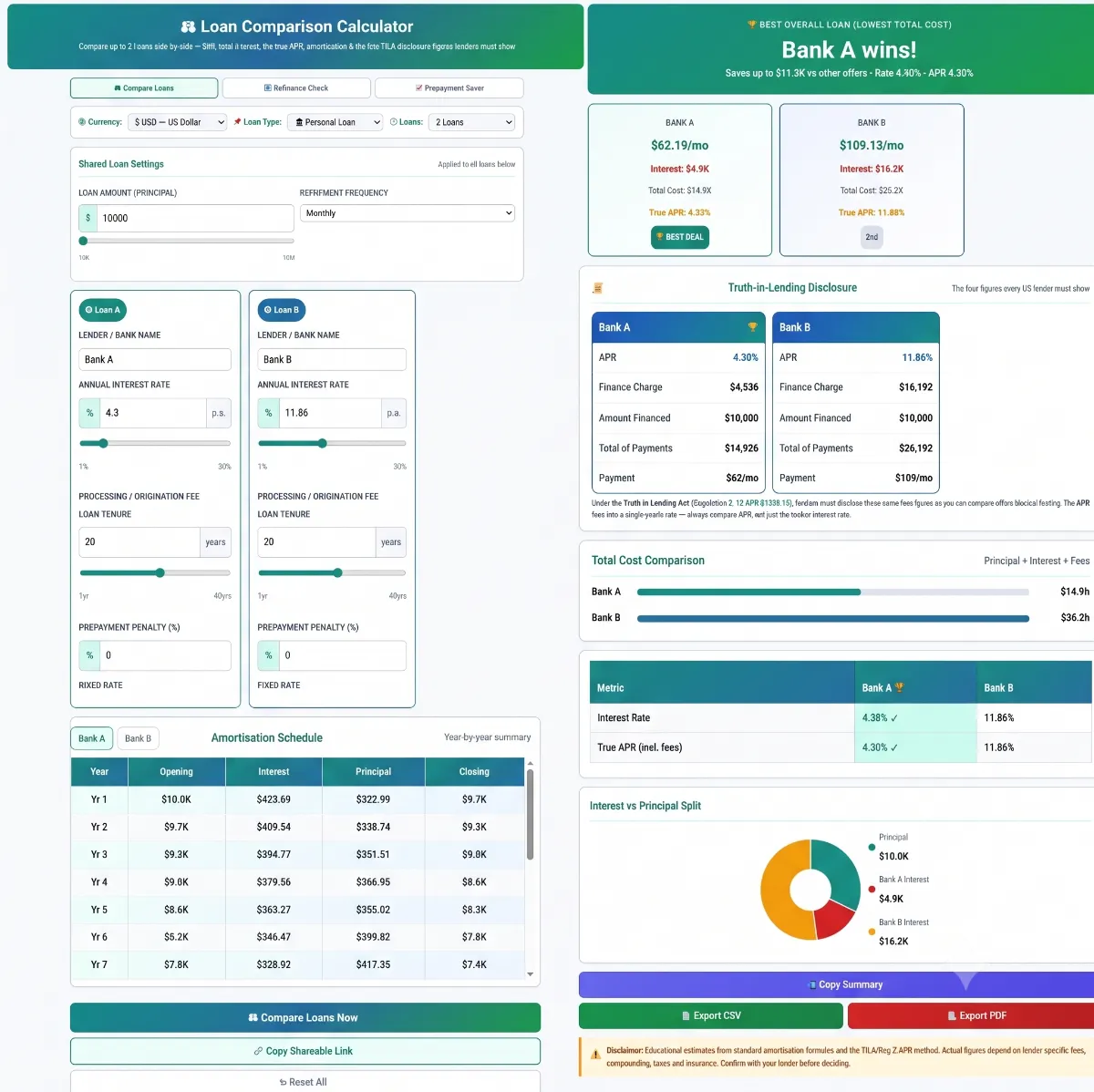
Compare two loans side-by-side to find the cheaper option.
Which Costs Less: The Numbers Behind the Comparison
The comparison comes down to a specific $10,000 worked example using the rates the research found — and an honest statement of where each figure comes from.
| Scenario | Balance Transfer (0% / 20 months) | Personal Loan (11.86% / 20 months) |
|---|---|---|
| Balance/principal | $10,000 | $10,000 |
| Upfront fee | $430 (4.3% CFPB average) | Varies — 0% to 6% origination fee possible (private estimates) |
| Interest during promotional/full term | $0 if paid in full before month 20 | Approximately $1,09.13 over 20 months at 11.86% |
| Total cost if paid within window | ~$430 | ~$1,09.13 + any origination fee |
| Total cost if balance carries past promo end | $430 + interest at 20.94%–24.1% on remaining balance | ~$1,09.13 — fixed regardless of when payments are made |
| Winner | ✅ Balance transfer — if fully paid within promotional window | ✅ Personal loan — if repayment extends beyond promotional window |
Source: CFPB 2025 Market Report (4.3% fee) · Federal Reserve FRED (11.86% rate) | Interest calculation: approximation using standard amortisation formula; actual loan cost depends on issuer’s specific terms
The approximately $1,09.13 figure for the 20-month personal loan is a standard amortisation approximation using 11.86% APR on a $10,000 principal. It’s an illustration of the cost comparison — your actual loan interest depends on the specific APR your lender offers, which varies by credit tier.
Private lending analysis finds personal loan APRs ranging from approximately 6.74% (excellent credit) to 29% (lower credit tiers). Bankrate reported a 12.44% average for customers with 700 FICO scores, $5,000 loans, and three-year terms (as of September 16, 2026). Those are not Federal Reserve benchmarks — they’re private market rate observations. The Federal Reserve’s FRED 11.86% figure is the most relevant federal reference point available.
⚖️ Run Your Own Comparison: SaveXpert Loan Comparison Calculator
The $10,000 example above uses the CFPB’s average 4.3% transfer fee and the Federal Reserve’s 11.86% benchmark rate. Your balance, your specific card’s transfer fee, and your actual loan rate produce a different comparison. The Loan Comparison Calculator lets you enter the transferred amount, upfront fee, promotional window, and loan APR to see the total cost of each path — including the origination fee — before making the decision.
Educational note: Calculator models scenarios for informational purposes only. Source: CFPB 2025 Market Report
What Happens When the 0% Promotional Period Ends
This is the most consequential scenario the research identifies — and the most commonly underplanned.
| Scenario at Promotional Period End | What Happens | Cost Implication vs. Personal Loan |
|---|---|---|
| Balance fully paid before expiry | Transfer complete — total cost is the upfront fee only (~$430 on $10,000) | Cheaper than the personal loan (~$1,09.13 in interest) |
| Partial balance remaining at expiry | Remaining balance immediately subject to the card’s standard variable APR | Depends on remaining balance and post-promo APR; could exceed personal loan total |
| Full balance remaining at expiry (no progress) | $10,000 now accruing at 20.94%–24.1% APR — plus the $430 fee already paid | Likely more expensive than the personal loan over the same payoff period |
Post-promotion APR sources: Federal Reserve data (~20.94%) · Philadelphia Federal Reserve Bank (~24.1%)
Both post-promotion APR figures — 20.94% from Federal Reserve data and 24.1% from the Philadelphia Fed — exceed the 11.86% personal loan benchmark. A borrower at month 22 of a 21-month promotional offer now faces an APR roughly double the personal loan rate on whatever balance remains.
⚠️ Model the “what if I’m not done” scenario before applying: The research supports planning around two scenarios simultaneously — one where you clear the balance within the promotional window and one where you don’t. A simple check: divide the transfer amount by the number of promotional months to find the required monthly payment. $10,000 ÷ 20 months = approximately $500/month. If that amount isn’t sustainable in your budget, the risk of hitting the post-promotion APR is real — and the fixed-rate personal loan may be the lower-risk choice.
The research also flags a separate risk: continued spending on the balance transfer card while the transferred balance is outstanding. New purchases on the same card may not benefit from the 0% rate and can complicate the repayment arithmetic. The CFPB noted that the $160 billion in credit card interest charges across 2024 reflects in part the pattern of consolidation without spending behaviour change.
How Each Option Affects Your Credit Score
The research doesn’t show that either option automatically damages a credit score — but both have credit-reporting effects worth understanding before applying.
| Credit Factor | Balance Transfer Card Effect | Personal Loan Effect |
|---|---|---|
| Hard inquiry on application | One hard inquiry; typically <5 points; visible on report for 2 years, scoring effect ~12 months | One hard inquiry; same typical effect |
| Multiple applications in short period | Each application = one inquiry; cumulative effect can be larger than a single application | Same — multiple personal loan applications in a short window create multiple inquiries |
| Credit utilization ratio | Transferred balance moves to the new card; utilization ratio on original cards drops (if not cancelled); new card starts at high utilization | Paying revolving debt with an installment loan removes the balance from revolving utilization entirely — credit utilization applies to revolving credit, not installment loans |
| Credit mix | Adds a new revolving account — doesn’t change the type of credit if borrower already has cards | Adds an installment loan — can improve credit mix if borrower previously held only revolving accounts |
| Negative marks from missed payments | Can remain on credit report for 7 years (same as any credit account) — not specific to balance transfers | Same CFPB-cited 7-year rule for negative payment information |
The utilization distinction is one of the more meaningful credit differences between the two products. A balance transfer moves revolving debt from one card to another — the total revolving balance doesn’t change, though its distribution across accounts does. A personal loan removes revolving debt from utilization entirely, because installment loan balances don’t count in the revolving utilization calculation. For a borrower whose credit score is suppressed by high utilization, a personal loan can produce a faster utilization improvement than a balance transfer.
What Credit Score Do You Need for Each Option?
| Product | Typical Credit Score Threshold | APR Range by Credit Tier | Source |
|---|---|---|---|
| 0% balance transfer card | Typically FICO 670+ (good-credit range) | 0% promotional, then variable (20.94%–24.1% post-promo) | Private credit-bureau analysis; CFPB / Fed post-promo rates |
| Personal loan — excellent credit | Typically 750+ | ~6.74% to 12% (private estimates) | Private lending analysis — not a Federal Reserve figure |
| Personal loan — good credit | 670–749 | ~12% to 20% (private estimates) | Private lending analysis |
| Personal loan — fair/lower credit | 580–669 | ~20% to 29% (private estimates) | Private lending analysis |
| Federal Reserve benchmark rate (commercial banks) | Not credit-score-specific | 11.86% (24-month term, May 2026) | Federal Reserve FRED — a population average, not a credit-tier-specific rate |
Source: Private credit-bureau estimates (not Federal Reserve benchmarks) · Federal Reserve FRED for benchmark rate
The access difference matters in a specific way: a borrower below 670 FICO may not qualify for a 0% balance transfer offer — making the personal loan the only realistically available consolidation option, even at a higher rate than the Federal Reserve benchmark. For borrowers in the good-to-excellent credit range, both options are typically accessible, and the choice becomes the cost comparison above.

What the IRS Says About Interest Deductibility
This is a clarification the research brief specifically surfaces because it changes how total costs compare.
| Interest Type | IRS Deductibility | Source |
|---|---|---|
| Personal loan interest for consumer debt consolidation | ❌ Not deductible | IRS Tax Topic 505; IRS Publication 936 |
| Mortgage interest | ✅ Deductible (subject to limits and filing requirements) | IRS Publication 936 |
| Qualified student loan interest | ✅ Deductible (subject to income limits) | IRS — student loan interest deduction |
| Business loan interest | ✅ Deductible as a business expense (subject to rules) | IRS Publication 535 |
| Balance transfer card interest (after promo period) | ❌ Not deductible — consumer credit card interest | IRS Tax Topic 505 |
Source: IRS Tax Topic 505 · IRS Publication 936
The tax point is relevant because neither the balance transfer interest nor the personal loan interest for consumer debt consolidation is deductible. That means there’s no tax-advantaged side to the comparison — the full interest cost of a personal loan is the effective after-tax cost. Borrowers who’ve heard that loan interest can be deducted should verify whether their specific loan purpose qualifies before factoring a deduction into the cost calculation.
Federal Disclosure Rules That Apply to Both
Both products operate under federal disclosure requirements that give borrowers specific rights before and after the transaction.
| Rule / Right | What It Covers | Regulatory Source |
|---|---|---|
| Balance transfer disclosures (Reg Z §1026.6) | Creditors must disclose APRs, fees, and payment terms before a balance transfer occurs; consumers can decline the transfer | Truth in Lending Act · Regulation Z — 12 C.F.R. § 1026.6 |
| Excess payment allocation (Reg Z §1026.53) | Payments above the minimum generally go first toward the highest-APR balance in multi-rate situations | Regulation Z — 12 C.F.R. § 1026.53 |
| Billing error dispute (Fair Credit Billing Act) | 60 days from statement date to dispute billing errors in writing; creditor must acknowledge within 30 days and resolve within 90 days | FTC — Fair Credit Billing Act |
| Personal loan disclosures | Lenders must disclose APR, finance charges, total payment, and payment schedule under Truth in Lending Act | Regulation Z · CFPB |
Source: Regulation Z · FTC — Fair Credit Billing Act
The right to decline a balance transfer before it occurs (Regulation Z §1026.6) is worth knowing before applying: receiving approval for a balance transfer card doesn’t automatically trigger the transfer. You can review the specific terms — including the actual transfer fee and promotional period length — and choose not to proceed if they differ from what was advertised.
What the Research Shows Works
Calculating the required monthly payment before applying for a balance transfer.
The research supports treating the promotional window as a fixed deadline, not a flexible timeline. The monthly payment needed to clear a transfer within the promotional period is a simple calculation: transfer amount ÷ promotional months. If that amount doesn’t fit the budget realistically, the personal loan’s fixed schedule may be the lower-risk path — even at a higher total interest cost.
Comparing the full cost of both options, not the headline rates.
A 0% rate and an 11.86% rate don’t compare directly because the transfer’s upfront fee and the loan’s potential origination fee are both part of the total. The CFPB’s 4.3% average transfer fee on a $10,000 balance is $430 regardless of the promotional rate. A personal loan with a 1% origination fee on the same amount adds $100 to the total cost. Running both through the Loan Comparison Calculator with their full costs — not just their APRs — is the research-supported way to make the comparison.
Choosing the personal loan when credit utilization improvement is the priority.
Because installment loan balances don’t count toward revolving credit utilization, a borrower with a high utilization ratio suppressing their credit score can see a faster utilization improvement from a personal loan consolidation than from a balance transfer. The balance transfer moves the debt from one revolving account to another; the personal loan removes it from revolving credit entirely.
Not applying to multiple lenders sequentially without a plan.
Each application creates a hard inquiry. The effect of a single inquiry is small (typically under five points, lasting about 12 months in scoring). Multiple applications in a short period create cumulative effects. Rate shopping within a concentrated window — consistent with what many scoring models call “rate shopping” behaviour for installment loans — can limit the inquiry impact compared to applying, waiting, and applying again over several months.
Treating the $160 billion in 2024 credit card interest as a reminder that consolidation without spending change doesn’t solve the underlying problem.
Both a balance transfer and a personal loan reduce interest cost on existing debt. Neither prevents new high-rate debt from forming. The CFPB’s figure reflects not just existing debt but the pattern of new spending on credit that produces interest charges. Consolidation is most effective as part of a plan to reduce overall credit-card reliance — not as a standalone transaction.

Bottom Line: 5-Point Decision Framework
1. Calculate whether you can realistically clear the full balance within the promotional window — before applying:
Divide the transfer amount by the number of promotional months. A $10,000 balance on a 20-month offer requires approximately $500/month to clear on time. If that monthly amount isn’t sustainable, the post-promotion APR risk (20.94%–24.1%) makes the fixed-rate personal loan (11.86% benchmark) likely the lower-cost option even though the headline APR is higher during the promotional period.
2. Compare total costs — transfer fee plus any post-promo interest vs. loan interest plus any origination fee:
The CFPB’s 4.3% average balance transfer fee on $10,000 is $430 upfront. A personal loan at 11.86% over 20 months generates approximately $1,09.13 in total interest. A 1% origination fee on the same loan adds $100. Run both scenarios through the Loan Comparison Calculator with their actual fees — not just their APRs — to find the genuine total-cost difference for your specific balance and timeline.
3. Check your credit score against each option’s typical access threshold:
Balance transfer cards typically require FICO 670+. Personal loans are available across a wider credit range, with private estimates putting rates from 6.74% (excellent credit) to 29% (lower tiers). A borrower below 670 may find the personal loan is the only accessible option, regardless of which would otherwise cost less. A borrower above 750 may access personal loan rates well below the Federal Reserve benchmark.
4. Factor in whether utilization improvement is a priority alongside cost reduction:
A personal loan removes the consolidated debt from revolving credit utilization entirely — because installment loans aren’t included in the utilization calculation. A balance transfer moves the debt from one revolving account to another, keeping total revolving utilization roughly unchanged. If high utilization is suppressing your credit score, the personal loan may produce a better credit outcome even in cases where the balance transfer would be marginally cheaper in total cost.
5. Confirm that personal loan interest for consumer debt consolidation is not tax-deductible — neither option carries a tax advantage:
Per IRS Tax Topic 505 and Publication 936, personal loan interest for consumer debt consolidation is not deductible. Credit card interest after the promotional period is also not deductible. There is no tax-advantaged side to this comparison — the full interest cost of whichever option you choose is the actual after-tax cost. Factor this in if you’ve seen guidance elsewhere suggesting a deduction is available for consolidation loan interest.
“The finding that most changes how I read a ‘0% balance transfer’ offer is the CFPB’s 4.3% average transfer fee. People see ‘0% for 21 months’ and do a quick mental calculation: move the debt, pay nothing in interest for 21 months, done. What they’re not factoring in is that the 4.3% fee is paid immediately on the full transferred balance — it’s front-loaded whether you pay in 3 months or 21. On $10,000, that’s $430 on day one. The question isn’t whether 0% beats 11.86% during the promotional period — it clearly does. The question is whether the total cost of a balance transfer, including that upfront fee and the real risk of the post-promotion rate, beats the total cost of a fixed-rate loan for your specific payoff timeline.”
— Kevin Brown, Lead Researcher at SaveXpert.com
Frequently Asked Questions
Ans: According to CFPB guidance, a balance transfer moves existing credit-card debt to a new card — typically offering a 0% introductory APR for 12–21 months — with the new issuer paying off the original creditors. A debt consolidation personal loan provides a lump sum at a fixed APR that the borrower uses to pay off existing creditors. The key structural difference: the personal loan is a closed installment facility (no new draws, fixed schedule), while the balance transfer card remains an open revolving line that can accumulate new spending.
Ans: Based on CFPB data and Federal Reserve figures, a balance transfer is generally cheaper if the full balance is cleared before the 0% promotional period ends (typically 12–21 months) — the total cost is roughly the upfront fee (CFPB average: 4.3%). If repayment extends beyond the promotional window, the fixed-rate personal loan typically costs less because post-promotion credit card APRs (20.94%–24.1%) exceed the Federal Reserve’s reported 11.86% 24-month benchmark rate. Payoff timing is the determining factor.
Ans: A balance transfer fee is a one-time upfront charge for moving existing debt to the new card. The CFPB’s 2025 Consumer Credit Card Market Report found an average fee of 4.3% among the 25 largest issuers in H2 2024, with a typical minimum fee of around $5.51. On a $10,000 transfer, the 4.3% average produces $430 upfront — added to the balance you then need to repay. Private credit-bureau analysis puts the typical fee range at 3%–5% of the transferred amount.
Ans: Private credit analysis puts the typical FICO threshold for promotional balance transfer cards at 670 or higher — the beginning of the “good credit” range. This isn’t a universal cutoff: individual issuers set their own approval standards. Borrowers below 670 typically have better access to personal loans, which private analysis shows are available across a wider credit range with APRs varying from approximately 6.74% (excellent credit) to 29% (lower tiers). The Federal Reserve’s 11.86% benchmark is a commercial-bank average across all credit profiles — not credit-tier-specific.
Ans: Any remaining balance on the card becomes subject to the card’s standard variable APR immediately when the promotional period expires. Federal Reserve and Philadelphia Fed data put average post-promotion credit card APRs between 20.94% and 24.1%. A borrower who still carries a balance at that point is paying revolving interest at roughly double the Federal Reserve’s reported 24-month personal loan benchmark rate. The transition is automatic — there’s no grace period or option to extend the promotional rate.
Ans: No. According to IRS Tax Topic 505 and IRS Publication 936, personal loan interest used for consumer debt consolidation is not deductible. The IRS allows interest deductions for mortgage interest, qualified student loan interest, and business loan interest — but not for personal loans used to consolidate credit card or other consumer debt. This means the full interest rate on the personal loan is the actual after-tax cost, with no tax offset to factor into the comparison.