
ⓘ Educational Disclosure:
This article is for educational and informational purposes only. It does not constitute financial, legal, tax, lending, or investment advice. SaveXpert and its authors are not licensed financial advisors, CPAs, attorneys, or tax advisors. All data comes from publicly available government and institutional sources. Repayment timelines and interest totals in this article are illustrative models — actual results depend on your specific balance, APR, minimum payment formula, and payment behaviour. Always verify your card’s terms and consult a qualified professional before making debt repayment decisions. Always consult a qualified professional before making investment decisions.
How long does it take to pay off $20,000 in debt? At 21% APR on minimum payments (3% of balance formula), approximately 304 months — about 25 years — with more than $27,260 in total interest. A fixed $600/month payment at 21% APR reduces that to roughly 51 months (about 4 years and 3 months) and approximately $11,000 in interest. A fixed $700/month at 22% APR reduces it further to roughly 41 months (about 3 years and 5 months) and approximately $8,600 in interest. The Federal Reserve G.19 reports the average APR on accounts that incurred interest at 22.15% in Q2 2026 — the highest in the Fed’s record. Regulation Z §1026.7 requires your card issuer to show the estimated payoff date under minimum payments and the payment needed to clear the balance in 36 months on every statement.
Key Takeaways
- Problem: A $20,000 credit card balance at 21% APR takes approximately 304 months — about 25 years — on minimum payments alone, generating more than $27,260 in interest. That’s more than the original balance paid back in interest.
- Solution: Federal Reserve G.19 puts the average APR on accounts that incurred interest at 22.15% in Q2 2026 — the highest in the Fed’s record. Against that rate, a fixed $600/month payment cuts the 25-year timeline to about 51 months. A fixed $700/month at 22% APR cuts it further to about 41 months, saving more than $18,000 in interest compared to the minimum-payment scenario.
- Result: The payoff timeline comes down to two variables you can see on your statement: the APR and the monthly payment. The Debt Payoff Calculator below runs that math with your actual numbers.
- Source: Federal Reserve G.19 Consumer Credit Report · CFPB Regulation Z §1026.7
- Time To Read: 7 Minutes
Table of Contents
1. Why a $20,000 Balance Can Take 25 Years at Minimum Payments
2. How Much Should You Pay Each Month on $20,000 of Debt?
3. How Much Interest Will You Pay on $20,000 of Debt?
4. Check Your Own Balance: Debt Payoff Calculator
5. Is $20,000 in Credit Card Debt a Lot?
6. Can Debt Consolidation Help Pay Off $20,000 Faster?
7. Snowball vs. Avalanche: What Does the Research Show?
9. Realistic Expectations for Paying Off $20,000
A $20,000 credit card balance at 21% APR with minimum payments takes approximately 304 months to clear. That’s about 25 years — and generates more than $27,260 in interest along the way. More than the original balance, paid back in interest alone. The research behind this article doesn’t lead to a complicated conclusion. The payoff timeline depends on two numbers that appear on every credit card statement: the APR and the monthly payment. A fixed $600/month cuts 304 months to about 51. A fixed $700/month at 22% APR cuts it to about 41.
Why a $20,000 Balance Can Take 25 Years at Minimum Payments
The mechanism is straightforward once you see the numbers. At 21% APR, the monthly interest on a $20,000 balance is $20,000 × 21% ÷ 12 = $350. A minimum payment calculated as 3% of the balance starts at roughly $600 — more than enough to cover the interest and make some principal progress at the start. But as the minimum payment formula shrinks with the balance, the payment drops each month while interest continues to accrue on whatever principal remains. Over time, the pace of repayment slows significantly.
That’s the core of what the research brief’s 304-month calculation shows. The minimum payment keeps the account in good standing each month. It doesn’t create a fixed, steady reduction of the principal. The Federal Reserve G.19 data makes the context clear: the average APR on credit card accounts that actually incurred interest was 22.15% in Q2 2026, and the research brief identifies this as the highest rate in the Federal Reserve’s recorded history.
| Federal Reserve Rate Data | APR | Period | Source |
|---|---|---|---|
| All credit card accounts (average) | 20.94% | September 2026 | Federal Reserve G.19 |
| Accounts that incurred interest (average) | 22.15% | Q2 2026 | Federal Reserve G.19 — highest in Fed’s record per research brief |
Source: Federal Reserve G.19 Consumer Credit Report. Separate release dates — don’t treat as same-period comparison.
One data point from the research brief: credit card APRs stayed above 19% even during the 2025 rate cuts. That matters for anyone waiting for the rate environment to improve before addressing the balance. The research says the payment amount — not the rate environment — is the variable borrowers can actually control from month to month.

How Much Should You Pay Each Month on $20,000 of Debt?
The research brief’s calculation uses a standard amortisation formula with the APR divided by 12 to produce a monthly rate. The scenarios below show how dramatically the monthly payment amount shifts the timeline and total interest.
| Payment Strategy | Monthly Payment | APR Used | Est. Payoff Timeline | Est. Total Interest |
|---|---|---|---|---|
| Minimum payments only (3% of balance formula) | ~$400–$600 initially, declining each month | 21% | ~304 months (~25 years) | ~$27,260+ |
| Fixed monthly payment | $600/month | 21% | ~51 months (~4 yrs 3 mo) | ~$11,000 |
| Fixed monthly payment | $700/month | 22% | ~41 months (~3 yrs 5 mo) | ~$8,600 |
⚠️ Illustrative models using standard amortisation formula (APR ÷ 12). Actual results depend on your specific balance, APR, minimum payment formula, and whether new charges are added. Federal Reserve G.19 APR benchmarks used as reference rates.
The research brief estimates that increasing payments from the $400–$500 range toward $700 reduces the repayment timeline by roughly 70% — from 304 months to 41 months. That’s the same balance, roughly the same APR, and a $200–$300 increase in monthly payment. The interest savings across those scenarios exceed $18,000.
The CFPB’s Regulation Z §1026.7 requires credit card issuers to provide two specific numbers on every periodic statement: the estimated time to pay off the balance under minimum payments, and the monthly payment required to clear the balance within 36 months. That 36-month payment amount — already printed on your statement — gives you the card-specific calculation that the national average rate benchmarks can’t provide.
Regulation Z disclosure note
When the estimated payoff time under minimum payments exceeds two years, the statement must express it in years — not just months. That means most $20,000 balances at current APRs will show a payoff date measured in decades on the statement itself. Reading that number is the single fastest way to see the real cost of minimum-only payments on your specific balance.
Find out exactly how long it takes to become debt-free.
How Much Interest Will You Pay on $20,000 of Debt?
The interest totals in the research brief illustrate why the payment-size decision is also an interest-cost decision. The same balance and a similar APR produce very different interest outcomes depending on the fixed payment amount.
| Scenario | Balance | APR | Monthly Payment | Est. Interest Paid | Interest as % of Original Balance |
|---|---|---|---|---|---|
| Minimum payments (~25 years) | $20,000 | 21% | Declining minimum | ~$27,260+ | ~136% of original |
| Fixed $600/month (~51 months) | $20,000 | 21% | $600 | ~$11,000 | ~55% of original |
| Fixed $700/month (~41 months) | $20,000 | 22% | $700 | ~$8,600 | ~43% of original |
Illustrative models — see the data note above. Source rate benchmarks: Federal Reserve G.19.
The minimum-payment scenario produces more than $27,260 in interest on a $20,000 original balance — that’s paying back roughly 136% of the original debt in interest alone before the principal is cleared. The fixed $600 payment scenario generates about $11,000 in interest — less than half. The fixed $700 scenario at a slightly higher APR produces about $8,600, saving more than $18,000 in interest compared to the minimum-only path.
The WalletHub private analysis cited in the research brief offers a comparison at a smaller scale: an average $6,595 balance at minimum payments takes more than seven years and generates about $3,610 in interest. That per-balance proportion (roughly 55% of the original balance in interest) illustrates the same compounding dynamic at the individual average balance level.
Check Your Own Balance: Debt Payoff Calculator
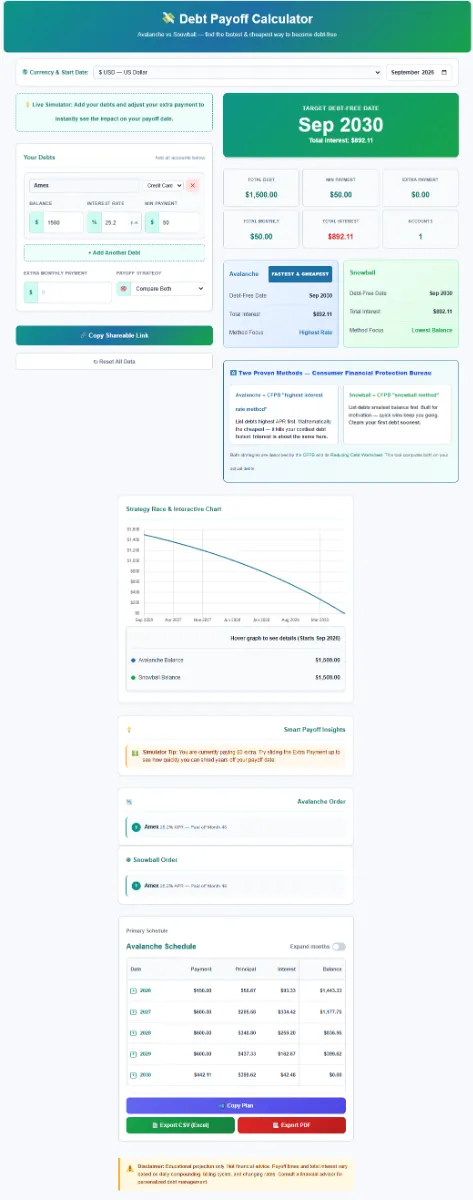
The scenarios above use 21% and 22% APR from the Federal Reserve’s data. Your actual card’s APR may be different. Your balance isn’t necessarily $20,000. And your minimum payment formula may differ from the 3% assumption in the research model. The Debt Payoff Calculator runs the same amortisation logic on your specific inputs.
🧮 SaveXpert Debt Payoff Calculator — Free & No Signup
Enter your actual balance, your actual APR (from your statement), and a target monthly payment. The calculator shows the estimated payoff date and total interest — then lets you increase the payment to see how the timeline and interest total change. That before-and-after comparison is the core of the research: the difference between your minimum payment timeline and a fixed larger payment makes the cost of staying at the minimum visible.
Educational note: Calculator models scenarios for informational purposes only. Source benchmarks: Federal Reserve G.19 · CFPB Regulation Z §1026.7
Is $20,000 in Credit Card Debt a Lot?
Context helps. The research brief provides several reference points for where $20,000 sits relative to reported averages.
| Reference Point | Figure | Source Type |
|---|---|---|
| Average individual credit card balance, 2026 | $6,735 | Experian 2026 (private credit analysis) |
| Average household credit card debt, Q2 2026 | $11,313 | WalletHub Q2 2026 (private analysis) |
| Total US credit card debt, Q2 2026 | $1.23 trillion | New York Fed Household Debt report — official |
| 30-day credit card delinquency rate, Q2 2026 | 2.85% | New York Fed (official) |
| Adults carrying credit card debt | 45%–53% | Federal Reserve and LendingTree-derived data (range reflects different measurement approaches) |
Source: Experian and WalletHub are private commercial sources — not federal figures. New York Fed figures are official. Federal Reserve / LendingTree range reflects different survey methodologies.
At $20,000, a balance is roughly three times the Experian individual average of $6,735 and about 1.8 times the WalletHub household average of $11,313. By that comparison, $20,000 is a high balance — but the research brief’s point is that what makes it significant isn’t the size relative to averages. It’s the interaction with high APRs under minimum payments. The delinquency rate and total debt figures from the New York Fed show the broader scale of the problem: $1.23 trillion in total credit card debt with a 2.85% 30-day delinquency rate means the minimum-payment dynamic the research describes is operating at population scale.

Can Debt Consolidation Help Pay Off $20,000 Faster?
The research brief treats consolidation as a rate-arbitrage decision, not a debt-elimination shortcut. Consolidation doesn’t erase the $20,000 balance — it changes the terms under which it gets repaid. The interest-cost benefit comes from the rate difference between the current card APR and the new product’s rate.
| Consolidation Option | Approximate Rate | Potential Interest Saving vs. 22% APR | Key Condition for Savings |
|---|---|---|---|
| Personal loan (private analysis range) | 12%–15% | 50%+ in cited examples | Must qualify for the lower rate; no new card charges during payoff |
| 0% promotional balance transfer | 0% (promotional window) | Eliminates interest during the promotional period | Full balance repaid before promotion ends; transfer fee (typically 3%–5%) must be lower than avoided interest |
| Debt management plan (DMP) | Negotiated by nonprofit counselor | Depends on negotiated rate vs. current APR | Nonprofit credit counseling data puts average DMP completion at 4–5 years |
Personal loan rate range from private analysis — not a federal rate figure. DMP timeline from nonprofit credit counseling industry data. Official context: CFPB Debt Management Plans
The research brief makes one broader observation worth keeping in view: ignoring APR differences across multiple debts can increase total interest by 15%–25% compared with prioritising higher-APR debt first. That framing applies whether the comparison is between two credit cards or between a current card and a potential consolidation product. The rate matters — and the direction of the rate change, after any fees, determines whether consolidation actually saves money.
If you’re considering a balance transfer option specifically, the Debt Consolidation Loan vs. Balance Transfer article on SaveXpert runs the full comparison — including the Regulation Z §1026.53 payment allocation rule that affects how payments apply when a transferred balance exists alongside new purchases.
Snowball vs. Avalanche: What Does the Research Show?
Both methods require making minimum payments on all balances throughout. The difference is only where the extra payment goes.
| Method | Where Extra Payment Goes | Research Finding | Best For |
|---|---|---|---|
| Debt avalanche | Highest APR balance first | Saves the most money in total interest mathematically (Investopedia cited analysis — private) | Minimising total interest across multiple balances |
| Debt snowball | Smallest balance first | Behavioural studies found higher completion rates vs. avalanche in cited research | Psychological momentum; eliminating individual accounts faster |
Source: Research brief synthesis of private analysis (Investopedia, behavioural debt studies). The CFPB’s debt management guidance covers structured repayment approaches.
The trade-off the research identifies: the avalanche saves more money mathematically; the snowball produces higher follow-through rates. For someone with only one large balance — like $20,000 on a single card — the distinction collapses. There’s only one balance to direct payments toward. In that case, the only question is the payment amount and consistency, not the method label.
The research brief also flags what inconsistent payments do to the timeline. Inconsistent payments can extend repayment by 30%–50% compared with a fixed-payment strategy. The behavioural case for the snowball method comes precisely from addressing that consistency problem — giving the payer early wins to sustain momentum across what can otherwise feel like a very long repayment horizon.
What the Research Shows Works
Fixed monthly payments above the minimum are the single most impactful variable.
The research brief’s core finding: moving from declining minimum payments to a fixed $600–$700/month collapses a roughly 25-year repayment timeline to 4–5 years, saving more than $15,000–$18,000 in interest. No product switch required — just a payment decision made once and sustained.
Specific payment amounts have more impact than the method label.
Whether the borrower calls it an avalanche, a snowball, or simply “paying $700 per month,” the research consistently shows that the payment amount drives the timeline more than the strategic framework attached to it. For a single large balance, the frame matters less than the number.
Debt management plans provide structure for households that need it.
Nonprofit credit counseling data cited in the research brief puts average DMP completion at four to five years. Counselors can negotiate reduced interest rates with creditors, which changes the rate environment even when the borrower can’t qualify for a better product independently. The CFPB’s DMP guidance explains what to look for in a legitimate nonprofit counseling programme.
Lower-APR consolidation can reduce the interest burden — under the right conditions.
Moving a 22% APR balance to a product at 12%–15% can cut the interest cost by 50%+ in the research brief’s cited examples. The conditions matter: the new rate must actually be lower after fees, the borrower must qualify for that rate, and no new charges should accumulate on the cards being paid off during the consolidation period.
The approaches the research links to worse outcomes:
Minimum-only payments stretching repayment into decades. Inconsistent payment patterns extending the timeline 30%–50% versus fixed payments. Ignoring APR differences across multiple debts by 15%–25% in added interest. Waiting for rate cuts — APRs stayed above 19% even through the 2025 rate cuts, and the research shows the payment amount is more controllable than the rate environment.

Realistic Expectations for Paying Off $20,000
The scenarios in this article are illustrative models, not guarantees. Your actual balance, APR, minimum payment formula, and payment behaviour will produce different numbers. What the research does establish firmly:
| Scenario Type | Research Finding | Key Variable |
|---|---|---|
| Minimum payments only | ~25 years / ~$27,260 in interest at 21% APR | The declining payment formula; interest accrual on remaining principal |
| Fixed $600/month | ~51 months / ~$11,000 in interest at 21% APR | The payment must stay fixed rather than following the minimum formula |
| Fixed $700/month | ~41 months / ~$8,600 in interest at 22% APR | Payment size; consistency |
| DMP (nonprofit counseling) | ~4–5 years (industry average completion) | Counselor-negotiated rate; structured repayment commitment |
| Inconsistent payments | Extends repayment 30%–50% vs. fixed-payment plan | Behavioural consistency is the variable |
Research brief models using standard amortisation formula. DMP completion from nonprofit counseling industry data. Federal Reserve G.19 APR benchmarks as reference.
The Regulation Z disclosures on your credit card statement are your most practical starting point. They show your current balance’s payoff timeline under minimum payments — expressed in years when it exceeds two years — and the fixed monthly payment needed to clear it in 36 months. Those two numbers, specific to your account, frame the decision better than any national average.
Bottom Line: 5 Steps to Attack a $20,000 Balance
1. Read your Regulation Z statement disclosures before calculating anything else:
Regulation Z §1026.7 requires your card issuer to print two specific numbers on every statement: the estimated payoff date under minimum payments (in years when it exceeds two years) and the monthly payment needed to clear the balance in 36 months. Those two numbers, pulled directly from your statement, give you the card-specific calculation that national average APRs can’t provide. Start there — not with estimated scenarios.
2. Calculate a specific fixed payment that clears the balance in 48–60 months using the Debt Payoff Calculator with your actual numbers:
The research brief’s 41-month and 51-month scenarios use $700 and $600 respectively against a $20,000 balance. Your balance may be different. Your APR is on your statement. Plug your actual figures into the Debt Payoff Calculator — not the national average — and find the fixed monthly payment that produces a 4–5 year payoff for your situation. Then set that number as the payment you make every month, fixed, regardless of what the minimum says.
3. Evaluate consolidation by calculating whether the new total cost — rate + fees — is actually lower than your current plan:
The research brief cites 50%+ interest savings from moving 22% APR debt to 12%–15%. But that saving only materialises if you qualify for the lower rate, the transfer or origination fee is lower than the interest avoided, and no new charges accumulate on the paid-off card. Run both scenarios through the Loan Comparison Calculator before accepting any consolidation offer. A lower headline rate doesn’t automatically produce a lower total cost.
4. If consistency has been the problem, pick snowball; if math is the priority, pick avalanche — but make the choice once and stay with it:
Inconsistent payments extend repayment 30%–50% versus a fixed strategy. The choice between avalanche and snowball matters less than choosing one and not switching. For a single $20,000 balance on one card, the distinction is moot — there’s only one balance to direct payments toward. In that case, the only variable is the payment amount each month.
5. Don’t wait for rate relief — start the fixed payment now at whatever APR the balance currently carries:
Credit card APRs stayed above 19% even during the 2025 rate cuts, per the research brief. The Federal Reserve G.19 records 22.15% as the Q2 2026 average APR for accounts that incurred interest — the highest in the Fed’s history. A future rate reduction of 1–2 percentage points would save meaningful interest, but the research shows the payment amount is the variable that produces the 70% timeline reduction — not the rate. A fixed $700/month at 22% produces a shorter timeline and lower total interest than a $400–$500 minimum payment would produce even at a lower rate.
“The number that most changes how I read the $20,000 debt question is 304 months. At 21% APR with 3% minimum payments, a $20,000 balance takes about 25 years to clear and generates more than $27,260 in interest — more than the original balance in interest alone. What that figure shows isn’t the danger of a 21% APR by itself. It’s the compounding effect of a minimum payment that barely moves the principal while interest keeps accruing. Moving from the $400–$500 minimum range toward a fixed $700 collapses that timeline by roughly 70% — from 304 months to 41. No product or plan required. Just the payment amount.”
— Kevin Brown, Lead Researcher at SaveXpert.com
Frequently Asked Questions
Ans: At 21% APR with minimum payments (3% of balance formula), approximately 304 months — about 25 years — generating more than $27,260 in interest. A fixed $600/month payment at 21% APR reduces the timeline to roughly 51 months (about 4 years and 3 months) and approximately $11,000 in interest. A fixed $700/month at 22% APR reduces it further to roughly 41 months (about 3 years and 5 months) and approximately $8,600 in interest. The Federal Reserve G.19 puts the Q2 2026 average APR at 22.15% for accounts that incurred interest — the highest in the Fed’s record.
Ans: It depends on your specific APR and timeline target. The research brief’s scenarios show $600/month at 21% APR clears a $20,000 balance in about 51 months; $700/month at 22% APR clears it in about 41 months. Regulation Z §1026.7 requires your card issuer to show the monthly payment needed to clear your specific balance in 36 months on every statement. That card-specific figure is your best starting reference. The Debt Payoff Calculator lets you model different payment amounts against your actual balance and APR.
Ans: At 21% APR on minimum payments, the research brief estimates more than $27,260 in total interest — exceeding the original $20,000 balance. A fixed $600/month at 21% APR reduces total interest to roughly $11,000. A fixed $700/month at 22% APR reduces it further to about $8,600. The difference between the minimum-payment scenario and the $700/month scenario is more than $18,000 in interest — on the same original balance — driven entirely by the payment amount and its effect on how long the balance remains outstanding.
Ans: By reported averages, yes. Experian’s private 2026 credit analysis puts the average individual credit card balance at $6,735 — making $20,000 roughly three times the individual average. WalletHub’s Q2 2026 private analysis puts average household credit card debt at $11,313. What makes a $20,000 balance particularly significant isn’t its size relative to those averages — it’s the interaction with current APRs. At 22.15% (Federal Reserve Q2 2026 average for accounts that incurred interest), the monthly interest on $20,000 is approximately $369. A minimum payment that barely exceeds that monthly interest cost produces very little principal reduction per cycle.
Ans: Potentially — if the new rate is actually lower after fees and the borrower qualifies. The research brief cites examples of moving 22% APR debt to a personal loan at 12%–15%, resulting in 50%+ interest cost reductions. Consolidation doesn’t erase the balance — it changes the repayment terms. The saving only materialises when the combined effect of the new rate and any transfer/origination fee produces lower total interest than the current card’s rate over the same repayment period. Use the Loan Comparison Calculator to run both scenarios before accepting an offer.
Ans: Not your specific card’s rate. The Federal Reserve G.19 publishes average APRs across all commercial bank credit card accounts: 20.94% for all accounts (September 2026) and 22.15% for accounts that actually incurred interest (Q2 2026 — the highest in the Fed’s record). Your specific card’s APR appears on your monthly statement and in your cardholder agreement. Regulation Z §1026.7 requires your card issuer to include your own balance’s projected payoff timeline and the 36-month payment figure on every statement — that card-specific calculation is more useful for your situation than the national average.