

ⓘ Educational Disclosure:
This article is for educational and informational purposes only. It does not constitute financial, legal, tax, lending, or investment advice. SaveXpert and its authors are not licensed financial advisors, CPAs, attorneys, or tax advisors. All data comes from publicly available government and institutional sources. Debt payoff timelines, interest costs, and outcomes depend on individual balances, APRs, payment capacity, and financial decisions. Always verify regulations at official government sources and consult a qualified professional before making debt-related decisions. Always consult a qualified professional before making investment decisions.
Where do you start when overwhelmed by debt? CFPB materials consistently emphasise a complete debt inventory as the first move — listing every balance, interest rate, minimum payment, creditor, and account status before selecting any payoff approach. The Federal Reserve’s 2025 SHED report found that 91% of adults with credit cards paid at least the minimum in the prior month, showing that most indebted households are managing minimums while the larger burden persists. Free annual credit reports from each bureau (at AnnualCreditReport.com) verify accounts and can reveal collections or errors that affect the picture. Credit counseling, debt management plans, and debt settlement are different services under the CFPB’s definitions — not interchangeable terms for the same relief.
Key Takeaways
- Problem: Households carrying multiple credit cards, loans, and bills often don’t know which step to take first. The scale of the problem can feel paralyzing — US household debt reached $20.5 trillion at the end of Q2 2025, and credit card balances hit $1.257 trillion.
- Solution: CFPB materials consistently point to the same first move: create a complete debt inventory before choosing any payoff strategy. List every account’s balance, interest rate, minimum payment, creditor, and account status. The strategy question comes second.
- Result: Organising that baseline information — verified against credit reports — gives accurate inputs for every payoff decision that follows. The research also identifies a clear limitation: government-source evidence doesn’t establish a universal winner between the debt avalanche and the debt snowball. Both are described; neither is proven to outperform the other across all households.
- Source: CFPB · Federal Reserve SHED 2025 · FTC Telemarketing Sales Rule
- Time To Read: 8 Minutes
Table of Contents
1. What the 91% Figure Actually Tells Us About Debt Burden
2. The First Steps: Building a Complete Debt Inventory
3. How to Organise Every Debt Before Making Payoff Decisions
4. What Happens When a Debt Doesn’t Look Familiar?
5. Should You Keep Paying While You Organise?
6. When Credit Counseling and Debt-Management Plans Enter the Picture
7. Debt Avalanche, Debt Snowball, and What the Research Doesn’t Prove
8. A Calculator Can Make the Debt List Easier to Understand
10. What Can You Realistically Expect?
US household debt reached $20.5 trillion at the end of Q2 2025, growing at a 3.8% annual rate. Credit card balances hit $1.257 trillion. Student loans reached $1.814 trillion. Those are national aggregates — they describe the size of the problem, not any one household’s situation. But they do explain why feeling overwhelmed by multiple debts is a documented, widespread experience and not a personal failure. The CFPB, Federal Reserve, and FTC materials I reviewed for this article consistently point to the same first move: before choosing a payoff strategy, make the debt visible. Create a list of what you owe, who you owe it to, and what each account requires each month. The strategy question comes second.
What the 91% Figure Actually Tells Us About Debt Burden
The Federal Reserve’s 2025 SHED report found that 91% of adults with credit cards paid at least the minimum on every card in the prior month. Just 3% paid less than the minimum on at least one card.
That statistic doesn’t mean debt feels easy. It shows something more specific: most cardholders kept up with the minimum payment even while carrying the broader financial burden. Minimum payments keep accounts current. They don’t significantly reduce the principal — and for large balances at current interest rates, they can extend repayment for years. The feeling of being overwhelmed by debt and the technical ability to make minimums can coexist, because minimums are designed to be manageable while interest continues to accumulate on the remaining balance.
| Federal Reserve Household Debt Data | Figure | Period |
|---|---|---|
| Total US household debt | $20.5 trillion | End of Q2 2025 |
| Household debt annual growth rate | 3.8% | Q2 2025 |
| Household debt annual growth rate | 4.1% | Q3 2025 |
| Consumer credit | $4.998 trillion | Q2 2025 |
| Credit card balances | $1.257 trillion | Q2 2025 |
| Student loan balances | $1.814 trillion | Q2 2025 |
| Auto loan balances | $1.563 trillion | Q2 2025 |
Source: Federal Reserve Z.1 Financial Accounts · Federal Reserve SHED 2025
For someone trying to figure out where to start with multiple debts, those aggregate figures make an important point: the first problem isn’t usually a missing payoff strategy. It’s a missing picture of the debt itself. The strategy question is harder to answer accurately when the list is incomplete, some balances haven’t been verified, and the total monthly obligation isn’t yet visible in one place.

The First Steps: Building a Complete Debt Inventory
I went through the CFPB’s published material on credit counseling, debt management, credit cards, collections, and credit reports. The same organising idea runs through all of it: understand the debts before deciding how to handle them.
The research brief identifies five specific fields to capture for each account:
| Field | Why It Matters | Where to Find It |
|---|---|---|
| Balance | The total amount currently owed — the payoff target | Monthly statement or online account |
| Interest rate (APR) | Determines how quickly the balance grows if not paid off; the primary driver of total interest cost | Monthly statement, cardholder agreement |
| Minimum payment | The amount required under the card agreement each month to keep the account current | Monthly statement (legally required disclosure) |
| Creditor name | Needed to match statements to credit report entries and to identify who holds each debt | Monthly statement, credit report |
| Account status | Current, past due, in collections, charged off — status determines which actions are available | Credit report (not always visible on the statement) |
Source: CFPB credit counseling materials · CFPB debt collection guidance
The practical value of combining statement data with credit report data is that statements show what creditors are billing right now, while credit reports can reveal accounts and statuses that aren’t visible in a current statement — including accounts in collections, charged-off balances, or accounts the household may have forgotten.
Consider a household with several credit cards, an auto loan, and a student loan. Looking at six monthly statements separately can make the total picture feel fragmented and unmanageable. Putting every account onto a single list — with the same five fields for each row — turns several separate bills into one visible debt picture. That’s not a payoff strategy. It’s the prerequisite for one.
How to Organise Every Debt Before Making Payoff Decisions
Credit reports are the second layer of the organisation process. CFPB materials state that consumers can obtain one free credit report every 12 months from each of Equifax, Experian, and TransUnion at AnnualCreditReport.com. Through December 2026, consumers may also request up to six free Equifax reports during each 12-month period.
The Fair Credit Reporting Act gives consumers the right to dispute inaccurate or incomplete information — both with the reporting company and with the company that furnished the information. That creates a second practical reason to pull credit reports early: not just to identify all accounts, but to catch errors that might affect the accuracy of the inventory and the credit score associated with it.
The CFPB’s 2025 complaint data adds context for why both of these steps matter:
| CFPB 2025 Complaint Data | Figure |
|---|---|
| Debt-collection complaints received in 2025 | ~387,400 |
| Debt-or-credit-management complaints received in 2025 | ~7,200 |
| Debt settlement as share of debt-or-credit-management complaints | 49% |
| Credit repair as share of debt-or-credit-management complaints | 46% |
Source: CFPB 2025 Annual Report
The complaint volume doesn’t measure every American’s debt experience. It does show that debt collection and debt-management problems generate substantial, documented consumer complaints — reinforcing why verifying every account from authoritative sources matters before building a repayment plan around the numbers.
What Happens When a Debt Doesn’t Look Familiar?
The CFPB says debt collectors generally must provide validation information when contacting consumers about a debt. That information must include the creditor’s name, the amount owed, and instructions for disputing the debt.
| FDCPA Validation Right | What the Law Establishes | Source |
|---|---|---|
| Required validation information | Collector must provide creditor name, amount owed, and dispute instructions | 12 C.F.R. § 1006.34 |
| Written dispute window | Generally 30 days after receiving the validation notice to dispute the debt in writing | 15 U.S.C. § 1692g · 12 C.F.R. § 1006.34 |
| What disputing does | Triggers the collector’s obligation to verify or cease collection — does not eliminate the debt if valid | CFPB debt collection guidance |
Not every debt an unfamiliar collection notice mentions will turn into a dispute. The validation process matters specifically when a consumer doesn’t recognise a debt, doesn’t recognise the amount, or suspects an error. An unfamiliar collection account has a documented legal process worth understanding before treating the balance as settled fact or adding it to the payoff plan without verification.

Should You Keep Paying While You Organise?
The CFPB’s credit-card guidance is direct about minimum payments. The minimum shown on a statement is the payment required under the card agreement. Missing it creates specific documented consequences:
| Consequence of Missing a Minimum Payment | CFPB Source |
|---|---|
| Late fee added to the account | CFPB credit card data |
| Penalty APR applied (often significantly higher than the existing rate) | CFPB credit card guidance |
| Loss of an introductory APR (if one was in effect) | CFPB credit card guidance |
| Damage to credit history | CFPB credit card guidance |
This gives the debt-inventory process a practical boundary. Organising the debt is a first project. Maintaining minimum payments is a simultaneous obligation throughout that process. The 91% Federal Reserve figure — adults who paid at least the minimum on all cards in 2025 — reflects widespread awareness of this reality: most people understand that the minimum has to be paid, even when the larger balance feels unmanageable.
The research doesn’t establish that every household can safely direct extra payments beyond minimums. It also doesn’t establish a universal formula for splitting limited cash between debt payoff and essential expenses. What it does establish clearly is narrower: missing the required minimum produces consequences the CFPB has specifically named.
Find out exactly how long it takes to become debt-free.
When Credit Counseling and Debt-Management Plans Enter the Picture
The CFPB specifically distinguishes several terms that often get used interchangeably in debt-relief marketing. That distinction matters before committing to any service.
| Term | CFPB Description | What It Doesn’t Do |
|---|---|---|
| Credit counseling | Formal help managing debt through professional counselors; focuses on payment management and budgeting | Not the same as debt settlement |
| Debt Management Plan (DMP) | Structured repayment plan that may coordinate payments to creditors; can reduce monthly payments, interest rates, or fees in some cases | Doesn’t automatically erase the underlying principal balance |
| Debt settlement | Focuses on renegotiating or settling debts for less than the full amount owed | Different process and risk profile from credit counseling |
| Credit repair | Focuses on credit-report accuracy and disputing incomplete or inaccurate information | Different from both counseling and settlement |
Source: CFPB — Credit Counseling vs. Debt Settlement vs. Credit Repair
The CFPB’s 2025 complaint data shows that debt settlement represented 49% of debt-or-credit-management complaints and credit repair represented 46%. That complaint concentration in two specific categories — not in nonprofit credit counseling — reinforces the CFPB’s framing that these services operate very differently and carry different risk profiles.
The FTC’s Telemarketing Sales Rule also covers for-profit debt-relief services sold by phone. The rule generally restricts covered providers from collecting fees before a qualifying result is achieved and before the consumer makes a payment under the resulting agreement. That makes the wording of any offer — and whether advance fees are requested before results — an important signal when evaluating any debt-relief service.
⚠️ Before paying any fee to a debt-relief company: Contact a nonprofit credit counselor first. The CFPB’s credit counseling guidance and the National Foundation for Credit Counseling (NFCC) directory connect consumers with accredited nonprofit counselors who provide free or low-cost services. For-profit debt-relief and credit-repair services dominate the CFPB’s complaint data in their category (49% and 46% respectively).
Enter your income and top expenses to see where you stand.
Debt Avalanche, Debt Snowball, and What the Research Doesn’t Prove
This is where I found the most important limitation in the evidence — and it’s worth stating precisely.
Private financial publishers describe two familiar self-directed approaches:
| Method | How It Works | Claimed Advantage | Source Type |
|---|---|---|---|
| Debt avalanche | Direct extra payments to the highest-APR balance first; pay minimums on all others | Minimises total interest paid mathematically | NerdWallet, Investopedia (private commercial sources) |
| Debt snowball | Direct extra payments to the smallest balance first; pay minimums on all others | Produces faster per-account wins; potential psychological momentum | NerdWallet, Investopedia (private commercial sources) |
Description source: NerdWallet, Investopedia (private sources — not federal research). The CFPB and Federal Reserve describe the existence of debt payoff strategies but don’t establish a government-sourced universal winner between these two approaches.
Here is the research limit the brief is specific about: the official US government sources reviewed for this article — CFPB, Federal Reserve, FTC — don’t establish a universal winner between the two methods. A method can have a clear mathematical description without the government evidence proving that one approach consistently produces better real-world outcomes than the other for all households. The source material supports describing both methods accurately. It doesn’t support declaring one the proven rule.
That’s a meaningful limitation to understand before committing to one approach as “the answer.” The right starting point is the debt inventory. The right method between avalanche and snowball is the one that the Debt Payoff Calculator’s numbers support for your specific balance structure — not a universal rule the research doesn’t establish.
A Calculator Can Make the Debt List Easier to Understand
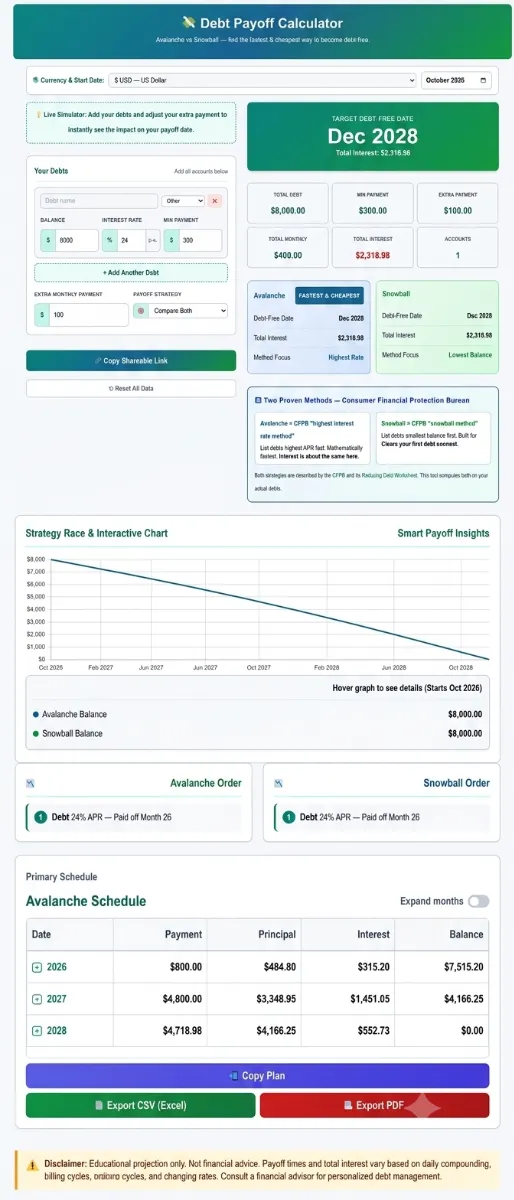
The Debt Payoff Calculator fits this article precisely because it uses the same fields the research identifies for the debt inventory: balances, interest rates, monthly payments, and estimated payoff timelines. The useful output isn’t a guaranteed result — it’s the comparison of what different monthly payment amounts produce in terms of timeline and total interest for a specific balance.
That connects to the research brief’s core point about the inventory. Once the debt is listed accurately, the calculator turns those numbers into estimated timelines. What changes between a $300 monthly payment and a $400 monthly payment on the same $8,000 balance isn’t visible from the statement — but it’s visible in the calculator output. (At 24% APR: $300/month = ~39 months and ~$3,547 in interest; $400/month = ~26 months and ~$2,319 in interest — a $100 monthly increase producing 13 fewer payments and approximately $1,228 in interest savings.)
🧮 SaveXpert Debt Payoff & Budget Planner Calculators — Free & No Signup
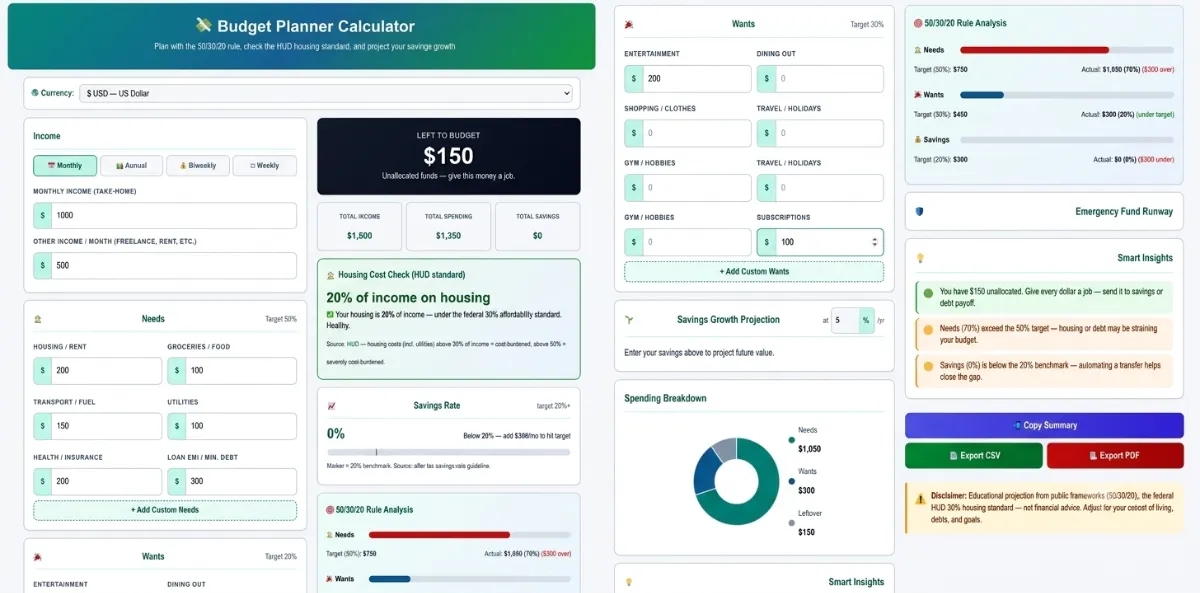
The Debt Payoff Calculator takes your completed inventory — each balance, APR, and planned monthly payment — and returns estimated payoff timelines and total interest. Change the monthly payment and see how the timeline shifts. The Budget Planner Calculator identifies what’s actually available for debt payments after essential expenses are covered — which is the number the Debt Payoff Calculator needs as its realistic monthly input. Use the Budget Calculator first, then bring that number to the Debt Payoff Calculator.
Educational note: Calculators model scenarios for informational purposes only — they can’t predict future income or expenses. Source benchmarks: Federal Reserve G.19 · CFPB credit card data
What the Research Shows Works
Creating a complete debt inventory using five specific fields.
The CFPB’s materials across credit counseling, debt management, and debt collection all point to the same organising framework: balance, interest rate, minimum payment, creditor name, account status. That five-field inventory is the prerequisite for every other decision the research covers.
Using credit reports to verify and complete the inventory.
Statements show what creditors are billing. Credit reports show account status, collections, and information that may not appear in any active monthly statement. The combination of both — available through the FCRA access rights — produces an accurate starting picture rather than an estimated one.
Maintaining minimum payments throughout the organising process.
The CFPB identifies specific consequences for missing minimums: late fees, penalty APRs, loss of introductory rates, and credit history damage. The 91% Federal Reserve figure shows most cardholders understand this obligation even while carrying significant balances.
Using debt validation rights when a debt doesn’t look familiar.
Under 15 U.S.C. § 1692g and 12 C.F.R. § 1006.34, consumers generally have 30 days after receiving validation information to dispute a debt in writing. That process exists precisely for situations where the balance, creditor, or amount doesn’t match the consumer’s records.
Understanding that credit counseling, debt settlement, and credit repair are different services.
The CFPB describes different functions, different risk profiles, and different consumer protections for each. The complaint data (49% of debt-or-credit-management complaints for settlement; 46% for credit repair) shows where documented problems concentrate. Nonprofit credit counseling — separate from both settlement and repair — is the CFPB-described path for households managing payments rather than renegotiating or disputing them.
What the research doesn’t support:
treating the avalanche or snowball as a universally proven method over the other. Both are described by private financial publishers; neither is established by government-source controlled evidence as consistently superior for all households. Use the calculator to test both against your specific numbers, then choose based on what the outputs show.

What Can You Realistically Expect?
The official sources don’t provide one universal number of months to become debt-free. That depends on balances, interest rates, payment amounts, unexpected expenses, and whether new debt continues to build alongside repayment efforts.
What the research does provide are concrete data points for calibrating expectations:
| Data Point | Figure | What It Means Practically |
|---|---|---|
| 30-day written dispute window after validation notice | 30 days | A specific, actionable deadline for unfamiliar collection accounts |
| Average annual consumer-unit expenditures (2024) | $78,535 (~$6,545/month) | BLS national average — not a prediction for any individual household |
| Average income before taxes (consumer unit, 2024) | $104,207 | BLS national average — context for income-to-expense ratios, not personal prediction |
| Adults with credit cards who paid at least the minimum (2025) | 91% | Federal Reserve SHED: most households are managing the minimum; the larger burden persists |
Source: BLS Consumer Expenditure Survey 2024 · Federal Reserve SHED 2025
The research points to a grounded expectation: clarity comes before certainty. A complete, verified debt inventory — with known minimum payments and a realistic available payment amount — produces the accurate inputs for a payoff calculation. Those inputs turn the Debt Payoff Calculator’s output from a generic estimate into a specific model of your situation. The next decision then comes from the numbers rather than from the feeling of being buried under them.
Bottom Line: 5 Steps to Start Your Debt-Free Journey
1. Build the five-field debt inventory from statements and credit reports before making any other decision:
Balance, interest rate, minimum payment, creditor name, and account status — for every account. Don’t rely on memory or estimates. Pull the most recent statement for each account and pull all three credit reports at AnnualCreditReport.com — they’re free, and through December 2026 you can request up to six Equifax reports per 12-month period. The inventory doesn’t need to be perfect in the first session. It needs to become accurate enough to show the complete picture, including accounts you may have overlooked or misremembered.
2. Keep making minimum payments while you organise — the CFPB names the specific consequences for missing them:
Late fees, penalty APRs, loss of any introductory rate, and credit history damage are all documented consequences of a missed minimum payment. The organising process doesn’t pause those obligations. The Federal Reserve’s 91% minimum-payment figure reflects how widely this is understood — and maintaining that status while building the inventory is what keeps the situation from worsening during the time it takes to get organised.
3. If an account on the credit report doesn’t look familiar, use the FDCPA validation process — not guesswork:
Under 12 C.F.R. § 1006.34 and 15 U.S.C. § 1692g, consumers generally have 30 days after receiving a debt validation notice to dispute the debt in writing. A collector must provide the creditor’s name, the amount owed, and dispute instructions. An unfamiliar collection account isn’t automatically an error — but it has a documented process for verification that’s worth using before the debt enters the payoff plan as settled fact.
4. Contact a nonprofit credit counselor before paying any fee to a for-profit debt-relief service — the CFPB specifically distinguishes these terms:
Credit counseling (payment management), debt settlement (renegotiation), and credit repair (credit-report disputes) are three different services under the CFPB’s descriptions. Debt settlement and credit repair account for 49% and 46% of debt-or-credit-management complaints, respectively, in the CFPB’s 2025 data. The FTC’s Telemarketing Sales Rule generally prohibits advance fees for covered debt-relief services before a qualifying result. The NFCC and CFPB’s credit counseling guidance connect consumers with accredited nonprofit counselors at no or low cost.
5. Run the Budget Calculator to find your realistic monthly payment, then model both avalanche and snowball in the Debt Payoff Calculator with your actual inventory numbers:
The government-source evidence doesn’t establish a universal winner between the two approaches. Both are described by private financial publishers; neither is proven by controlled government research to consistently outperform the other across all households. Use the Budget Calculator to find what’s genuinely available after essential expenses. Then use the Debt Payoff Calculator to model what that available amount produces under both methods for your specific balances. Choose based on your numbers — not on a universal rule the research doesn’t support.
“The research finding that most changed how I think about automatic savings tools is the 81%/41% split. The CFPB’s 2022 Qapital study found that 81% of savings goals used contingent spending rules — round-ups, save-with-purchase features — while only 41% used guaranteed rules like fixed payday transfers. Those numbers show the gap between what’s popular and what produced larger balance increases in the study. Round-ups are popular because they fit invisibly into spending. But their output depends on spending volume — fewer purchases mean fewer round-ups. A fixed payday transfer doesn’t care whether you bought coffee that week. The rule fires regardless. That independence from spending behaviour is what the CFPB data consistently links to larger savings accumulation.”
— Kevin Brown, Lead Researcher at SaveXpert.com
Frequently Asked Questions
Ans: CFPB materials consistently identify the same first move: build a complete debt inventory. Document every balance, interest rate, minimum payment, creditor name, and account status before evaluating any payoff strategy. Pull all three credit reports at AnnualCreditReport.com to verify accounts and catch any errors or unfamiliar collections. The inventory converts a fragmented feeling of multiple debts into one visible, accurate picture — the prerequisite for every decision that follows.
Ans: The research supports two simultaneous first moves: build the debt inventory and maintain minimum payments. The Federal Reserve’s 2025 SHED data found that 91% of adults with credit cards paid at least the minimum in the prior month. The CFPB identifies specific consequences for missing minimums: late fees, penalty APRs, loss of introductory rates, and credit history damage. Maintaining minimums keeps the situation from worsening while the inventory is being built. Strategy — avalanche, snowball, consolidation, counseling — comes after the accurate baseline exists.
Ans: Use a single document or spreadsheet with five columns for each account: total balance, current APR, required minimum payment, creditor name, and account status. Data comes from the most recent statement for each account. Then pull all three credit reports at AnnualCreditReport.com — free under FCRA access rights — to verify account status and catch any balances or collections not visible in current statements. The combination of statement data and credit report data produces an accurate, complete picture rather than an estimated one.
Ans: The research points to the emergency savings gap as a structural problem that affects debt repayment. The Federal Reserve’s SHED report found that 40% of adults earning under $50,000 couldn’t cover a $100 emergency from savings in 2025. Unexpected expenses frequently force new credit card use — which erases debt progress even when every planned payment was made. Use the Budget Calculator to analyse income against essential spending and minimum payments; the result shows how much cash is genuinely available, and how to split it between a modest emergency buffer and additional debt payments.
Ans: The research points to concrete, visible progress rather than abstract motivation. The CFPB materials associate tracking measurable progress with sustained repayment behaviour. Building the initial inventory creates a visible debt picture. Using the Debt Payoff Calculator shows specific payoff dates for different payment amounts — converting the abstract goal of “getting out of debt” into a date on the calendar that changes when the payment amount changes. Concrete numbers visible in one place is what the research describes as the practical foundation for sustained repayment.
Ans: The CFPB specifically distinguishes these terms. Credit counseling and debt management plans focus on managing payments to creditors — DMPs may coordinate multiple payments and can reduce interest rates or fees in some cases, but don’t automatically erase the underlying principal. Debt settlement focuses on renegotiating balances for less than the full amount owed. Credit repair involves working on credit-report accuracy. The CFPB’s 2025 complaint data shows debt settlement at 49% and credit repair at 46% of debt-or-credit-management complaints. The FTC’s Telemarketing Sales Rule generally prohibits advance fees from covered for-profit debt-relief companies before a qualifying result is achieved. These three services are not interchangeable — and the consumer protections and risk profiles differ significantly between them.