
ⓘ Educational Disclosure:
This article is for educational and informational purposes only. It does not constitute financial, legal, tax, lending, or investment advice. SaveXpert and its authors are not licensed financial advisors, CPAs, attorneys, or tax advisors. All data comes from publicly available government and institutional sources. Always consult a qualified professional before making investment decisions.
What happens if you only pay the minimum on a credit card? According to the CFPB and Regulation Z (12 C.F.R. § 1026.7), your account remains in good standing and avoids late fees — but the unpaid balance continues to accrue interest daily. The minimum payment is designed to keep the account current, not to reduce the balance efficiently. At the Federal Reserve’s reported average APR of 21.16%, a $5,000 balance generates approximately $88 in first-month interest alone under a simple monthly approximation. Federal statements must disclose both the minimum-only repayment timeline and the monthly amount required to clear the balance in 36 months.
Key Takeaways
- Problem: Millions of cardholders make only the required minimum payment each month — keeping their account current while their balance barely moves. The CFPB’s 2025 market report found 15% of general-purpose cardholders made only the minimum, up from 13% in the prior comparable period.
- Solution: The CFPB’s most common minimum formula uses roughly 1% of the balance plus finance charges and fees. At the Federal Reserve’s reported average APR of 21.16%, a $5,000 balance generates approximately $88 in first-month interest alone — meaning the minimum payment is barely ahead of the interest it’s covering.
- Result: Federal law requires every credit-card statement to show you exactly how long minimum-only payments will take — and the monthly amount needed to clear the balance in 36 months. That statement disclosure is the most accurate tool available; any calculator is a starting approximation.
- Source: CFPB 2025 Consumer Credit Card Market Report · Federal Reserve G.19
- Time To Read: 6 Minutes
Table of Contents
1. The Minimum Payment Statistic That Surprised Me
2. What Actually Happens When You Only Pay the Minimum
3. How the Minimum Credit Card Payment Is Calculated
4. How Long Does It Take to Pay Off a Credit Card With Minimum Payments?
5. The Real Math: A $5,000 Balance at 21.16% APR
6. Does Paying Only the Minimum Hurt Your Credit Score?
7. How Much Interest Do You Pay Making Only Minimum Payments?
8. The Minimum Payment Warning on Your Statement
9. What the Research Shows Works
About 15% of general-purpose credit-card holders made only the minimum payment in the period covered by the CFPB’s 2025 market report — up from 13% in the prior comparable period. Federal law requires every credit-card statement to show you exactly how long minimum-only payments will take, and exactly how much they’ll cost. Most cardholders read that warning and keep paying the minimum. The research shows why the math behind that decision is more expensive than it looks.
The Minimum Payment Statistic That Surprised Me
The headline finding from the CFPB’s 2025 consumer credit-card market report is specific: about 15% of general-purpose cardholders made only the minimum payment during the covered period. That’s up from 13% in the prior comparable report.
| CFPB Data Point | Figure | What It Means |
|---|---|---|
| Share of cardholders making only minimum payment (2025 report) | 15% | Up from 13% in the prior comparable period — a rising share of cardholders in revolving debt |
| Federal Reserve average APR — all accounts (Sept 8, 2025) | 21.16% | The broad average across all card accounts, including promotional and lower-rate accounts |
| Federal Reserve average APR — accounts assessed interest (Sept 8, 2025) | 22.25% | Higher average for accounts actually carrying balances and generating interest charges |
| Most common minimum payment floor (CFPB 2025 report) | $40 | Floors ranged from $15 to $50; $40 was the most frequently reported floor across issuers |
| Average 2024 minimum payment — general-purpose cards | $129 | Average dollar amount of the minimum payment charged, not just the floor |
| Average 2024 minimum payment — private-label cards | $81 | Private-label (store) cards typically carry lower balances and lower minimums |
Source: CFPB 2025 Consumer Credit Card Market Report · Federal Reserve G.19, September 8, 2025
Those 15% aren’t in default — their accounts are current. The issue is the gap between what it costs to stay current and what it costs to actually reduce the revolving balance on a meaningful timeline.
What Actually Happens When You Only Pay the Minimum
The mechanics are straightforward once you separate two things the minimum payment does simultaneously — and one thing it doesn’t do.
| Outcome | Does the Minimum Payment Achieve This? | Source |
|---|---|---|
| Keeps the account in good standing | ✅ Yes — the account is current; no late fee applies | CFPB / Regulation Z 12 C.F.R. § 1026.7 |
| Prevents a negative payment mark on your credit report | ✅ Yes — on-time minimum payment is a timely payment | CFPB credit reporting guidance |
| Avoids a penalty APR trigger | ✅ Yes — penalty APR generally applies after 60+ days late, not from paying the minimum on time | CFPB APR increase rules |
| Reduces the revolving balance efficiently | ❌ No — the balance declines slowly because interest continues to accrue on the unpaid portion | CFPB 2025 market report |
| Reduces credit utilization meaningfully | ❌ No — high balance stays high, keeping utilization elevated | CFPB research |
Source: Regulation Z — 12 C.F.R. § 1026.7 · CFPB 2025 Market Report
The minimum payment solves a specific short-term problem — keeping the account current — but doesn’t address the long-term cost of the revolving balance. Those are two different financial outcomes measured by different things: payment history vs. balance reduction speed.
How the Minimum Credit Card Payment Is Calculated
Not every issuer uses the same formula. This is one of the most commonly misunderstood features of minimum payments — and it’s why a generic “$25 minimum” assumption in an online example can give a very different result from what a real issuer actually requires.
⚠️BLS data limitation — gifts outside the consumer unit excluded since 2020: The Bureau of Labor Statistics excludes gifts given to people outside the consumer unit from its published Consumer Expenditure tables since the 2020 midyear tables. That means BLS data doesn’t capture what consumers spend on gifts for others in the way most gift-budget articles imply. Any source that cites the BLS $78,535 annual consumer-unit figure to derive an “average gift amount” is working with a dataset that explicitly doesn’t count external gift spending. Source: BLS Consumer Expenditure Surveys
| Formula Component | How It Works | Effect on the Minimum |
|---|---|---|
| Balance percentage (most common: ~1%) | Roughly 1% of the current balance; the CFPB’s 2025 report identifies this as the most common formula basis | On a $5,000 balance: ~$50 toward principal before charges are added |
| Finance charges (interest) | Added to the minimum separately — the ~1% doesn’t include the monthly interest charge | At 21.16% APR, approximately $88 first-month interest on $5,000 gets added on top of the 1% |
| Fees (late, annual, etc.) | Any outstanding fees are added to the minimum required | Raises the minimum beyond the baseline 1% + interest calculation |
| Past-due amounts | Any amounts from missed prior payments are included | Can substantially increase the required minimum in subsequent months |
| Payment floor | A fixed minimum dollar amount — most commonly $40 (range: $15–$50 per CFPB 2025 report) | Applies when the percentage-based calculation falls below the floor; protects the issuer’s minimum revenue |
Source: CFPB 2025 Consumer Credit Card Market Report · CFPB — How Credit Card Interest Is Calculated
The practical consequence: on a $5,000 balance with the most common formula, the issuer calculates roughly $50 (1% of balance) and then adds approximately $88 in first-month interest, producing a minimum in the range of $138 before any fees. That minimum is mostly covering the interest charge generated that month — not meaningfully reducing the $5,000 balance.
Find out how long it takes to clear your card — and the interest cost.
How Long Does It Take to Pay Off a Credit Card With Minimum Payments?
The research doesn’t produce a single universal payoff period — because card balances, APRs, minimum formulas, fees, and payment timing all differ. That’s precisely why federal law requires the statement to show a specific estimate for each account.
| Source | Data Point | What It Represents |
|---|---|---|
| Your credit-card statement (Regulation Z) | Specific minimum-only repayment period for your current balance | The most accurate estimate available — uses your actual APR, balance, and minimum formula |
| Your credit-card statement (Regulation Z) | Monthly payment needed to clear the balance in 36 months | A concrete alternative to the minimum — specific to your account |
| CFPB earlier account analysis (2019 data) | Revolving balances lasted ~10 months continuously on average | Observed behaviour across accounts — not a prediction for any specific cardholder |
| CFPB earlier account analysis (2019 data) | ~15% of accounts revolved continuously for at least 2 years | A significant minority remained in long-term revolving debt |
Source: Regulation Z — 12 C.F.R. § 1026.7 · CFPB revolving credit analysis (2019 data)
The statement disclosure is the most actionable data point in this article because it’s specific to the account, not an approximation. The 36-month repayment amount — shown on every statement under federal law — tells you exactly what to pay each month to clear the balance within three years, and what that path will cost in total. The minimum-only path on the same statement shows the opposite scenario.
The Real Math: A $5,000 Balance at 21.16% APR
The research brief provides a worked example using the Federal Reserve’s reported average APR. Here’s what the numbers show — and where the approximations lie.
| Calculation Step | Figure | Method & Limitation |
|---|---|---|
| Balance | $5,000 | Hypothetical starting balance for illustration |
| APR used | 21.16% | Federal Reserve G.19 average for all accounts, September 8, 2025 |
| Simple monthly interest approximation | $5,000 × (21.16% ÷ 12) = ~$88 | Simple division — actual issuers calculate daily using average daily balance; the real charge may differ |
| 1% minimum principal component | 1% × $5,000 = $50 | Based on the most common formula reported by the CFPB; actual formula varies by issuer |
| Approximate minimum (1% + interest) | $50 + $88 = ~$138 | Before any fees; subject to the issuer’s actual formula and floor; not the cardholder’s real minimum |
| Balance remaining after one minimum payment | $5,000 − $50 = ~$4,950 | The principal reduction from one minimum payment is approximately 1% of the balance — the interest charge is also covered but doesn’t reduce principal |
Source: Federal Reserve G.19 · CFPB 2025 Market Report · CFPB — Credit Card Interest Calculation
💡 Why this is an approximation, not your actual minimum: Real issuers calculate interest daily using the average daily balance — not by dividing the annual rate by 12. Your actual minimum payment, interest charge, and payoff timeline are on your statement. The Federal Reserve average APR (21.16%) is also a broad average across all accounts; your card’s specific APR may be higher or lower. Use the Credit Card Calculator below with your actual card details for a more precise scenario.
For context on how the numbers can grow over longer timelines, the research brief includes illustrative examples from Bankrate’s minimum-payment analysis. A $1,000 balance at 29.24% APR with a $34 minimum produced an estimated payoff of 11.1 years and $1,688.33 in total interest under Bankrate’s stated assumptions. A $5,000 balance at 25.24% APR took approximately 23.9 years and $9,735.87 in interest. These are Bankrate’s calculations with specific assumptions — they are not CFPB or Federal Reserve statistics, and they use APRs and minimums different from the figures in this article’s example. They illustrate the long-term compounding effect, not a prediction for any specific cardholder.
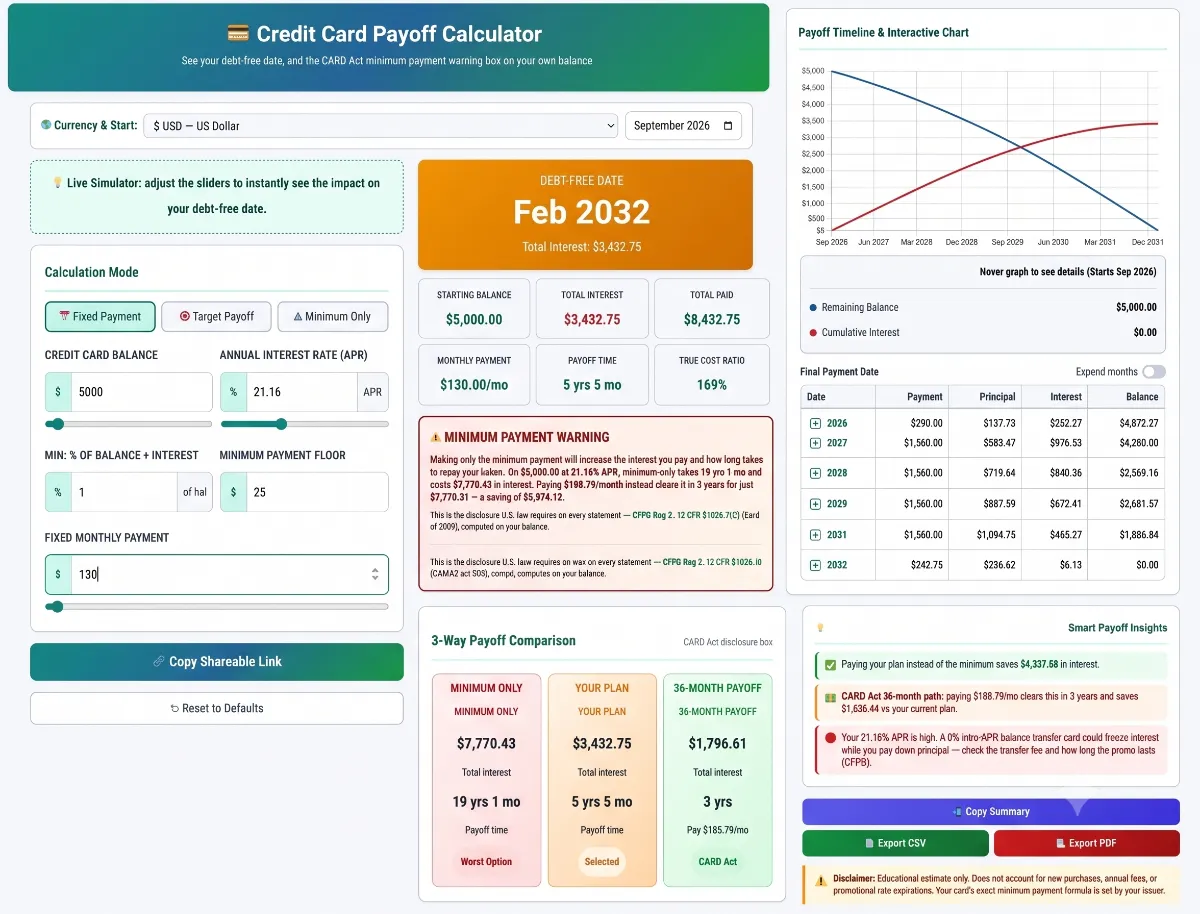
💳 Run Your Actual Numbers: SaveXpert Credit Card Payoff Calculator
The $5,000/21.16% example above is an illustration. Your card has its own APR, balance, minimum formula, and fees. The Credit Card Calculator lets you enter your real balance, your card’s actual APR, and a target monthly payment — then shows the payoff timeline and total interest at the minimum versus at a higher amount. The difference between paying the minimum and paying an extra $50 per month becomes a concrete number, not an estimate.
Educational note: Calculator models scenarios for informational purposes only. Source: CFPB — How Credit Card Interest Is Calculated
Does Paying Only the Minimum Hurt Your Credit Score?
The research draws a clear distinction between two separate things the credit system measures — and minimum payments affect them very differently.
| Credit Factor | Effect of Paying Only the Minimum On Time | Source |
|---|---|---|
| Payment history | Positive — a timely minimum payment is a timely payment; no negative mark is generated | CFPB credit reporting guidance |
| Negative payment information duration | On-time minimum payments don’t create negative marks; negative marks from missed payments can remain for 7 years | CFPB — How to Rebuild Your Credit |
| Credit utilization ratio | Neutral-to-negative — the balance stays high, keeping utilization elevated even when payment history is clean | CFPB research on revolving balances |
| Overall credit-score impact of minimum-only payments | Not quantified by a single federal number — the sources reviewed don’t provide a specific numeric score impact | Research brief limitation — CFPB material doesn’t publish a per-payment score effect |
The distinction matters practically. A cardholder who has paid the minimum on time every month has a clean payment history. The same cardholder who carries a $5,000 balance on a $6,000 credit limit has an 83% utilization ratio on that card — which is a separate credit factor from payment history. Paying the minimum on time protects payment history; it doesn’t reduce utilization.

How Much Interest Do You Pay Making Only Minimum Payments?
The answer to this question depends on the card’s APR, balance, minimum formula, fees, and payment behaviour — which is why the statement disclosure exists. The research brief provides the building blocks for understanding the cost, while correctly acknowledging that a simple calculation doesn’t reproduce an issuer’s exact daily-balance method.
How credit-card interest is actually calculated
According to CFPB guidance, card interest is typically calculated daily using the average daily balance — not by a simple monthly division of the annual rate. The steps:
| Step | How It Works | Why It Matters |
|---|---|---|
| 1. Find the daily periodic rate | APR ÷ 365 (or 360 — varies by issuer) | 21.16% ÷ 365 = 0.05797% per day |
| 2. Calculate the average daily balance | Sum of each day’s balance ÷ days in billing cycle | Purchases and payments during the month change the daily balance |
| 3. Apply the rate to the average daily balance | Average daily balance × daily rate × days in cycle | Produces a slightly different result than APR ÷ 12 × balance |
| 4. Add to the statement | Finance charge appears on the billing statement | The statement figure is the issuer’s actual charge — more accurate than any approximation |
The daily method means that making a payment mid-cycle lowers the average daily balance for the rest of the billing period — reducing the interest charge slightly even if you can’t pay the full balance. Every dollar paid above the minimum during the billing cycle reduces the average daily balance and the resulting interest charge.
The Minimum Payment Warning on Your Statement
This section of your statement carries more specific information than any generic example — because it’s calculated from your actual balance, APR, and minimum formula.
| Statement Disclosure | What It Shows | Legal Requirement |
|---|---|---|
| Minimum payment warning | How long it will take to repay the current balance making only minimum payments; the total interest cost over that period | Required by Regulation Z — 12 C.F.R. § 1026.7; periods under 3 years shown in months, longer periods rounded into years |
| 36-month repayment disclosure | The monthly payment needed to repay the current balance in 36 months; the total cost (principal + interest) over that period | Required by Regulation Z — 12 C.F.R. § 1026.7; assumes no new purchases |
Source: Regulation Z — 12 C.F.R. § 1026.7 · CFPB — Regulation Z Statement Requirements
The two disclosures together give you both paths: the minimum-only path and a three-year alternative. The 36-month disclosure assumes no new purchases — meaning if you continue using the card, the actual payoff timeline extends further than the disclosure shows. The statement is therefore a floor estimate on the minimum-only path, not a ceiling.
💡 Research note — CARD Act disclosure impact: A peer-reviewed study in the Quarterly Journal of Economics found a 0.4 percentage-point increase in consumers paying enough to repay balances within 36 months after the CARD Act required the 36-month disclosure, from a 5.3% baseline. The research also found no large overall change in payments — the disclosure produced a small, measurable effect on a small share of consumers, not a broad repayment shift. A CFPB study (Wang 2023) found autopay increased the likelihood of making a minimum payment by 20–29 percentage points — reducing missed payments while also leaving some consumers paying only the minimum.
What the Research Shows Works
Paying above the minimum — by any amount — reduces the balance faster.
The CFPB confirms that payments above the minimum reduce the balance that generates interest. The compounding effect runs in both directions: interest compounds on the unpaid balance month after month at the minimum, while every dollar above the minimum reduces the base on which future interest is calculated.
Knowing where excess payments go under Regulation Z.
When a card carries multiple balances at different APRs — a standard purchase rate and a promotional 0% rate, for example — Regulation Z (12 C.F.R. § 1026.53) generally requires excess payments (above the minimum) to go first toward the balance with the highest APR. That means extra payments are directed where they save the most interest — not necessarily to the promotional balance a cardholder might assume they’re paying down.
Using the statement disclosures as the planning tool, not a generic calculator.
The minimum-only repayment estimate and the 36-month repayment amount on your statement are specific to your account’s APR, balance, and minimum formula. A calculator using national average APRs is a starting point; your statement is the most accurate version of the same calculation.
Understanding the APR context for any carried balance.
The Federal Reserve reported that accounts actually assessed interest averaged 22.25% APR as of September 2025. A balance at 22.25% generates more interest than the same balance at 21.16% — which changes the minimum-only payoff timeline meaningfully. Checking your card’s current APR on the statement (not what it was when you opened the account) is the first step in understanding the real cost.
Recognising the 60-day late-payment threshold.
Paying the minimum on time avoids a penalty APR increase. A card issuer can generally raise the APR after a required minimum payment is more than 60 days late, subject to applicable rules and required notice. That makes the minimum payment a floor worth protecting even when the amount above it is modest — missing it entirely opens a separate set of consequences.

Bottom Line: 5 Things the Real Math Shows
1. The minimum keeps the account current — it doesn’t reduce the balance meaningfully:
The CFPB’s most common formula uses ~1% of the balance before interest and fees are added. On a $5,000 balance at 21.16% APR, the simple monthly interest approximation is ~$88. A 1%-based minimum produces roughly $50 in principal reduction before that interest is added. The required payment is mostly covering the monthly interest charge — the $5,000 moves very slowly toward zero at the minimum.
2. Read the minimum payment warning on your statement — it shows your specific payoff timeline, not a national average:
Regulation Z requires two disclosures: (a) how long minimum-only payments will take and the total cost, and (b) the monthly amount to clear the balance in 36 months. Those two figures together show you the full cost of the minimum-only path and a concrete faster alternative — both calculated from your actual balance and APR, not a hypothetical example.
3. Paying any amount above the minimum saves more than it looks like it should — because Regulation Z directs the extra to the highest-APR balance:
Excess payments above the minimum generally go first toward the balance with the highest APR under Regulation Z. An extra $50/month on a card carrying both a standard 22% balance and a promotional 0% balance gets applied to the high-rate balance automatically. The interest saved from that application compounds over time — it’s not linear.
4. Minimum payments protect payment history but don’t reduce utilization — those are two separate credit factors:
Paying the minimum on time is a timely payment — no negative mark is generated. The CFPB notes negative payment information can remain on a credit report for seven years, which is the rule that matters if you miss a payment. But a $5,000 balance on a $6,000 limit is 83% utilization regardless of how clean the payment history is. The two factors measure different things and respond to different actions.
5. Run your actual balance and APR through the Credit Card Calculator before deciding the minimum is your only option:
The Federal Reserve’s 21.16% average APR and the illustrative $5,000 example produce numbers specific to that scenario. Your card may have a different APR, a different minimum formula, and a different floor. The Credit Card Calculator converts your real inputs into a concrete payoff timeline and total interest at the minimum versus at a higher fixed monthly payment. Seeing the difference in your own numbers — not the national average — is the most actionable step the research supports.
“The CFPB data point that most changed how I read minimum-payment advice was the 1% formula. When people see that a card’s minimum is roughly 1% of the balance, it sounds like they’re paying down 1% of principal each month. They’re not — the 1% is the floor before interest and charges are added on top. On a $5,000 balance at 21.16% APR, the simple monthly interest approximation alone is about $88. A 1% minimum calculation on $5,000 produces $50 before interest is added. The required minimum payment is barely staying ahead of what the interest is generating — and most cardholders don’t calculate that until they read the statement warning.”
— Kevin Brown, Lead Researcher at SaveXpert.com
Frequently Asked Questions
Ans: According to CFPB Regulation Z, making only minimum payments keeps your account current and avoids late fees and negative payment marks — but the unpaid balance continues to accrue daily interest. The minimum payment is designed to keep the account from becoming delinquent, not to reduce the balance efficiently. The CFPB’s 2025 market report found about 15% of general-purpose cardholders made only the minimum, with the revolving balance declining very slowly because the minimum largely covers the monthly interest charge rather than the principal.
Ans: There is no single universal answer — because every issuer calculates minimums differently and every balance, APR, and fee situation differs. Federal law (Regulation Z) requires the statement to show you the specific minimum-only repayment period for your current balance. A CFPB earlier analysis found revolving balances lasted about 10 months continuously on average, with roughly 15% of accounts revolving for at least two years. The statement disclosure is more reliable than any general estimate because it’s calculated from your actual account terms.
Ans: The CFPB’s 2025 Consumer Credit Card Market Report found that the most common minimum payment formula uses approximately 1% of the balance, with finance charges and fees added separately. Payment floors ranged from $15 to $50, with $40 being the most common floor. Average 2024 minimum payments reached $129 for general-purpose cards. The exact minimum depends on your specific card agreement — the issuers’ formulas vary, which is why a $25 assumption in a generic calculator can differ significantly from what your issuer actually requires.
Ans: Paying the minimum on time avoids negative payment marks — a timely payment is a timely payment regardless of amount. The CFPB notes that negative payment information can generally remain on a credit report for seven years. However, making only the minimum doesn’t reduce your credit utilization ratio if the balance stays high. A persistently high utilization can suppress a credit score even while payment history remains clean. The two factors — payment history and utilization — respond to different actions and are measured separately.
Ans: The answer depends on the card’s APR, balance, minimum formula, and fees. The Federal Reserve reported average APRs of 21.16% (all accounts) and 22.25% (accounts assessed interest) as of September 2025. According to CFPB guidance, card interest is often calculated daily using the average daily balance — not a simple monthly division. That means daily interest compounds on virtually unchanged principal when only the minimum is paid. The minimum payment warning on your statement shows the total interest cost over the minimum-only repayment period for your specific account.
Ans: According to CFPB guidance, missing a required minimum payment can trigger a late fee and create a negative payment mark on your credit report. The CFPB notes that negative payment information can generally remain on a credit report for seven years. If a minimum payment is more than 60 days late, the card issuer can generally increase your APR, subject to applicable rules and required advance notice. Making the minimum payment — even when you can’t pay more — protects you from those specific consequences. Missing the minimum opens a separate set of costs and credit consequences beyond simply carrying a revolving balance.