
ⓘ Educational Disclosure:
This article is for educational and informational purposes only. It does not constitute financial, legal, tax, lending, or investment advice. SaveXpert and its authors are not licensed financial advisors, CPAs, attorneys, or tax advisors. All data comes from publicly available government and institutional sources. Always consult a qualified professional before making investment decisions.
How do you pay off debt before Christmas 2026? According to CFPB data, paying down a balance before a specific date requires calculating the exact monthly payment needed based on your starting balance, APR, and number of months remaining. The CFPB’s 2024 average general-purpose credit card APR of 25.2% means a large portion of each payment goes toward interest before touching principal. Paying significantly above the minimum is mathematically required to reduce a balance quickly at that rate. The NY Fed reported $1.263 trillion in credit card balances in Q2 2026, with the Experian average consumer balance at $6,659 in March 2026.
Key Takeaways
- Problem: Americans are heading into the 2026 holiday season with $1.263 trillion in credit card balances and a 25.2% average APR — conditions where a Christmas payoff plan has to be built on actual math, not a general intention.
- Solution: The CFPB data points to one consistent finding: paying well above the minimum every cycle is the only way to meaningfully reduce a balance at 25% APR within a short window. The specific timeline depends on your starting balance, APR, and the extra amount paid each month.
- Result: Fifteen percent of general-purpose cardholders made only minimum payments in 2024, per the CFPB. Those balances didn’t move much. Consumers who paid significantly more reduced both their balance and their total interest cost.
- Source: CFPB Consumer Credit Card Market Report, NY Fed Q2 2026 Household Debt Report
- Time To Read: 5 Minutes
Table of Contents
1. The Average Credit Card Balance Reached $6,659 in 2026
2. Paying Off Debt Before Christmas 2026 Starts With the Math
3. Why High APRs Make Fast Debt Payoff Harder
4. Debt Avalanche vs. Snowball: What the Research Actually Supports
5. Is Debt Consolidation a Good Idea Before the Holidays?
6. Should You Stop Saving to Pay Debt Faster?
7. What the CFPB Shows About Debt Already in Collections
8. What the Research Shows Works (and What Doesn’t)
9. Realistic Expectations for a Christmas 2026 Payoff
10. Bottom Line: 5 Steps to Pay Off Debt Before Christmas 2026
$160 billion. That’s how much consumers paid in credit card interest in 2024 alone, according to the CFPB’s latest market report. The average general-purpose APR that produced it: 25.2%. If you’re looking at your balance right now and wondering whether there’s a path to zero before Christmas 2026, the data makes one thing clear — the timeline isn’t a feeling. It’s math.
The Average Credit Card Balance Reached $6,659 in 2026
Before any payoff plan makes sense, the starting-point data matters. Here’s what the official research shows about where American households stand right now.
| Metric | Figure | Source |
|---|---|---|
| Total credit card balances (Q2 2026) | $1.263 trillion | NY Fed Household Debt Q2 2026 |
| Q2 2026 balance increase (vs. prior quarter) | +$21 billion | NY Fed Q2 2026 |
| Q2 2026 balance increase (vs. same quarter 2025) | +$54 billion | NY Fed Q2 2026 |
| Credit card balances in serious delinquency (preceding year) | 6.97% | NY Fed Q2 2026 |
| All household debt in some stage of delinquency | 4.7% | NY Fed Q2 2026 |
| Average consumer credit card balance (March 2026) | $6,659 | Experian State of Credit Cards |
| Prior-year comparison balance | $6,618 (+0.6%) | Experian State of Credit |
Source: NY Fed Q2 2026 Household Debt and Credit · Experian State of Credit Cards 2026
The $6,659 Experian average doesn’t represent every American’s situation — there are large generational differences. The research brief breaks them out:
| Generation | Average Credit Card Balance (March 2026) |
|---|---|
| Generation X | $9,560 |
| Millennials | $7,013 |
| Generation Z | $3,483 |
Source: Experian State of Credit Cards, March 2026
The generational spread means a Gen X household and a Gen Z household face completely different payoff math — even if both are asking the same question about getting debt-free before Christmas.

Find out exactly how long it takes to become debt-free.
Paying Off Debt Before Christmas 2026 Starts With the Math
When I looked through the official data, one point stood out immediately. No federal source publishes a universal debt-free deadline. Your starting balance, APR, required minimum payment, and extra payment determine the timeline. That’s why the question isn’t “Can an American get out of debt before Christmas?” The better question is whether a specific balance can reach zero by that date.
Consider the Experian 2026 average of $6,659. At the CFPB’s 25.2% average general-purpose APR, the math changes significantly compared to a lower-rate card. At that rate, a meaningful portion of each payment covers interest before anything reaches the principal balance.
I ran a $6,659 balance at 25.2% APR through a debt-payoff estimate. With roughly three and a half months until Christmas from September, the required monthly payment works out to approximately $1,993 per month under a standard amortization estimate. That’s a mathematical example using figures from the research — not a CFPB projection for any individual borrower.
For most households, $1,993/month toward a credit card isn’t realistic. That’s where knowing the actual number matters — because it sets realistic expectations and shows how much additional income or expense reduction would be needed to hit the date.
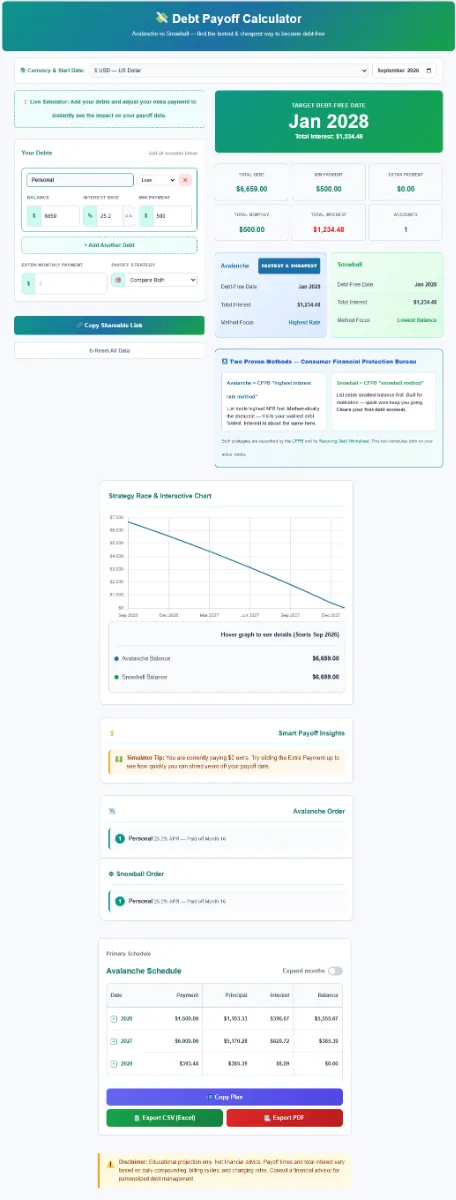
💳 Run Your Own Numbers: SaveXpert Debt Payoff Calculator
I ran the Experian average balance of $6,659 at 25.2% APR through the Debt Payoff Calculator with several payment amounts. At the minimum payment level (~1% of balance plus interest), the balance doesn’t clear by Christmas — not even close. At $500/month above minimum, the payoff date shifts meaningfully. Put your own balance, APR, and available monthly payment in and see your specific date — because the CFPB is right that there’s no universal timeline. There’s only yours.
Educational note: This calculator models debt repayment scenarios for informational purposes only and does not provide personalized financial advice. Source: CFPB Consumer Credit Card Market Report
Why High APRs Make Fast Debt Payoff Harder
The CFPB’s 2024 data gives specific numbers on the rate environment every holiday debt plan has to work against.
| Credit Card Type | Average APR (CFPB 2024) |
|---|---|
| General-purpose cards (all accounts) | 25.2% |
| Private-label cards (store cards) | 31.3% |
| New general-purpose accounts (opened in 2024) | 27.5% |
Those figures matter because high APR debt compounds quickly. The CFPB reported that consumers paid $160 billion in credit card interest in 2024 — plus another $31.3 billion in credit card fees. About 50% of credit card accounts revolved balances that year, with the average monthly balance per cardholder at $5,300.
Here’s the practical point. Two households can have identical $6,659 balances. The one making only the minimum payment sees most of each payment absorbed by interest charges. The one making a larger fixed payment sees more reach the principal. The CFPB’s finding that 15% of general-purpose cardholders made only minimum payments in 2024 is what the data shows about who stays in debt longest.
⚠️ Minimum payments aren’t designed for fast payoff: The CFPB found issuers commonly set minimums around 1% of the balance plus finance charges, fees, and past-due amounts. At 25.2% APR, a minimum payment on a $6,659 balance covers little more than the month’s interest. The principal barely moves.
Debt Avalanche vs. Snowball: What the Research Actually Supports
This is where I want to be careful about what the official data actually proves versus what appears in third-party guidance.
Two popular debt payoff methods get cited frequently:
The snowball method targets the smallest balance first. Paying that off produces a quick win and redirects the freed-up payment to the next-smallest balance. The goal is momentum.
The avalanche method targets the highest-APR balance first. Paying down the most expensive debt first minimises total interest over the payoff period. The goal is mathematical efficiency.
But there’s a specific limitation in the official research. The CFPB does not establish that either method consistently produces better completion rates across all borrower groups. The available CFPB data doesn’t support definitive causal conclusions about which payoff order works better universally.
What the data does support: the actual payment schedule — balance, APR, and amount paid each month — determines the timeline more than the order of repayment. For someone with one credit card balance and a Christmas deadline, the order question doesn’t apply. For someone with multiple balances, the avalanche method produces less total interest at 25%+ APRs, while the snowball method produces faster first wins that may help with sustained motivation.
💡 Research note: The CFPB’s market data describes the interest-rate environment and payment behaviour patterns across millions of accounts. It doesn’t provide government-backed endorsement of either the snowball or avalanche method. The payoff-order decision remains a methodological choice based on individual balance structure and personal motivation patterns.

Is Debt Consolidation a Good Idea Before the Holidays?
The research gives consolidation a narrower answer than many consumer finance articles suggest — and the distinction between consolidation and debt management matters.
Debt consolidation typically means moving multiple balances into one new loan or balance transfer product — often at a lower APR. Consolidation mathematically helps when the new rate is genuinely lower than the existing rates. At a 25.2% average existing APR, a personal loan at 12% or a 0% promotional balance transfer would change the payoff math substantially.
Debt management plans through nonprofit credit counselling agencies are a separate process. These plans involve working with a counsellor to create a budget and repayment plan, often with reduced interest rates negotiated directly with creditors for enrolled accounts.
Debt settlement is different again — and the CFPB and third-party research both flag that settling debt for less than the full balance can have credit-report consequences.
The CFPB also reported $352 billion in credit card balances on accounts with introductory promotional APRs at the end of 2024. But the agency noted that those accounts had higher longer-term balances than accounts without promotional periods. The promotional window matters: if a balance isn’t cleared before the introductory rate expires, the rate resets — often to a rate near or above the current average.
💡 Research note: Before consolidating, the question to verify is specific: is the new rate — after accounting for balance transfer fees, origination fees, and the actual length of any promotional period — lower than the current effective rate on existing balances? A product advertised as consolidation doesn’t automatically save money if the all-in cost is the same or higher.
Should You Stop Saving to Pay Debt Faster?
The research brief doesn’t provide a CFPB rule directing consumers to stop saving. It doesn’t establish that every borrower should prioritise debt over savings. What the official data gives is the debt side of the equation: balances, APRs, minimum payments, revolving rates, and delinquency data.
What that data does support is running the numbers rather than applying one rule to everyone. A borrower with a revolving credit card balance at 25.2% APR faces a very different mathematical situation from someone with a low-rate balance or a managed-rate loan. Interest at 25% compounds faster than most savings accounts grow.
At the same time, the research brief doesn’t establish a government-approved savings target for holiday debt payoff. A household with no emergency fund that depletes savings to zero to pay down credit card debt faces a different risk profile than one with three months of expenses covered.
A debt-payoff calculator can show how changing the extra payment changes the payoff date. A budget calculator can then show how much capacity exists after required payments to redirect toward the balance. Those two tools together give a more accurate picture than any blanket rule about savings vs. debt.
What the CFPB Shows About Debt Already in Collections
Some households approaching Christmas aren’t dealing with active credit card revolving balances. They’re dealing with debt already in collections — a different legal and tactical situation that the CFPB specifically addresses.
The CFPB’s debt collection guidance establishes specific consumer rights:
The 30-day validation window
Debt collectors must generally provide validation information in the initial written communication or within five days of first contact. From the date of that validation notice, consumers have 30 days to dispute the debt in writing.
A timely written dispute matters. When a consumer disputes the debt in writing during the validation period — or requests information about the original creditor — collection activity on that disputed amount must pause until the collector responds adequately. That’s different from simply asking a collector to stop contacting you.
What stopping contact does and doesn’t do
The CFPB states clearly that requesting a collector cease communication doesn’t stop other lawful collection methods. Those methods can include a lawsuit or credit reporting. A cease-communication request changes what the collector can say to you — it doesn’t change what the collector can do.
⚠️ Identify the debt type before starting any payoff plan: A revolving credit card balance and a debt in collections involve different rules, different timelines, and different strategic options. Anyone researching how to pay off debt before Christmas 2026 needs to identify which situation applies to each balance — because the approach differs.

What the Research Shows Works (and What Doesn’t)
What the CFPB and NY Fed data consistently support
Calculating the specific timeline before starting.
No federal source publishes a universal payoff schedule. Your balance, APR, and monthly payment determine your date. The Debt Payoff Calculator makes that calculation concrete — showing the payoff date and total interest cost for different payment levels before any decision is made.
Paying meaningfully above the minimum every cycle.
The CFPB found 15% of cardholders made only minimum payments in 2024. At a 25.2% average APR, minimum payments don’t produce meaningful principal reduction within a short window. Every dollar above the minimum goes toward principal — the only thing that actually moves the balance toward zero.
Verifying that consolidation actually lowers the rate.
The CFPB’s $352 billion in promotional-rate balances shows these products are widely used. But the same data shows those accounts carried higher longer-term balances. The promotional period has to work within the payoff timeline — not beyond it.
Using the 30-day validation window if debt is in collections.
A written dispute during the validation period pauses collection activity. That changes the tactical picture — specifically, it can create time to evaluate payment options without collection pressure escalating simultaneously.
What the data says doesn’t work
Minimum-only repayment toward a Christmas deadline.
The math doesn’t support it. At 25.2% APR on a $6,659 balance, minimum payments would still leave a substantial balance well into 2027. The CFPB’s 15% minimum-only figure represents the population most likely to still carry the same balance next December.
Consolidating to a product that doesn’t lower the effective rate.
Moving balances for convenience or simplicity without rate reduction doesn’t change the underlying cost. The research supports verifying the math before consolidating — not assuming all consolidation saves money.
Choosing a payoff method without knowing the balance, APR, and payment capacity.
Snowball vs. avalanche is a decision that comes after calculating what’s actually achievable. Picking a method first and calculating later produces optimism, not a payoff date.
Realistic Expectations for a Christmas 2026 Payoff
The research doesn’t support a universal promise that any balance can reach zero by December 25. What it supports is a framework for finding out whether your specific balance can.
The Experian average of $6,659 at 25.2% APR requires approximately $1,993 per month over three and a half months under a standard amortization estimate. For households where that payment is realistic, a Christmas payoff is mathematically achievable. For households where it isn’t, the more useful question is: what payoff date is achievable, and what does that mean for holiday spending plans this season?
A smaller balance or a lower APR changes that answer significantly. A Gen Z household with a $3,483 average balance has a different payoff math than a Gen X household carrying $9,560. The research supports running the calculation for the specific situation rather than calibrating expectations against a national average.
Bottom Line: 5 Steps to Pay Off Debt Before Christmas 2026
1. Calculate your specific timeline first — don’t estimate:
Open the Debt Payoff Calculator and enter your actual balance, your card’s APR, and what you can realistically pay each month. The $6,659 Experian average at 25.2% APR requires ~$1,993/month over 3.5 months. Your number may be very different — and knowing it accurately is what makes any plan real.
2. Pay as much above the minimum as possible every single cycle:
The CFPB found 15% of cardholders made only minimum payments in 2024. At 25.2% APR, minimum payments are largely absorbed by interest. Every dollar above the minimum goes toward principal — the only thing that moves the balance toward zero. There’s no substitute for this step.
3. If you have multiple balances, target the highest APR first:
At 25%+ average APRs, the highest-rate balance costs the most per day it’s open. Within a short window like 3-4 months, the avalanche method minimises how much of your payment disappears into interest charges before touching principal. The research doesn’t promise one method is universally superior — but the math on high-APR debt favours attacking it first.
4. If consolidating, verify the new rate is actually lower — including all fees:
A balance transfer or personal loan only helps if the all-in cost (new APR, transfer fee, loan origination fee, promotional period expiry) is lower than the existing rate. The CFPB’s promotional-rate data shows those balances ended up higher over time — meaning the promotional window didn’t get used effectively. The math has to work before you move the balance.
5. If any debt is in collections, start with the CFPB’s 30-day validation window:
A written dispute during the validation period pauses collection activity on that debt — not permanently, but long enough to evaluate payment options without collection escalating simultaneously. Identify whether you’re dealing with active revolving balances or collected debts before building any plan, because the rules and timelines are completely different.
“When I went through the CFPB’s 2024 credit card market data and the New York Fed’s Q2 2026 household debt report, the number that crystallised the challenge was $160 billion. That’s what consumers paid in credit card interest in a single year — at an average APR of 25.2%. At that rate, every day a balance stays unpaid is the kind of compounding cost that makes a Christmas payoff significantly harder than the starting balance alone suggests.”
— Kevin Brown, Lead Researcher at SaveXpert.com
Frequently Asked Questions
Ans: According to Experian data from March 2026, the average consumer credit card balance is $6,659 — up 0.6% from $6,618 in the prior period. The New York Fed reported $1.263 trillion in total credit card balances at the end of Q2 2026, up $54 billion from the same quarter in 2025. Generational differences are significant: Generation X averages $9,560, millennials average $7,013, and Generation Z averages $3,483.
Ans: The CFPB data doesn’t publish a universal yes or no. Whether any specific balance can reach zero by December 25 depends on the starting balance, the APR, and the monthly payment applied. Using the Experian 2026 average of $6,659 at the CFPB’s 25.2% average general-purpose APR, a mathematical estimate puts the required monthly payment at approximately $1,993 over roughly 3.5 months. That figure illustrates the challenge — and shows why calculating your specific numbers in the Debt Payoff Calculator matters more than assuming a general timeline applies.
Ans: The CFPB data doesn’t establish one universally fastest method. What the research consistently shows is that paying significantly above the minimum accelerates any timeline. The avalanche method — targeting the highest APR balance first — minimises total interest paid, which matters most at average APRs of 25% or higher. The snowball method — paying the smallest balance first — may produce faster early wins that support sustained payment behaviour. The research doesn’t support a government-backed claim that one approach always beats the other across all borrower situations.
Ans: It depends on the rate. Consolidation makes mathematical sense when the new rate — accounting for all fees and the promotional period — is genuinely lower than the existing balance’s effective rate. The CFPB reported $352 billion in promotional-rate balances at the end of 2024, but also found those accounts carried higher longer-term balances than non-promotional accounts — suggesting the promotional window frequently wasn’t used to eliminate the balance. The research supports verifying the math before moving any balance.
Ans: The CFPB doesn’t publish universal financial recommendations or prescribe a specific payoff strategy. Its published market data consistently shows that higher payments reduce balances faster and lower total interest costs at the prevailing APRs. The agency’s 2024 credit card market report found that 15% of general-purpose cardholders made only minimum payments — the group whose balances moved slowest. The data supports the value of larger monthly payments, but the CFPB presents this as market-derived evidence, not personalised advice for any individual borrower.
Ans: The CFPB states that consumers have a 30-day window from the date of the validation notice to dispute a collection debt in writing. A written dispute during that period generally pauses collection activity on the disputed amount until the collector responds adequately. Debt collectors must provide validation information in the initial written communication or within five days of first contact. Importantly, requesting a collector to stop contacting you doesn’t stop other lawful collection methods — such as filing a lawsuit or reporting the debt to credit bureaus. Identifying whether your debt is in active revolving credit or collections is the first step, because the rules differ completely.