

ⓘ Educational Disclosure:
This article is for educational and informational purposes only. It does not constitute financial, legal, tax, lending, or investment advice. SaveXpert and its authors are not licensed financial advisors, CPAs, attorneys, or tax advisors. All data comes from publicly available government and institutional sources. Always consult a qualified professional before making investment decisions.
What are the projected 401(k) catch-up contribution limits for 2027 for people over 50? The 2027 limits are not yet official. Current analyst projections estimate the standard catch-up at $8,000–$8,500 for eligible workers age 50 and older, and the super catch-up for ages 60–63 at approximately $11,750. These projections are based on IRS cost-of-living adjustment methodology applied to the confirmed 2026 limits ($8,000 standard, $11,250 super catch-up) from IRS Notice 2025-67. The IRS is expected to announce official 2027 figures in October or November 2026. Until then, projections are directional estimates only.
Key Takeaways
- Problem: Workers over 50 planning ahead for 2027 retirement contributions face a specific challenge: the IRS hasn’t published the official 2027 limits yet, but many planning decisions happen well before the announcement window.
- Solution: The 2026 confirmed limits — standard catch-up $8,000 (ages 50–59 and 64+), super catch-up $11,250 (ages 60–63) — are the right planning baseline. Current analyst projections suggest the 2027 standard catch-up could reach $8,000–$8,500 and the super catch-up approximately $11,750. Neither figure is official until the IRS publishes its cost-of-living notice, typically in October or November.
- Result: The rules that govern catch-up eligibility — which ages qualify, how the super catch-up works, and the mandatory Roth treatment for high earners under SECURE 2.0 — are already confirmed for 2026 and will carry into 2027 under the same structure.
- Source: IRS Notice 2025-67 · IRS COLA Contribution Limits
- Time To Read: 6 Minutes
Table of Contents
1. The 2027 Limits Are Not Yet Official — Here’s What the Data Projects
2. Who Qualifies for 401(k) Catch-Up Contributions?
3. The Confirmed 2026 Limits by Age Group (Your 2027 Planning Baseline)
4. How the Ages 60–63 Super Catch-Up Works
5. The Roth Catch-Up Rule for High Earners: What SECURE 2.0 Changed
6. How Catch-Up Contributions Relate to the Regular 401(k) Limit
7. What the Research Consistently Shows About Catch-Up Planning
8. Bottom Line: 5 Things to Know About 2027 Catch-Up Contributions
The official 2027 401(k) catch-up contribution limits don’t exist yet. The IRS typically announces cost-of-living adjustments for the following year in October or November — which means the figures most websites are publishing for 2027 are analyst projections, not IRS announcements. What does exist, confirmed in IRS Notice 2025-67, is the full structural framework that will carry into 2027: which ages qualify, how the super catch-up works for ages 60–63, and what the mandatory Roth catch-up requirement means for high earners. The confirmed 2026 structure is the right foundation for planning around numbers that haven’t been officially set yet.
The 2027 Limits Are Not Yet Official — Here’s What the Data Projects
This distinction matters before anything else in this article. The 2026 limits are confirmed. The 2027 limits are not.
⚠️ 2027 figures below are analyst projections — NOT IRS announcements: The IRS publishes official cost-of-living adjustments for retirement plan limits in October or November of the preceding year. As of September 2026, the official 2027 figures have not been released. The projected amounts below are estimates based on applying IRS COLA methodology to the confirmed 2026 limits. They may change when the official notice is published.
| Limit | 2025 (Confirmed) | 2026 (Confirmed — IRS Notice 2025-67) | 2027 (Projected — Not Official) |
|---|---|---|---|
| Regular elective deferral | $23,500 | $24,500 | Not yet announced |
| Standard catch-up (age 50+) | $7,500 | $8,000 | ~$8,000–$8,500 (projected) |
| Super catch-up (ages 60–63) | $11,250 | $11,250 | ~$11,750 (projected) |
| Total — standard catch-up users | $31,000 | $32,500 | Not yet announced |
| Total — super catch-up users (60–63) | $34,750 | $35,750 | Not yet announced |
| Section 415(c) combined limit | $70,000 | $72,000 | Not yet announced |
Source: IRS Notice 2025-67 · IRS COLA Contribution Limits | 2027 projections: analyst estimates based on COLA methodology — not IRS-confirmed
The IRS calculates catch-up contribution adjustments using cost-of-living methodology tied to the Consumer Price Index. Adjustments are made in $500 increments, which is why analysts project a range ($8,000–$8,500) rather than a single figure — the actual increment depends on CPI movement that plays out through the year. The confirmed announcement window is typically October or November preceding the plan year.
For planning purposes, the 2026 confirmed limits are the right working figures. The projected 2027 amounts are useful for directional thinking — not for entering into HR systems or making binding payroll decisions.

Who Qualifies for 401(k) Catch-Up Contributions?
The IRS eligibility rules for catch-up contributions have two requirements that must both be met — and one that many workers overlook.
| Eligibility Requirement | What the IRS Rule Says | Where to Verify |
|---|---|---|
| Age requirement | Participant must reach age 50 by the end of the calendar year (not just be 50 at the time of contribution) | IRS Retirement Topics: Catch-Up |
| Elective deferral access | Participant must be eligible to make elective salary deferrals under the plan — not all employees are immediately eligible | Plan’s Summary Plan Description (SPD) |
| Plan must permit catch-ups | The specific 401(k) plan must allow catch-up contributions — they are not universally mandatory across all plans | Plan document / HR department |
| Regular limit must be reached | Catch-up contributions apply after the regular elective deferral limit ($24,500 in 2026) — governed by IRC §§402(g) and 414(v) | IRS Notice 2025-67 |
The third requirement is one the research brief specifically highlights: not every 401(k) plan automatically offers catch-up contributions. A worker who meets the age requirement can’t use the catch-up capacity if their employer’s plan doesn’t permit it. This is worth confirming directly with the plan administrator before building catch-up contributions into any retirement projection.
The fourth requirement answers a common question about sequencing. Catch-up contributions aren’t available from the beginning of the year in a separate bucket — they kick in after the regular elective deferral limit is met. Reaching the $24,500 regular limit first is the gateway to catch-up contributions.
The Confirmed 2026 Limits by Age Group (Your 2027 Planning Baseline)
The 2026 limits, confirmed by IRS Notice 2025-67, are the right numbers to use for current planning until the 2027 announcement. They’re also the clearest illustration of how the age bracket system works — since the same structure carries into 2027.
| Age Group | Regular Deferral Limit | Catch-Up Amount | Total Employee Limit | Catch-Up Type |
|---|---|---|---|---|
| Under 50 | $24,500 | None | $24,500 | — |
| Ages 50–59 | $24,500 | $8,000 | $32,500 | Standard catch-up |
| Ages 60–63 | $24,500 | $11,250 | $35,750 | Super catch-up (SECURE 2.0) |
| Age 64+ | $24,500 | $8,000 | $32,500 | Standard catch-up |
Source: IRS Notice 2025-67 (published November 13, 2025) · IRS COLA Limits
Two things stand out in that table. First, the super catch-up for ages 60–63 creates a distinct bracket — workers at 59 and workers at 64 both use the $8,000 standard, while the window between 60 and 63 carries a higher limit. Second, the jump from $8,000 to $11,250 is meaningful: the $3,250 difference represents 40.6% more catch-up capacity during those four years than before or after them.
Estimate your future nest egg from your current savings.
How the Ages 60–63 Super Catch-Up Works
The SECURE 2.0 Act established the super catch-up as a defined provision in the retirement savings framework, not a gradual phase-in. The IRS confirms the enhanced limit as 150% of the standard catch-up amount — and that formula carries the same logic into future years, which is why analyst projections for 2027 simply apply 150% to the projected standard catch-up.
The 150% formula and what it produces
| Year | Standard Catch-Up | Super Catch-Up (150% of Standard) | Difference |
|---|---|---|---|
| 2025 | $7,500 | $11,250 | $3,750 more for ages 60–63 |
| 2026 (confirmed) | $8,000 | $11,250 | $3,250 more for ages 60–63 |
| 2027 (projected) | ~$8,000–$8,500 | ~$11,750 | Projection only — not IRS-confirmed |
Source: IRS Notice 2025-67 · SECURE 2.0 Act | 2027 projections: analyst estimates, not IRS-confirmed
One detail in the 2025→2026 numbers is worth noting: the standard catch-up rose from $7,500 to $8,000, but the super catch-up held at $11,250 (rather than rising to $12,000 at 150%). The IRS applies the 150% formula but also uses $500 increment rounding — which can produce outcomes where the super catch-up doesn’t move in the same period as the standard catch-up. The $11,750 projection for 2027 reflects the expectation that the standard catch-up rises enough in 2027 to push 150% of it above the current $11,250 threshold.
The four-year window — and what ends it
The super catch-up applies during the calendar years when a worker is 60, 61, 62, or 63. A worker who turns 60 in 2027 enters the window for the first time. A worker who turns 64 in 2027 exits it — their catch-up drops back to the standard amount for that year and every subsequent year.
⚠️Turning 64 ends the window — it doesn’t phase out: The research brief is specific about this. There’s no grace period or partial year at the super catch-up amount after turning 64. The rate drops back to the standard catch-up immediately in the first plan year where the participant’s age is 64. If you’re currently 63 and turning 64 during the plan year, confirm with your plan administrator how they handle the age bracket transition for mid-year birthday scenarios.
The Roth Catch-Up Rule for High Earners: What SECURE 2.0 Changed
This is the structural change that matters most for higher-earning workers planning multi-year catch-up strategies, because it doesn’t sunset with 2026. It carries into 2027 and beyond under the same framework.
Starting January 1, 2026, under SECURE 2.0 Act Section 603 (IRC §414(v)(7)), workers age 50 and older whose prior-year FICA wages exceeded the applicable threshold must make all catch-up contributions as Roth. Pre-tax catch-up contributions are no longer available to workers above the threshold.
| Factor | 2025 Rule | 2026 Rule (Effective January 1, 2026) |
|---|---|---|
| Wage threshold for mandatory Roth | $145,000 (prior-year FICA) | $150,000 (2025 FICA wages — Box 3 of 2025 W-2) |
| What the threshold applies to | Same employer’s FICA wages only | Same employer’s FICA wages only (other employers’ wages don’t count) |
| Effect on pre-tax catch-ups | Pre-tax catch-up still available above threshold | Pre-tax catch-up eliminated for workers above $150,000 threshold |
| Wage year used for the test | Prior calendar year wages | Prior calendar year wages (2025 wages determine 2026 treatment) |
| Statute vs. final regulations | Statutory rule in place | Statutory Roth rule applies for 2026 plan years; final regulations address later years |
Source: IRS Notice 2025-67 · SECURE 2.0 Act §603 · IRC §414(v)(7)
Why 2027 planning needs the same lookback check
For 2027, the mandatory Roth catch-up test will use 2026 FICA wages — the same prior-year lookback structure. Workers who need to plan their 2027 catch-up strategy should check their anticipated 2026 W-2 Box 3 figure against the 2027 threshold (which will be confirmed alongside the other 2027 limits in the IRS announcement). The threshold itself may be adjusted for cost-of-living.
The practical implication: someone whose income fluctuates across the threshold in adjacent years needs to check the wage test fresh each plan year. A worker above the 2025 threshold for 2026 treatment might be below the 2026 threshold for 2027 treatment — or above it again. The test doesn’t carry forward automatically.
💡 Research note — the 2025 threshold was $145,000, not $150,000: Some earlier guidance materials referenced $145,000 as the Roth catch-up threshold. The research brief confirms the 2026 threshold is $150,000 in prior-year (2025) FICA wages. Workers who saw the $145,000 figure in earlier planning resources should verify against IRS Notice 2025-67 directly — the threshold was adjusted, and the $150,000 figure is operative for 2026 plan years.

See how your money grows with the power of compounding.
How Catch-Up Contributions Relate to the Regular 401(k) Limit
This is where two separate IRS limits frequently get confused. The research brief separates them clearly.
| Contribution Type | 2026 Limit | Counts Toward §415(c) Annual Additions Cap? |
|---|---|---|
| Regular elective deferral (all workers) | $24,500 | Yes — counts toward the $72,000 combined cap |
| Employer contributions (match, profit-sharing) | Up to the $72,000 combined cap alongside employee contributions | Yes — counts toward the $72,000 combined cap |
| Standard catch-up (ages 50–59 and 64+) | $8,000 | No — excluded from the §415(c) annual additions limit |
| Super catch-up (ages 60–63) | $11,250 | No — excluded from the §415(c) annual additions limit |
Source: IRS 401(k) Plan Contribution Limits · IRS Notice 2025-67
The exclusion of catch-up contributions from the §415(c) cap is a meaningful distinction. It means that eligible workers ages 60–63 with generous employer match and profit-sharing can, in theory, receive $72,000 in regular contributions and still contribute an additional $11,250 in catch-up contributions for a combined total of $83,250 in a single plan year. That upper bound applies in relatively rare high-compensation scenarios, but it shows why understanding the two limits as separate structures matters.
The simpler version: catch-up contributions are genuinely additive. They don’t displace employer contributions or eat into the $72,000 base. They add to whatever the regular system allows.
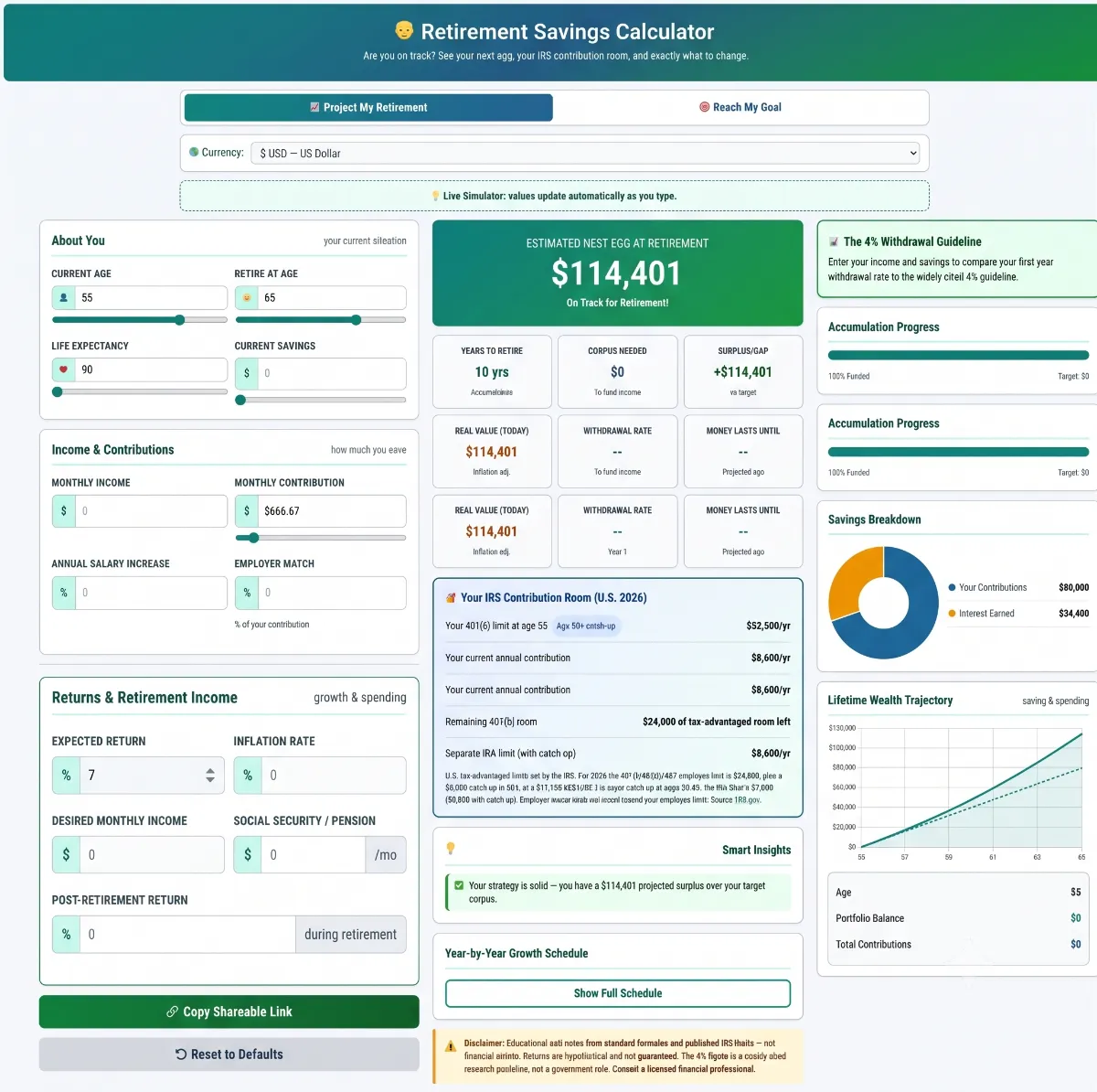
📈 Project the Catch-Up Difference: Two SaveXpert Calculators
I ran an $8,000 annual catch-up scenario through the Retirement Saving Calculator to model what consistent catch-up contributions represent over a 10-year remaining working window versus the base deferral alone. The Compound Interest Calculator is useful for a different comparison: modelling $8,000 versus $11,250 annually over a 5–15 year period to see what the $3,250 super catch-up difference produces in compounded growth across the four-year window.
Educational note: These calculators model scenarios for informational purposes only. Source: IRS Notice 2025-67
What the Research Consistently Shows About Catch-Up Planning
Patterns from the IRS data and SECURE 2.0 guidance
The super catch-up creates more capacity meaningfully — but only for four years.
The research brief treats ages 60–63 as a defined window, not a permanent upgrade. At $3,250 more per year than the standard catch-up, the four-year window represents up to $13,000 in additional tax-advantaged capacity (at 2026 confirmed rates) that isn’t available before 60 or after 63. Workers in that window who aren’t using the full $11,250 are leaving the most significant age-specific retirement savings capacity unused.
The Roth rule isn’t expiring — it’s structural.
SECURE 2.0 Section 603 established mandatory Roth treatment for high earners as a permanent feature of the post-2026 framework, not a temporary provision. Workers building multi-year catch-up strategies should factor in that the upfront tax cost of Roth catch-up contributions is a permanent feature of their retirement planning above the FICA wage threshold — not a one-year adjustment.
The IRS notification system is announcement-based, not personal.
The research brief flags a common misconception: workers sometimes assume the IRS will notify them individually when limits change. The IRS publishes annual limit announcements via COLA notices, revenue procedures, and IRS.gov updates. Workers who want to plan around the 2027 limits need to watch for the IRS announcement — not wait for a letter.
Plan eligibility is a separate check from IRS eligibility.
Meeting the IRS age and deferral requirements doesn’t automatically create access to catch-up contributions if the specific plan document doesn’t allow them. The research brief identifies this as a frequently missed eligibility check. Most large employer plans do permit catch-up contributions, but “most” isn’t “all” — confirming with the plan administrator or reviewing the SPD is the appropriate first step.
What the data says doesn’t work
Using projected 2027 figures as binding planning inputs.
The projections ($8,000–$8,500 standard, ~$11,750 super catch-up) are analyst estimates applying COLA methodology to confirmed 2026 amounts. They’re useful for directional thinking. They’re not reliable enough to enter into HR systems as election amounts — because the IRS can produce a different result depending on the CPI movement through the year, and the $500 rounding increments don’t always produce linear outcomes.
Assuming catch-up contributions count against the Section 415(c) combined limit.
They don’t. Catch-up contributions sit outside the $72,000 annual additions cap. Workers who assume they’re constrained by the $72,000 ceiling after maxing catch-up contributions are working with a misread of the IRS framework.

Bottom Line: 5 Things to Know About 2027 401(k) Catch-Up Contributions
1. The 2027 catch-up limits are not official yet — use 2026 confirmed figures as your planning baseline:
The IRS publishes annual cost-of-living adjustments in October or November. As of September 2026, no official 2027 catch-up limits exist. Analyst projections estimate the standard catch-up at $8,000–$8,500 and the super catch-up at approximately $11,750. Use these as directional estimates, not as payroll inputs. The confirmed 2026 limits ($8,000 standard, $11,250 super catch-up) are the right numbers to work with until the official announcement.
2. Confirm that your specific 401(k) plan permits catch-up contributions before planning around them:
IRS eligibility (age 50 by year-end, access to elective deferrals) is necessary but not sufficient. The plan document must also allow catch-up contributions. Most large employer plans do, but not all — and a worker who meets both IRS requirements but whose plan doesn’t permit catch-ups can’t use them. Check with your plan administrator or review the Summary Plan Description before treating catch-up capacity as available.
3. If you’re ages 60–63, the super catch-up window is time-limited — treat it accordingly:
The $11,250 super catch-up (2026 confirmed) applies only during ages 60, 61, 62, and 63. It drops back to the standard catch-up amount in the first plan year a participant turns 64. There’s no partial-year extension. If you’re currently in the 60–63 window, this is the highest catch-up capacity you’ll have during your working years — the four-year window doesn’t come back.
4. If you earned above $150,000 in 2025 FICA wages, your 2026 catch-up contributions must go to Roth — and 2027 will use the same structure with 2026 wages as the lookback:
SECURE 2.0 Section 603 mandatory Roth catch-up treatment is a permanent feature of the post-2026 framework. For 2027 planning, the test will use 2026 FICA wages (Box 3 of your 2026 W-2). Workers building multi-year catch-up strategies need to factor the upfront tax cost of Roth treatment into their planning in both years — and check the lookback wage figure fresh each year, since the applicable threshold may adjust for COLA alongside the contribution limits.
5. Catch-up contributions are excluded from the Section 415(c) combined limit — they’re genuinely additive, not a reallocation:
The $72,000 combined employer-plus-employee annual additions limit does not include catch-up contributions. Workers ages 60–63 who receive maximum employer contributions can contribute the full $11,250 super catch-up on top of the $72,000 base, reaching $83,250 combined. This means planning around both limits simultaneously produces a different ceiling than assuming catch-ups are counted within the $72,000 cap.
“What the research makes clear — but most forward-planning articles don’t flag — is that the 2027 catch-up figures circulating right now are projections from third-party analysts, not IRS announcements. The IRS publishes cost-of-living adjustments for the following year in October or November — until that notice drops, the $8,000–$8,500 range for the standard catch-up and the ~$11,750 projection for the super catch-up are useful planning estimates, but not the official limits. Anyone structuring 2027 payroll elections around a projected figure should build in flexibility until the IRS confirms the number — because projections can change, and plan administrators need the official figure before processing.”
— Kevin Brown, Lead Researcher at SaveXpert.com
Frequently Asked Questions
Ans: The 2027 limits have not been officially announced. Current analyst projections estimate the standard catch-up at $8,000–$8,500 for eligible workers age 50 and older, and the super catch-up for ages 60–63 at approximately $11,750. These projections apply the IRS cost-of-living adjustment methodology to the confirmed 2026 limits from IRS Notice 2025-67. The IRS is expected to publish official 2027 figures in October or November 2026 — projections can change before that announcement.
Ans: According to IRS guidance, a participant qualifies when they reach age 50 by the end of the calendar year and are eligible to make elective salary deferrals under their employer’s plan. There is a third requirement the research brief specifically highlights: the plan itself must permit catch-up contributions. A worker who meets both IRS age and deferral eligibility requirements still can’t use catch-up capacity if the specific plan doesn’t allow it. Confirm with your plan administrator or review the plan’s Summary Plan Description.
Ans: Under SECURE 2.0 Act Section 603 (effective January 1, 2026), workers age 50 and older whose prior-year FICA wages from the plan’s sponsoring employer exceeded $150,000 must make all catch-up contributions as Roth. Pre-tax catch-up contributions are no longer available to workers above that threshold. The test uses 2025 FICA wages (Box 3 of the 2025 W-2) for 2026 plan-year treatment. For 2027, the test will use 2026 FICA wages — the same prior-year lookback structure applies each year.
Ans: The super catch-up provides workers ages 60 through 63 with a higher catch-up limit than the standard amount — set at 150% of the standard catch-up by SECURE 2.0. For 2026 (confirmed), the super catch-up is $11,250 versus the $8,000 standard catch-up, a $3,250 difference. The window covers exactly four years: ages 60, 61, 62, and 63. After age 63, the catch-up drops back to the standard limit. For 2027, analysts project the super catch-up at approximately $11,750 — but that figure is not yet officially confirmed by the IRS.
Ans: Catch-up contributions don’t count toward the regular elective deferral limit ($24,500 in 2026) — they’re additional contributions available after that limit is reached. They’re also excluded from the Section 415(c) combined annual additions limit ($72,000 in 2026). This means eligible workers ages 60–63 can receive up to $72,000 in regular combined contributions and still contribute an additional $11,250 in super catch-up contributions on top, for a possible total of $83,250 — because the catch-up exclusion from the §415(c) cap is genuine additional savings room, not a reallocation within the cap.
Ans: The IRS typically announces annual cost-of-living adjustments for retirement plan contribution limits in October or November of the preceding year. For 2027 limits, the announcement is expected in October or November 2026. The official figures come through an IRS Notice and are published at the IRS COLA Contribution Limits page. Any figures published before that announcement — including the analyst projections cited in this article — are estimates subject to change when the official notice is released.