
ⓘ Educational Disclosure:
This article is for educational and informational purposes only. It does not constitute financial, legal, tax, lending, or investment advice. SaveXpert and its authors are not licensed financial advisors, CPAs, attorneys, or tax advisors. All data comes from publicly available government and institutional sources. Always consult a qualified professional before making investment decisions.
What are the most important year-end 401(k) moves for 2026? According to IRS Notice 2025-67, the most important moves involve adjusting Q4 payroll deferrals to reach the applicable 2026 limit before December 31. The 2026 employee deferral limits are: $24,500 for workers under 50; $32,500 for ages 50–59 and 64+; and $35,750 for ages 60–63 under the SECURE 2.0 super catch-up. A separate rule takes effect January 1, 2026: workers age 50 and older whose 2025 FICA wages exceeded $150,000 must now make catch-up contributions as Roth under SECURE 2.0 Section 603. Unused contribution room expires permanently on December 31 and cannot carry forward.
Key Takeaways
- Problem: Many workers reach December with unused 401(k) contribution room because they treat the December 31 payroll deadline like the flexible April IRA deadline — or don’t check their contribution rate until it’s too late to adjust payroll.
- Solution: A Q4 payroll deferral review against your applicable 2026 limit closes the gap. Workers under 50: $24,500. Ages 50–59 and 64+: $32,500. Ages 60–63: $35,750 under the SECURE 2.0 super catch-up. The limits expire permanently on December 31 — unused room doesn’t carry forward.
- Result: Workers ages 50 and older with 2025 FICA wages above $150,000 also face a new mandatory Roth catch-up requirement starting January 1, 2026 under SECURE 2.0 Section 603 — a rule the IRS confirmed in Notice 2025-67 that most affected workers don’t know applies to them until Q4 payroll changes surface it.
- Source: IRS 2026 Contribution Limits · IRS Notice 2025-67
- Time To Read: 7 Minutes
Table of Contents
1. The Hard Date That Separates 401(k) Planning from IRA Planning
2. The 2026 401(k) Contribution Limits by Age Group
3. The Ages 60–63 Super Catch-Up: A Four-Year Window That Closes
4. The 2026 Roth Catch-Up Rule That Changes the Math for High Earners
5. How to Find Your Contribution Gap Before December 31
6. Why Your Plan’s Compensation Definition Can Change the Number
7. Employer Match Rules and What Q4 Payroll Changes Can Affect
8. What the IRS Data Consistently Shows
The 2026 employee 401(k) deferral limit is $24,500. Workers ages 60 through 63 can reach $35,750 under the super catch-up provision in IRS Notice 2025-67. Both figures expire permanently on December 31, 2026. Unlike an IRA — which allows contributions until tax filing day — employee 401(k) deferrals must be processed through your employer’s payroll system before the calendar year closes. A Q4 payroll review is the only mechanism for closing the gap between where you are and where the IRS allows you to be.
The Hard Date That Separates 401(k) Planning from IRA Planning
The research identifies one misconception as the most common cause of missed year-end contribution capacity: treating the 401(k) like an IRA.
| Account Type | 2026 Contribution Deadline | How Contributions Are Made |
|---|---|---|
| 401(k) — employee deferrals | December 31, 2026 (hard cutoff) | Must process through employer payroll during the calendar year |
| Traditional or Roth IRA | April 15, 2027 (tax day) | Direct contribution — can be made anytime up to the tax filing deadline |
| 401(k) — employer contributions | Varies by plan (can be after December 31) | Employer controls timing under separate plan rules |
Source: IRS 2026 Contribution Limits · IRS Retirement Plans FAQ
The consequence is specific: a worker who reaches December 15 without reviewing their year-to-date contributions may have too few pay periods remaining to close a large contribution gap. Two weeks of payroll may not be enough to process a significant deferral increase, depending on the employer’s payroll system and cut-off dates for election changes.
The IRS data doesn’t distinguish “close” from “missed.” Contributions that don’t process by December 31 don’t count. That’s why reviewing contribution rates in October and November — not December 31 — is the approach the research supports.

The 2026 401(k) Contribution Limits by Age Group
The IRS raised the regular 401(k) employee deferral limit from $23,500 in 2025 to $24,500 for 2026. Catch-up contribution amounts depend on which age group applies.
| Age Group | Employee Deferral Limit | Catch-Up Amount | Combined (Employee + Employer) |
|---|---|---|---|
| Under 50 | $24,500 | None | Up to $72,000 total |
| Ages 50–59 | $32,500 | $8,000 standard catch-up | Up to $80,000 total |
| Ages 60–63 | $35,750 | $11,250 super catch-up | Up to $83,250 total |
| Age 64+ | $32,500 | $8,000 standard catch-up | Up to $80,000 total |
Source: IRS Notice 2025-67 (published November 13, 2025) · IRS COLA Contribution Limits
The combined employer-plus-employee limits reflect the Section 415(c) annual additions cap. Catch-up contributions sit outside the 415(c) calculation — they’re added on top, not included within the $72,000 base figure.
The practical planning point: the employee deferral limit is the only portion a worker controls directly through payroll. The combined limit represents the maximum available from all sources to a single participant’s plan account in one year. Reviewing and adjusting your payroll deferral percentage is the only mechanism for closing the gap on the employee side.
The Ages 60–63 Super Catch-Up: A Four-Year Window That Closes
The SECURE 2.0 super catch-up for workers ages 60 through 63 creates a four-year window — for workers currently in that age range, it’s available now but doesn’t remain indefinitely.
In 2026, the super catch-up amount is $11,250, compared to the $8,000 standard catch-up for eligible workers age 50 and older. That $3,250 difference represents additional tax-advantaged capacity available only during ages 60, 61, 62, and 63.
⚠️ Turning 64 before December 31, 2026 ends the super catch-up: The research brief specifically identifies this as a planning checkpoint. A worker who turns 64 in 2026 drops back to the $8,000 standard catch-up — the $11,250 window closes when age 63 ends. If you’re currently 63 and turn 64 before the end of the year, verify which catch-up limit applies to your remaining 2026 pay periods.
For workers currently in the 60–63 window who haven’t maximised contributions this year, the Q4 payroll review is the mechanism to capture the remaining super catch-up capacity. The window doesn’t come back — workers who turn 64 move permanently to the $8,000 standard catch-up.
Estimate your future nest egg from your current savings.
The 2026 Roth Catch-Up Rule That Changes the Math for High Earners
This is the most consequential change for many high earners in 2026, and the research brief identifies it as something many affected workers don’t know applies to them until a Q4 payroll change surfaces it.
Starting January 1, 2026, under SECURE 2.0 Section 603, workers age 50 or older whose prior-year FICA wages exceeded $150,000 must make all catch-up contributions as Roth contributions. Pre-tax catch-up contributions are no longer available to workers above that threshold.
The 2025 wage lookback — why current income isn’t the test
| Factor | What the Rule Uses | Why It Matters |
|---|---|---|
| Wage test for 2026 catch-up treatment | 2025 FICA wages (Box 3 of 2025 W-2) | Current 2026 salary doesn’t determine the rule — prior year wages do |
| Threshold | $150,000 | Workers above this in 2025 face mandatory Roth treatment on 2026 catch-ups |
| Plan source | The employer sponsoring the plan | FICA wages from other employers don’t count — only the sponsoring employer’s wages |
| Effect on pre-tax options | Pre-tax catch-up eliminated above threshold | High earners above the threshold can no longer choose pre-tax treatment for catch-up amounts |
Source: IRS Notice 2025-67 · SECURE 2.0 Act §603
The upfront tax impact of mandatory Roth treatment
The research brief includes an estimate from one financial planning source for context. A worker above the $150,000 threshold in the 32% federal tax bracket would pay approximately $2,560 in upfront tax on the $8,000 standard catch-up — and approximately $3,600 on the $11,250 super catch-up. These figures illustrate the after-tax cost of mandatory Roth treatment; the actual amount depends on the individual’s full tax situation and state taxes.
The upfront tax is real, even though the long-term benefit of Roth treatment (tax-free withdrawal in retirement) may offset it over time. The planning implication: workers affected by the mandatory Roth rule who want to make catch-up contributions need to budget for the additional current-year tax — and should verify their 2025 W-2 Box 3 figure before making Q4 payroll changes.
💡 Research note — the threshold didn’t change from $145,000 to $150,000: Some workers saw earlier guidance referencing $145,000. The research brief is specific: the actual 2026 threshold is $150,000 in 2025 FICA wages. Verify the figure in IRS Notice 2025-67 directly before relying on secondary sources that may reference earlier draft guidance.
How to Find Your Contribution Gap Before December 31
The research brief suggests a straightforward calculation for finding the remaining contribution gap. It doesn’t require complex projections — it’s arithmetic from three numbers on your paystub.
| Step | What to Find | Where to Find It |
|---|---|---|
| 1. Current YTD contributions | Total 401(k) employee deferrals year-to-date | Most recent pay stub or employer benefits portal |
| 2. Applicable 2026 limit | $24,500 / $32,500 / $35,750 depending on age | IRS Notice 2025-67 — confirm your age group |
| 3. Remaining gap | Limit minus YTD contributions | Simple subtraction |
| 4. Remaining pay periods | Number of paychecks before December 31 | Payroll calendar or HR department |
| 5. Required deferral increase | Remaining gap ÷ remaining pay periods | The dollar amount per paycheck needed to close the gap |
Source: IRS 2026 Contribution Limits
The example from the research brief: a worker under 50 who has contributed $19,000 by the time of the Q4 review has $5,500 remaining under the $24,500 limit. If eight pay periods remain before year-end, they need to defer approximately $688 per paycheck in addition to whatever they’re currently deferring — or increase their deferral rate to cover that amount.
This calculation doesn’t account for whether the employer’s payroll system can process the change before the cutoff date. That’s a plan-specific administrative question — the research brief recommends checking with HR or the plan administrator to confirm processing deadlines for deferral changes, which are typically several days before the final paycheck of the year.
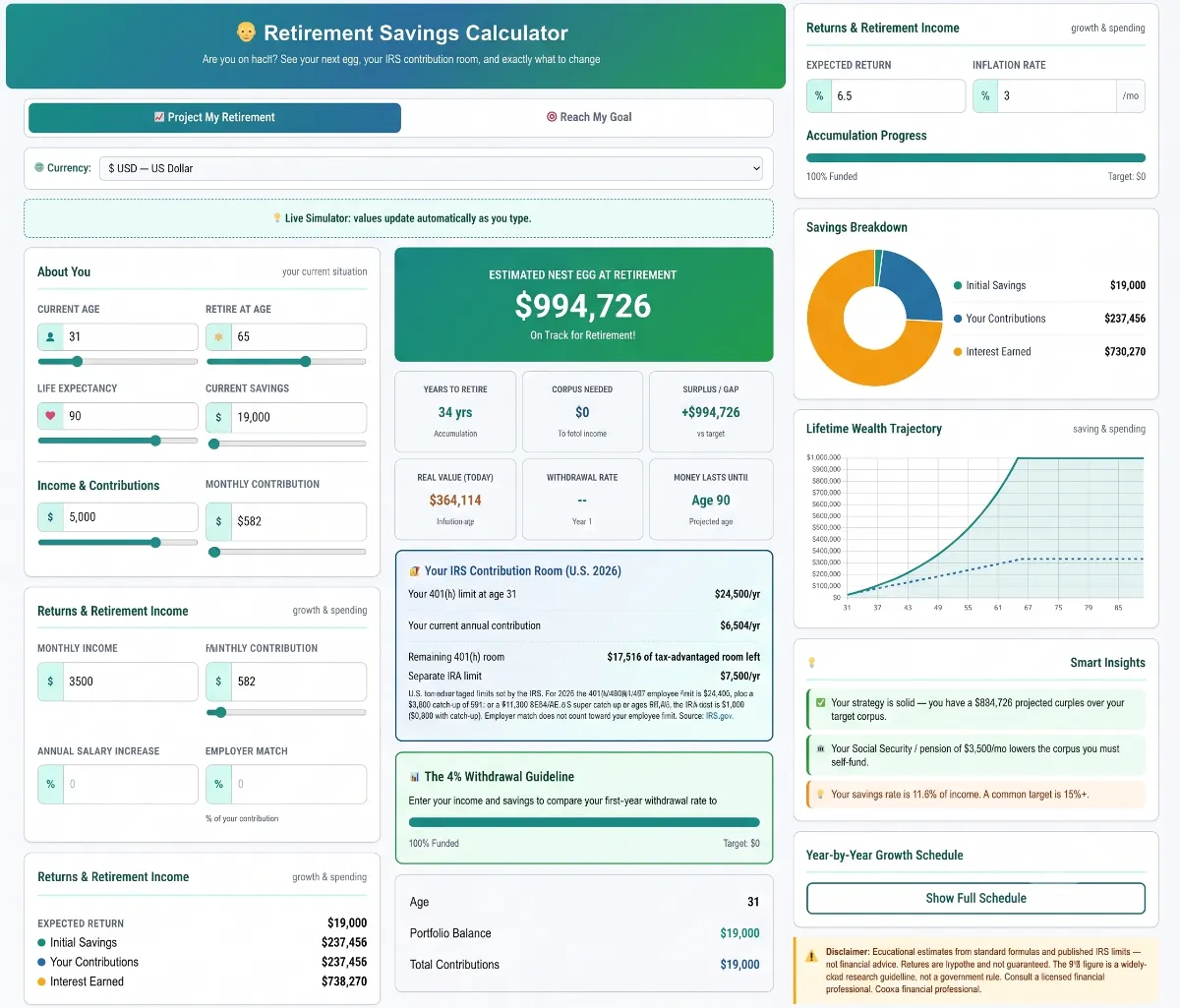
📈 Model the Gap: SaveXpert Retirement Savings Calculator
I ran the research brief’s $19,000 YTD example through the Retirement Saving Calculator using remaining contribution room ($5,500) and remaining pay periods. The useful output wasn’t a projected retirement balance — it was the per-paycheck amount required to close the gap before December 31. For workers affected by the mandatory Roth catch-up rule, the Tax Bracket Calculator separately shows the upfront tax cost of switching catch-up contributions from pre-tax to Roth treatment at different income levels.
Educational note: These calculators model scenarios for informational purposes only and do not constitute financial or tax advice. Source: IRS Notice 2025-67
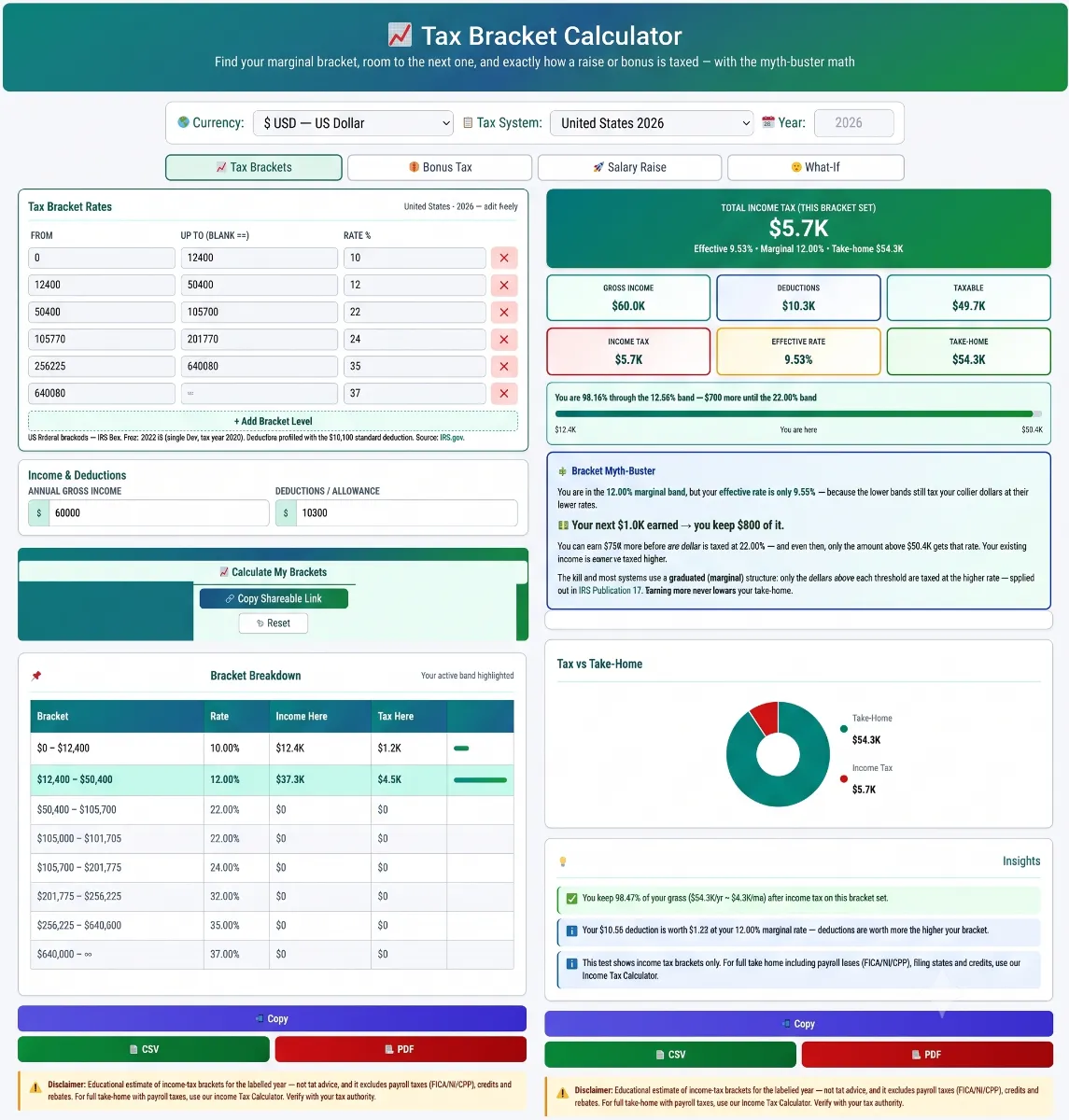
Find your marginal bracket, income tax, and take-home.
Why Your Plan’s Compensation Definition Can Change the Number
The IRS sets the overall contribution limits. Your plan document sets how compensation is defined for purposes of calculating eligible contributions and employer matching — and those two things aren’t always the same.
The research brief identifies three common compensation components that may or may not count as eligible compensation depending on plan terms:
| Compensation Component | May Count as Eligible? | Planning Implication |
|---|---|---|
| Regular salary or wages | Typically yes | Most plans use W-2 wages or a similar definition |
| Year-end bonus | Varies by plan | Some plans exclude bonus compensation from matching calculations; don’t assume a Q4 bonus raises your eligible matching base |
| Stock option income | Varies by plan | Plans may exclude option exercise income from eligible compensation |
| Fringe benefits / non-cash compensation | Often excluded | Non-cash benefits that appear in total compensation may not qualify under the plan’s definition |
Source: Research brief — plan document / HR verification recommended for individual plan terms
The practical check: if you expect a year-end bonus that might push you above a match threshold, confirm with your HR department or plan administrator that the bonus counts as eligible compensation under your specific plan’s terms before assuming it does. A bonus that appears in your total income for the year may not affect your plan’s matching calculation.

Employer Match Rules and What Q4 Payroll Changes Can Affect
The research brief highlights one specific outcome associated with not updating Q4 payroll elections: potentially missing available employer match dollars. But it’s careful about how it frames this — because employer match rules are plan-specific, not universal.
The general pattern the research identifies: a worker who reaches December without reviewing their deferral rate may fall short of the employee contribution level required to trigger the full available employer match. The employer contributes based on what the employee defers — if the employee contribution falls short of the match ceiling, the employer match falls proportionally short.
💡 Research note: The research brief doesn’t provide a universal employer match deadline or a universal formula. Plan documents control both. Some employers make matching contributions per pay period (as each employee deferral occurs); others make a year-end true-up that accounts for the full annual contribution. If your employer uses a true-up, missing a Q4 payroll update may matter less. If matching happens per period, it can’t be recaptured. Check your plan’s matching timing before assuming one approach applies.
Another detail the research brief flags: workers who leave an employer mid-year sometimes receive a pro-rated match, depending on the vesting schedule and matching formula. This is relevant for anyone considering a job change in Q4 — the timing affects both match receipt and vesting.
What the IRS Data Consistently Shows
Patterns the research identifies across the IRS data and SECURE 2.0 guidance
Q4 payroll reviews produce better contribution outcomes than year-end scrambles.
The research brief consistently shows that workers who update deferral rates during Q4 — rather than waiting until December — have more pay periods available to absorb the increase. A large deferral increase over two pay periods is harder on cash flow than a moderate increase spread over eight to ten.
Age brackets determine which limit applies — and those limits have inflection points.
The IRS limits aren’t one-size-fits-all. Workers ages 60–63 operate under a different limit than workers 50–59 or 64+. Workers turning 60 in 2026 enter the super catch-up window. Workers turning 64 in 2026 exit it. The applicable limit for the current year depends on the age reached during 2026 — not just the age at year-end.
The Roth catch-up threshold is a 2025 wage question, not a 2026 income question.
The mandatory Roth treatment for 2026 catch-up contributions uses 2025 FICA wages as the trigger. Reviewing last year’s W-2 Box 3 is the appropriate first step before making Q4 catch-up changes — not estimating current-year income.
RMD rules add another retirement planning checkpoint in Q4 for different workers.
The research brief notes that required minimum distributions currently begin at age 73 under SECURE 2.0, increasing to age 75 in 2033. RMDs don’t affect the contribution limit analysis — but they remind us that age is a recurring variable across retirement planning decisions, not just the catch-up determination.
What the data says doesn’t work
Waiting until December to review contribution rates.
The December 31 payroll cutoff is the deadline — not the starting point. Reviewing in October or November gives more pay periods to spread an increase and allows time to confirm processing deadlines with HR.
Assuming the IRA deadline applies to 401(k) deferrals.
The research brief identifies this as the most common conceptual error. Employee 401(k) deferrals must process through payroll during the calendar year. There is no April equivalent for the employee deferral side of a 401(k).
Counting on year-end bonus compensation to affect matching without verifying plan terms.
The plan document controls what counts as eligible compensation. Bonuses that appear in total income may not count under the plan’s matching formula.

Bottom Line: 5 Year-End 401(k) Steps Before December 31
1. Find your contribution gap now — not in December:
Pull your year-to-date 401(k) contribution from your most recent paystub and subtract it from your applicable 2026 limit ($24,500 / $32,500 / $35,750 by age group). Divide the remainder by your remaining pay periods before December 31 to find the per-paycheck deferral increase needed to close the gap. Confirm with HR what the processing deadline is for deferral changes — it’s typically several days before the final paycheck, not December 31 itself.
2. If you’re ages 60–63, confirm you’re using the $11,250 super catch-up — and check your birthday:
The super catch-up window covers ages 60, 61, 62, and 63. Workers turning 64 before December 31, 2026 lose access to the $11,250 limit and drop back to the $8,000 standard catch-up. If you turn 64 during 2026, verify which limit applies to your remaining pay periods. The four-year window doesn’t restart once it closes.
3. If you’re age 50 or older, check your 2025 W-2 Box 3 before making Q4 catch-up changes:
The mandatory Roth catch-up rule under SECURE 2.0 Section 603 uses 2025 FICA wages — not 2026 income — as the $150,000 threshold test. Workers above that 2025 figure must route 2026 catch-up contributions to Roth, eliminating the pre-tax option. Reviewing last year’s W-2 before adjusting your Q4 deferral rate prevents unexpected withholding gaps and confirms which treatment applies. Run the Tax Bracket Calculator to estimate the upfront tax cost of Roth treatment at your bracket.
4. Verify your plan’s compensation definition before counting on a year-end bonus to affect employer match:
Bonuses, stock option income, and fringe benefits may not count as eligible compensation under your specific plan’s matching formula. Check your plan document or ask HR whether Q4 bonus income raises your match-eligible compensation — don’t assume it does based on how it affects your total annual income.
5. Run your remaining contribution gap through the Retirement Saving Calculator — and remember that December 31 is a hard cutoff with no IRA-style extension:
Unlike IRA contributions (which can be made until tax day), employee 401(k) deferrals must process through payroll before the calendar year closes. Unused contribution room expires permanently — it doesn’t carry forward to 2027. The Retirement Saving Calculator converts the remaining gap into a per-paycheck number; that’s the figure to take to your employer’s payroll system.
“When I went through IRS Notice 2025-67 and the SECURE 2.0 Section 603 documentation, the finding that most changed how I read year-end 401(k) planning advice was the 2025 FICA wage lookback. The mandatory Roth catch-up rule uses Box 3 of the prior year’s W-2 — not current-year income. A worker whose income drops in 2026 can still face mandatory Roth treatment if 2025 wages cleared $150,000. And conversely, someone whose 2026 income exceeds $150,000 for the first time may be fine for pre-tax catch-ups this year — because the test uses 2025. That timing detail changes Q4 payroll decisions in both directions.”
— Kevin Brown, Lead Researcher at SaveXpert.com
Frequently Asked Questions
Ans: According to IRS Notice 2025-67, the most important moves involve adjusting Q4 payroll deferrals before the December 31 cutoff. Review your year-to-date contributions against your applicable limit ($24,500 under 50; $32,500 for ages 50–59 and 64+; $35,750 for ages 60–63). Workers age 50 and older should also check their 2025 FICA wages against the $150,000 Roth catch-up threshold. Unused contribution room expires permanently on December 31 — it cannot carry forward.
Ans: The IRS establishes December 31, 2026 as the hard deadline for employee 401(k) payroll deferrals. Unlike IRAs — which allow contributions until the tax filing deadline in April — employee 401(k) deferrals must process through the employer’s payroll system within the calendar year to count toward 2026 limits. Employer contributions can follow different timing rules. In practice, the effective deadline for requesting a deferral change is several days before the final paycheck of the year — confirm the processing cutoff with your HR department.
Ans: If your year-to-date contributions are below your applicable 2026 limit and you have remaining pay periods before December 31, increasing your deferral rate can close that gap. The research brief identifies Q4 deferral reviews as the most reliable approach to reaching the annual limit. The useful question isn’t whether to increase — it’s how much to increase to close the specific remaining gap across the specific remaining pay periods. The Retirement Saving Calculator converts those two figures into a per-paycheck deferral number.
Ans: Compare your current year-to-date contribution (from your most recent paystub or your employer’s benefits portal) against your applicable 2026 limit. Subtract to find the remaining gap. Divide the gap by your remaining pay periods before December 31 to find the per-paycheck increase needed. Cross-reference that amount with your employer’s payroll processing deadline for deferral changes — elections often need to be submitted several business days before the final paycheck, not on December 31.
Ans: Per IRS rules, unused employee 401(k) contribution room expires permanently at the end of the plan year — December 31, 2026. Unlike IRA contribution limits (which can be used up to the April tax filing deadline), 401(k) employee deferrals can only count for 2026 if they process through payroll before December 31. The 2027 limits will be separate figures, announced by the IRS later; the 2026 amounts cannot be retroactively applied to 2027.
Ans: According to IRS Notice 2025-67, the 2026 combined employer-plus-employee Section 415(c) annual additions limit is $72,000. Catch-up contributions sit outside the 415(c) calculation and are added on top: with the $8,000 standard catch-up (ages 50–59 and 64+), the combined total can reach $80,000. Workers ages 60–63 using the $11,250 super catch-up can reach $83,250 combined. These totals include both employee elective deferrals and employer matching and profit-sharing contributions to the same plan account.