
ⓘ Educational Disclosure:
This article is for educational and informational purposes only. It does not constitute financial, legal, tax, lending, or investment advice. SaveXpert and its authors are not licensed financial advisors, CPAs, attorneys, or tax advisors. All data comes from publicly available government and institutional sources. Always consult a qualified professional before making investment decisions.
What are the IRA catch-up contribution limits for 2027? The 2027 IRA catch-up limits have not yet been announced by the IRS (as of September 2026). The confirmed 2026 figures are: a $1,100 catch-up contribution for savers age 50 and older, bringing the total annual IRA maximum to $8,600 (regular limit + catch-up, combined across all IRA accounts). SECURE 2.0 established inflation indexing for the IRA catch-up, so 2027 may bring another adjustment — but the official figure won’t be confirmed until the IRS publishes its annual COLA notice, typically in October or November 2026. One key point: the mandatory Roth catch-up rule under SECURE 2.0 applies to workplace plans only. It does not affect IRA catch-up contributions. Source: IRS Publication 590-B
Key Takeaways
- Problem: Americans over 50 planning retirement savings for 2027 face a timing gap — the IRS hasn’t announced official 2027 IRA limits yet, while planning decisions often happen well ahead of the new year.
- Solution: The confirmed 2026 IRA limits are the right planning baseline: a $1,100 catch-up contribution for savers age 50 and older, bringing the total annual IRA contribution ceiling to $8,600. SECURE 2.0 now indexes the catch-up amount to inflation — meaning the 2027 figure may adjust when the IRS publishes its annual cost-of-living notice in October or November 2026.
- Result: The structural rules that govern IRA catch-ups — who qualifies, what the combined limit covers, the April deadline advantage, and what the SECURE 2.0 mandatory Roth rule does and does not affect — are already confirmed and carry into 2027 unchanged in structure.
- Source: IRS Publication 590-B · IRS COLA Contribution Limits
- Time To Read: 6 Minutes
Table of Contents
1. The 2027 IRA Catch-Up Limit Is Not Yet Official
2. What the 2026 $1,100 IRA Catch-Up Limit Means
3. How IRA Catch-Up Contributions Work in Practice
4. IRA Catch-Up vs. 401(k) Catch-Up: Key Differences
5. Traditional vs. Roth IRA: Does the Catch-Up Work the Same?
6. The IRA Deadline: One Key Advantage Over 401(k) Plans
7. What the IRS Data Shows About Catch-Up Planning
8. Bottom Line: 5 Things to Know About IRA Catch-Up Contributions
The 2026 IRA catch-up contribution limit increased to $1,100 — the first time it moved above the $1,000 fixed amount that had held unchanged for over a decade. That change came from SECURE 2.0’s inflation indexing requirement, which ties future IRA catch-up adjustments to the Consumer Price Index rather than leaving them at a static figure. For 2027, the IRS has not yet published official limits. What’s already confirmed is the framework: one flat catch-up amount for all eligible savers age 50 and older, a combined ceiling across all IRA accounts, and a filing-season deadline that gives IRA contributors significantly more flexibility than their 401(k) counterparts.
The 2027 IRA Catch-Up Limit Is Not Yet Official
The same planning context that applies to 401(k) catch-up projections applies here: the IRS has not announced official 2027 IRA contribution limits as of September 2026. The annual COLA notice typically drops in October or November of the preceding year. Any 2027 figures in circulation right now are analyst projections, not confirmed IRS amounts.
⚠️ 2027 IRA figures are not yet official: The table below shows confirmed 2026 limits and the trajectory established by SECURE 2.0 indexing. The 2027 column shows the adjustment is possible — not confirmed. Wait for the IRS COLA notice (expected October–November 2026) before treating any projected 2027 amount as a planning target.
| IRA Limit | 2025 (Confirmed) | 2026 (Confirmed) | 2027 (Not Yet Announced) |
|---|---|---|---|
| Regular contribution limit (all ages) | $7,000 | $7,500 | Not yet announced |
| Catch-up contribution (age 50+) | $1,000 | $1,100 | Not yet announced; possible COLA adjustment |
| Total limit for age 50+ (regular + catch-up) | $8,000 | $8,600 | Not yet announced |
| Catch-up indexing method | Fixed (no COLA) | Inflation-indexed (SECURE 2.0) | Same indexing applies |
Source: IRS COLA Contribution Limits · IRS Publication 590-B
⚠️ Data flag — verify the regular 2026 IRA limit ($7,500): The research brief reports the 2026 regular IRA contribution limit as $7,500 and the catch-up as $1,100, for a combined $8,600. The $1,100 catch-up figure is widely confirmed across SECURE 2.0 sources. The regular limit increase from $7,000 (2025) to $7,500 (2026) is consistent with IRS Notice 2025-67 COLA methodology but should be verified at IRS.gov before publishing, as IRS adjustments are rounded to $500 increments and depend on CPI movement through late 2025.
The structural significance of SECURE 2.0’s inflation indexing is what makes the 2027 trajectory plannable even without official figures. Before SECURE 2.0, the IRA catch-up was fixed at $1,000 indefinitely — it required an Act of Congress to move. Now it follows the same COLA mechanism as other retirement plan limits, adjusted in $100 increments when inflation warrants. The 2026 move from $1,000 to $1,100 was the first product of that indexing.

What the 2026 $1,100 IRA Catch-Up Limit Means
The $1,100 catch-up is not a standalone contribution — it’s additional room that becomes available after meeting standard eligibility conditions. Here’s the complete picture for 2026.
| Saver Age Group | Regular Annual Limit | Catch-Up Amount | Total Annual IRA Limit |
|---|---|---|---|
| Under age 50 | $7,500 | None | $7,500 |
| Age 50 and older | $7,500 | $1,100 | $8,600 |
Source: IRS Publication 590-B · IRS COLA Limits
The $1,100 difference between the under-50 ceiling ($7,500) and the over-50 ceiling ($8,600) is the catch-up contribution — the additional room Congress created to help workers closer to retirement close savings gaps. For a saver who starts maxing their IRA at age 50 and does so consistently until retirement at 67, that extra $1,100 per year represents $18,700 in additional principal contributions alone, before any investment growth.
The catch-up amount is the same regardless of whether the saver is 50, 60, or 75. Unlike the 401(k) system — which created a separate, higher super catch-up for ages 60–63 under SECURE 2.0 — the IRA framework uses one flat catch-up amount for everyone 50 and older.
How IRA Catch-Up Contributions Work in Practice
The combined-limit rule across all IRA accounts
The $8,600 total (regular + catch-up) is a combined limit across all of your IRA accounts — not a per-account allowance. A saver who holds both a Traditional IRA and a Roth IRA can split contributions between them in any proportion, but the total across both accounts cannot exceed $8,600 in 2026.
| Example Split | Traditional IRA | Roth IRA | Total | Within 2026 Limit? |
|---|---|---|---|---|
| Max Roth only | $0 | $8,600 | $8,600 | ✅ Yes (if income eligible) |
| Split evenly | $4,300 | $4,300 | $8,600 | ✅ Yes |
| Max Traditional only | $8,600 | $0 | $8,600 | ✅ Yes |
| Max both separately | $8,600 | $8,600 | $17,200 | ❌ No — excess contribution |
Source: IRS Publication 590-B
⚠️ Excess contributions carry a 6% annual penalty: Contributions that push the total across all IRAs above the applicable limit ($8,600 for age 50+ in 2026) are subject to a 6% excise tax each year until the excess is withdrawn. The penalty applies per year the excess remains — it doesn’t resolve itself automatically. IRS Publication 590-B covers the correction process.
Eligibility requirements
The IRS sets two core eligibility requirements for IRA catch-up contributions: the saver must reach age 50 by December 31 of the contribution year, and must have taxable compensation (earned income) at least equal to the contribution amount. Roth IRA contributions also carry income limits — above certain modified adjusted gross income (MAGI) thresholds, Roth eligibility phases out or disappears entirely. Traditional IRA contributions are available to anyone with earned income, though deductibility depends on income and workplace plan access.
The catch-up amount itself ($1,100) applies identically whether contributions go to a Traditional IRA or a Roth IRA. Income limits don’t affect the catch-up amount — they affect whether a Roth contribution is allowed at all, or whether a Traditional contribution is deductible. The amount you can contribute and the tax treatment of that contribution are two different questions.
IRA Catch-Up vs. 401(k) Catch-Up: Key Differences
Workers who have access to both an IRA and a workplace 401(k) plan can contribute to both simultaneously — IRA limits and 401(k) limits are separate. But the catch-up structures are meaningfully different.
| Feature | IRA Catch-Up (2026) | 401(k) Catch-Up (2026) |
|---|---|---|
| Catch-up amount (standard) | $1,100 | $8,000 (ages 50–59 and 64+) |
| Enhanced catch-up for ages 60–63 | None — flat $1,100 for all ages 50+ | $11,250 (SECURE 2.0 super catch-up) |
| Mandatory Roth treatment for high earners | Does NOT apply to IRAs | Applies — workers with 2025 FICA wages above $150,000 must use Roth for catch-ups |
| Contribution deadline | Tax filing deadline — April 2027 for 2026 contributions | December 31 hard cutoff — must process through payroll within calendar year |
| Inflation indexing | Yes (SECURE 2.0) — adjusted in $100 increments | Yes — adjusted in $500 increments |
| Who controls contributions | Individual — direct deposit to IRA custodian | Employer payroll system — employee sets deferral rate |
| Can you use both simultaneously? | Yes — limits are separate and independent | |
Source: IRS Publication 590-B · IRS Notice 2025-67
The mandatory Roth catch-up rule deserves a clear statement: it applies only to workplace plans (401(k), 403(b)). Workers age 50 and older whose prior-year FICA wages exceeded $150,000 must direct 401(k) catch-up contributions to Roth — but that rule has no effect on their IRA contributions. Someone above the $150,000 threshold can still make a traditional pre-tax IRA contribution (subject to deductibility rules) alongside their mandatory Roth 401(k) catch-up. The two accounts operate under completely separate frameworks.
Estimate your future nest egg from your current savings.

Traditional vs. Roth IRA: Does the Catch-Up Work the Same?
According to IRS Publication 590-B, the $1,100 catch-up allowance applies identically to both Traditional and Roth IRAs. The amount you can catch up doesn’t change based on which account type you choose. What changes is the tax treatment.
| Feature | Traditional IRA Catch-Up | Roth IRA Catch-Up |
|---|---|---|
| Catch-up amount (2026) | $1,100 | $1,100 |
| Tax treatment of contributions | Pre-tax (deductible, if eligible) — reduces taxable income now | After-tax — no current deduction |
| Tax treatment of withdrawals in retirement | Taxable as ordinary income | Tax-free (if qualified distribution) |
| Income limits on contributions | No income limit on contributions; deductibility phases out at higher incomes with workplace plan access | Contributions phase out above MAGI thresholds ($150,000–$165,000 single; $236,000–$246,000 MFJ in 2026 — verify at IRS.gov) |
| Required minimum distributions | RMDs required starting at age 73 (age 75 from 2033) | No RMDs during the owner’s lifetime |
Source: IRS Publication 590-B · IRS COLA Limits
The research brief finds no government outcome study demonstrating that one IRA type consistently outperforms the other for every saver. The right choice between Traditional and Roth depends on current tax rates versus expected retirement tax rates, RMD planning needs, and income eligibility — variables that are specific to each individual. What the IRS data confirms is that the catch-up amount is the same either way.
The IRA Deadline: One Key Advantage Over 401(k) Plans
This is the most practical planning advantage IRA contributions carry over 401(k) employee deferrals, and it’s often understated.
| Account Type | Contribution Deadline for 2026 Tax Year | Extension Available? |
|---|---|---|
| 401(k) employee deferrals | December 31, 2026 — must process through payroll | No — hard cutoff; unused room expires permanently |
| IRA contributions (Traditional and Roth) | Tax filing deadline — April 15, 2027 (or later with extension) | No extension for IRA contributions, but a filing extension does not affect the April 15 IRA deadline |
Source: IRS Publication 590-B · IRS Retirement Plans FAQ
The practical difference is nearly four months. A 401(k) employee deferral that doesn’t process through payroll by December 31 is gone — the contribution room expires with the calendar year. An IRA contribution for the 2026 tax year can be made any time up to April 15, 2027. A worker who reaches January 2027 and realises they didn’t maximise their 2026 IRA can still fix it. The same worker can’t retroactively adjust their 2026 401(k) deferral.
Similarly, 2027 IRA contributions can be made any time from January 1, 2027 through April 15, 2028. That means a worker contributing to their IRA in early 2028 might be deciding between 2027 and 2028 tax years — an important consideration to track at the custodian level.
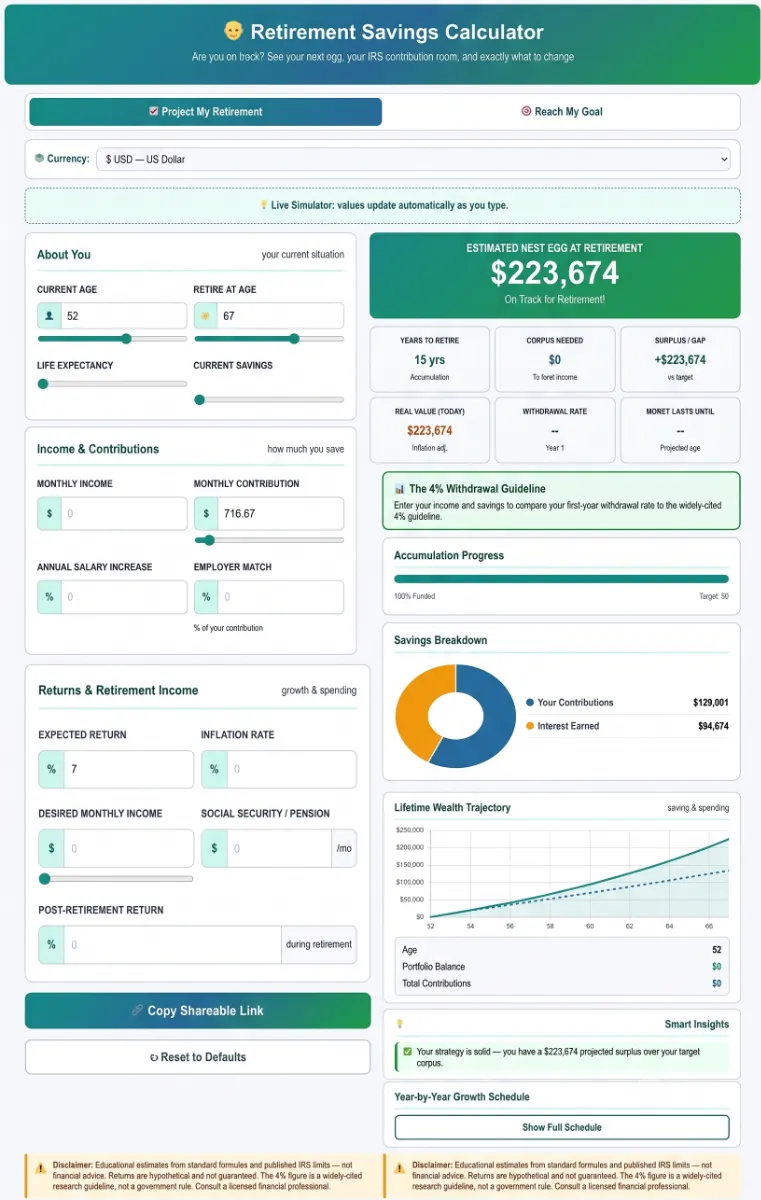
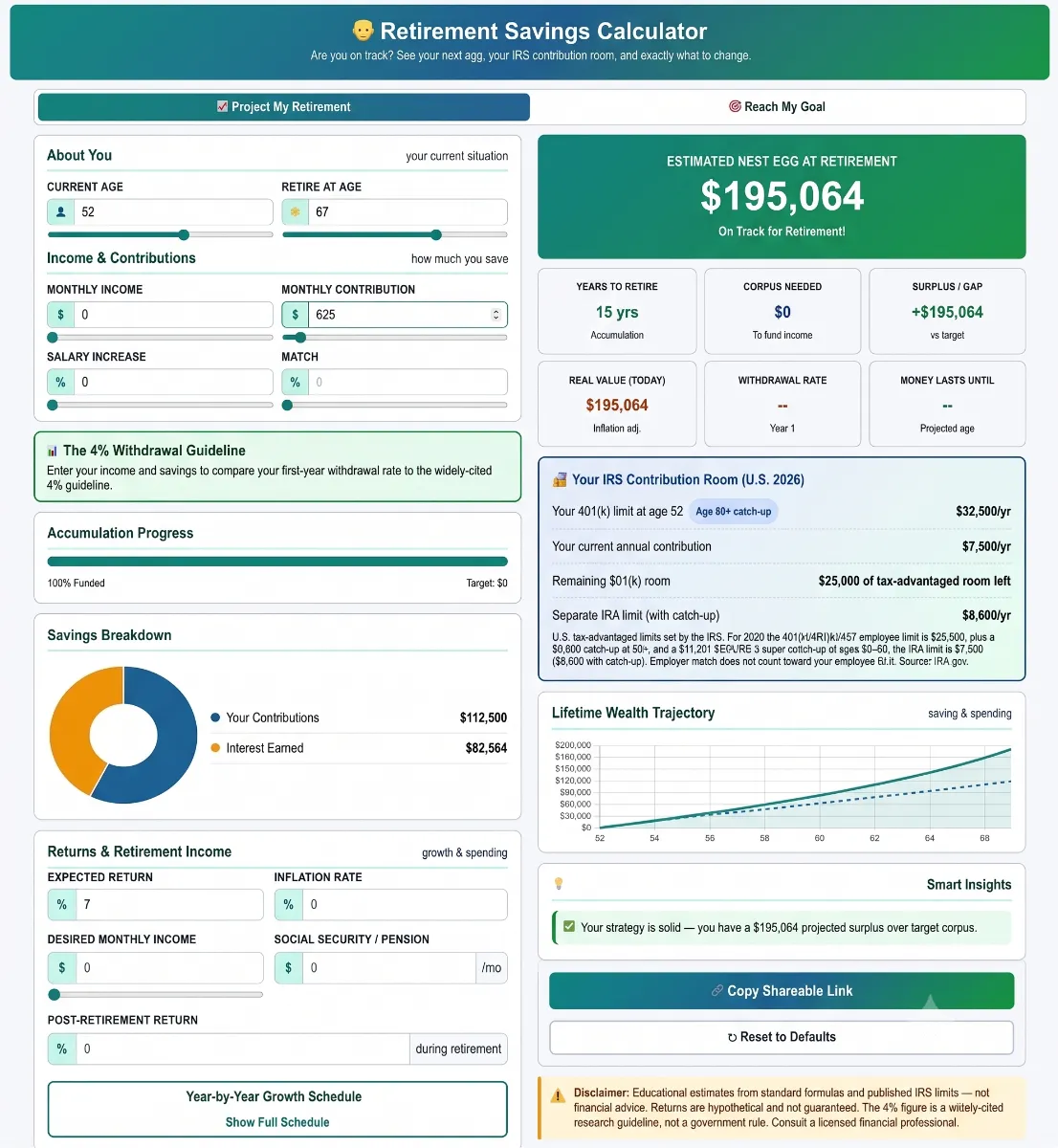
📈 Model the $1,100 Difference: SaveXpert Retirement Savings Calculator
I ran an $8,600 per year scenario (full contribution including catch-up) versus $7,500 per year (no catch-up) through the Retirement Savings Calculator over a 15-year period to a retirement age of 67. The $1,100 annual difference compounds meaningfully over time — the calculator converts that gap into a projected balance difference so you can see what consistent catch-up contributions add in dollar terms before any assumptions about investment returns.
Educational note: Calculator models scenarios for informational purposes only. Does not constitute investment advice. Source: IRS Publication 590-B
What the IRS Data Shows About Catch-Up Planning
Patterns the research confirms
SECURE 2.0’s inflation indexing changes the long-term value of IRA catch-up planning.
Before 2026, the IRA catch-up was fixed at $1,000 and required legislative action to change — it held at $1,000 for years with no movement. Inflation indexing means the $1,100 figure in 2026 can grow in future years without Congressional action. The indexing adjusts in $100 increments when CPI movement warrants it — so increases will be infrequent and incremental, but they no longer require a new law to happen.
The IRA catch-up is smaller than the 401(k) catch-up but carries different advantages.
At $1,100 versus $8,000, the IRA catch-up isn’t designed to be the primary driver of retirement savings — it’s designed to complement the 401(k) system. The IRA’s advantages lie elsewhere: individual control over investment selection, no dependence on employer plan quality or payroll processing, and the April deadline flexibility. Workers who use both accounts benefit from both systems simultaneously.
The mandatory Roth catch-up rule for high earners doesn’t touch IRAs — and that distinction matters for planning.
Workers above the $150,000 prior-year FICA wage threshold who face mandatory Roth treatment in their 401(k) catch-up can still contribute pre-tax to a Traditional IRA (subject to deductibility rules). The IRA operates as a separate avenue with its own tax treatment choices, independent of the mandatory Roth rule that governs workplace plans.
No government study in the research brief found an outcome advantage for one catch-up approach over another.
Policy design establishes what’s allowed — not what outcome any individual will experience. The research brief found no IRS, Social Security, Federal Reserve, CFPB, or BLS study measuring IRA catch-up effectiveness across populations. That’s an appropriate limitation to acknowledge: the IRS confirms the rules; individual results depend on investment choices, tax situations, and time horizons that vary by person.
What the data says to watch
The official 2027 IRA limits — not projections.
SECURE 2.0 indexing makes an adjustment possible but not guaranteed. The $100 increment requirement means 2027 may hold at $1,100 or rise to $1,200 depending on CPI movement. The IRS COLA notice in October or November 2026 is the authoritative source — projections before that announcement are estimates.
Roth IRA income limits change with COLA adjustments each year.
Roth IRA contribution eligibility phases out above MAGI thresholds that themselves adjust annually. A saver who was eligible for full Roth contributions in 2025 may find their 2026 eligibility changed. Verify current year thresholds at IRS.gov before contributing.

Bottom Line: 5 Things to Know About IRA Catch-Up Contributions
1. The 2027 IRA catch-up limit isn’t official yet — use $1,100 (2026 confirmed) as your planning baseline and watch for the IRS COLA notice:
The IRS publishes annual cost-of-living adjustments in October or November for the following year. SECURE 2.0 inflation indexing means the 2027 catch-up could stay at $1,100 or adjust upward in $100 increments. Until the official notice, the confirmed 2026 figures ($1,100 catch-up, $8,600 total for age 50+) are the right working numbers.
2. The $8,600 total limit is across all your IRAs combined — not per account:
Holding both a Traditional and Roth IRA doesn’t double your limit. The $8,600 (in 2026) is the ceiling across every IRA account you hold, in any combination. Contributing $8,600 to a Roth and an additional $8,600 to a Traditional creates an excess contribution with a 6% annual IRS penalty until corrected. Split contributions however you want — but keep the total at or under $8,600.
3. The mandatory Roth catch-up rule for high earners applies to workplace plans only — not to IRAs:
Workers age 50 and older with 2025 FICA wages above $150,000 must route 401(k) catch-up contributions to Roth under SECURE 2.0 Section 603. That rule has zero effect on their IRA contributions. The IRA operates under a completely separate framework — pre-tax Traditional IRA contributions (subject to deductibility rules) remain available regardless of the mandatory Roth catch-up requirement in the workplace plan.
4. The IRA has an April tax-filing deadline — use it if December 31 caught you short on 401(k) room:
IRA contributions for the 2026 tax year can be made until April 15, 2027. For 2027 contributions, the deadline extends to April 15, 2028. A worker who missed the December 31 payroll cutoff for 401(k) contributions can still make a 2026 IRA contribution well into 2027. The two accounts’ deadlines are independent — the 401(k) hard cutoff doesn’t close the IRA window.
5. There is no IRA super catch-up for ages 60–63 — that provision applies only to workplace plans:
SECURE 2.0 created an enhanced $11,250 super catch-up for 401(k) participants ages 60 through 63 (2026 figure). No equivalent provision exists for IRAs. All eligible IRA savers age 50 and older use the same $1,100 catch-up amount — the age-tiered system is a 401(k) feature, not an IRA feature. Workers in the 60–63 window who want the higher age-based catch-up capacity must access it through a workplace plan.
“The detail most people miss when they read IRA catch-up rules is the combined-limit constraint. The $1,100 catch-up doesn’t give you an additional $1,100 on top of a separate Roth IRA and a separate Traditional IRA — it’s $1,100 additional total, shared across every IRA you hold. Someone already contributing $7,500 to a Roth IRA and wanting to catch up can add $1,100 more, split however they want between Traditional and Roth, but the total across all accounts can’t exceed $8,600. Exceeding that number creates an excess contribution, and the IRS charges a 6% annual penalty until it’s corrected. The figure sounds straightforward until people realise it’s an across-all-accounts ceiling, not a per-account allowance.”
— Kevin Brown, Lead Researcher at SaveXpert.com
Frequently Asked Questions
Ans: The official 2027 IRA catch-up limits have not yet been announced by the IRS as of September 2026. The confirmed 2026 catch-up is $1,100 for savers age 50 and older, bringing the total annual IRA maximum to $8,600. SECURE 2.0 established inflation indexing for the IRA catch-up, so 2027 may bring a further adjustment — but the official figure won’t be confirmed until the IRS publishes its COLA notice, typically in October or November 2026. The current $1,100 figure is the right planning baseline.
Ans: The catch-up amounts are very different: $8,000 (standard) or $11,250 (super catch-up, ages 60–63) for 401(k) versus $1,100 for IRAs in 2026. They also operate under different rules. The SECURE 2.0 mandatory Roth catch-up for high earners (workers age 50+ with prior-year FICA wages above $150,000) applies only to workplace plans — it does not affect IRA contributions. IRA contributions have an April tax-filing deadline; 401(k) employee deferrals have a hard December 31 payroll cutoff. Both sets of limits are independent — contributing to one doesn’t reduce capacity in the other.
Ans: Yes, if you meet the eligibility requirements for each account. 401(k) limits and IRA limits are separate systems — funding one doesn’t reduce capacity in the other. A worker who has already contributed $35,750 (the 2026 ages 60–63 maximum) to their 401(k) can still make the full $8,600 IRA contribution (including catch-up) if they have qualifying earned income and meet any applicable IRA income requirements. The accounts run in parallel, not against each other.
Ans: IRA contributions for the 2027 tax year can generally be made until the tax filing deadline — April 15, 2028 (or the deadline for that year if it falls on a weekend or holiday). This is a meaningful advantage over 401(k) plans, where employee deferrals must be processed through payroll before December 31. When making an IRA contribution early in a new year, make sure to designate the correct tax year with the custodian — early 2028 contributions can apply to either 2027 or 2028.
Ans: The catch-up amount is identical — $1,100 in 2026 — for both Traditional and Roth IRAs. The difference is tax treatment: Traditional IRA contributions may be deductible now (depending on income and workplace plan access), with withdrawals taxed in retirement. Roth contributions are after-tax now, with qualified withdrawals tax-free in retirement. Total contributions across both account types still cannot exceed $8,600 (the combined limit for age 50+ in 2026). The catch-up doesn’t become larger or smaller based on which account type receives it.
Ans: No. The super catch-up provision — which allows workers ages 60 through 63 to contribute 150% of the standard catch-up amount in their workplace plan — applies only to employer-sponsored plans such as 401(k) and 403(b) plans. For 2026, the 401(k) super catch-up is $11,250. IRA catch-up contributions have one flat amount for all eligible workers age 50 and older: $1,100 in 2026. There is no age 60–63 enhanced tier for IRA contributions. Workers in that age window who want the higher catch-up capacity must access it through their workplace plan.