

ⓘ Educational Disclosure:
This article is for educational and informational purposes only. It does not constitute financial, legal, tax, lending, or investment advice. SaveXpert and its authors are not licensed financial advisors, CPAs, attorneys, or tax advisors. All data comes from publicly available government and institutional sources. Research findings reflect study results — individual outcomes vary based on debt type, income, household expenses, and financial decisions. Always verify current regulations at official government sources and consult a qualified professional before making debt repayment decisions. Always consult a qualified professional before making investment decisions.
How do you get out of debt on a low income? Federal Reserve and CFPB research point to three measurable approaches. First, build a small emergency buffer — Federal Reserve data links even a modest savings cushion to reduced reliance on high-cost credit. Second, use structured nonprofit credit counseling — FDIC research on 6,000+ consumers found average debt reductions of $1,762 to $3,600 within 18 months, with measurable improvements in delinquency rates. Third, review medical collections separately — CFPB research found an average 25-point credit-score increase in the first quarter after a consumer’s last medical collection disappeared. Progress can take months or years depending on debt type, income, and whether unexpected costs continue forcing new borrowing.
Key Takeaways
- Problem: Low-income households face a harder starting position for debt repayment. The Federal Reserve’s 2025 SHED report found 40% of adults earning under $50,000 couldn’t cover a $100 emergency from savings. When essential bills consume every available dollar, even a single unexpected expense can force new credit card use — erasing a month of debt progress.
- Solution: Federal Reserve data points to building a small emergency buffer before aggressively paying down balances. FDIC research on 6,000+ consumers found that nonprofit credit counseling produced average debt reductions of $1,762 to $3,600 within 18 months — with measurable improvements in delinquency rates over three years.
- Result: Structured nonprofit counseling, medical-debt review, and FDCPA rights awareness each address separate but connected parts of the low-income debt picture. The research doesn’t offer a guaranteed outcome — but it does identify the approaches linked to real measured improvements, and the risks associated with alternatives like for-profit debt settlement.
- Source: Federal Reserve 2025 SHED · FDIC Credit Counseling Research · CFPB
- Time To Read: 7 Minutes
Table of Contents
1. Start With Cash Flow: Why the Emergency Buffer Comes First
2. Nonprofit Credit Counseling Has Measurable Debt Results
3. Medical Debt Deserves a Separate Review
4. Debt Collectors Have Legal Limits — and Debt Settlement Carries Risks
5. Can Lower Interest Rates Help?
6. Use the Debt Payoff Calculator to Test the Math First
8. What Can Someone Realistically Expect?
9. Bottom Line: 5 Steps for Getting Out of Debt on a Low Income
Four in 10 adults earning under $50,000 couldn’t cover a $100 emergency from savings alone in 2025. That one Federal Reserve figure reframes the entire question of how lower-income households get out of debt. The problem isn’t usually a lack of effort. It’s a structural starting condition where essential bills — rent, food, transportation — leave little for debt payments and almost nothing for unexpected costs. When a $300 car repair forces a card purchase, it can erase an entire month of debt progress. This article focuses on what’s actually been measured: which approaches show real debt reductions, which carry documented risks, and what the Federal Reserve, CFPB, and FDIC data show about the path forward.
I reviewed the Federal Reserve, CFPB, New York Fed, FDIC, NFCC, FTC, and other sources in this research brief. My focus was on findings that show what happened to real consumers — not claims about what might work in theory.
Start With Cash Flow: Why the Emergency Buffer Comes First
The research brief’s most consistent finding about low-income debt repayment isn’t a debt strategy. It’s about the emergency savings gap — and why plugging it comes before aggressive debt payoff.
| Federal Reserve 2025 SHED Finding | Figure |
|---|---|
| Adults earning under $50,000 who couldn’t cover a $100 emergency from savings | 40% |
| Adults who could cover a $400 emergency (cash, savings, or card paid next statement) | 63% |
| Adults with three months of emergency savings in 2025 | 55% — unchanged from 2024 |
| Adults who didn’t pay all their bills during the prior month | 16% |
| Renters who fell behind on rent at some point during 2025 | 23% |
Source: Federal Reserve 2025 Economic Well-Being of US Households (SHED)
The emergency savings data also connects to borrowing behaviour. Federal Reserve research in the brief found that people who could cover a $500 emergency borrowed from friends or family only 11% of the time. Among those who couldn’t cover it, that figure was 27%. A buffer doesn’t eliminate debt — but it changes the frequency of the emergency credit-card use that keeps adding to it.
A simple example from the research brief makes this concrete. A household with $3,000 in credit card debt and $200 left after monthly bills makes every planned payment — and then a $300 car repair forces another card charge. That single event erases the month’s debt progress even though the household did everything right. The research doesn’t provide a universal formula for how to split limited cash between essentials and debt. It does show that the buffer is the variable that changes what follows.
Federal assistance programs:
The research brief mentions that programmes like SNAP, LIHEAP, and TANF can help with essential expenses — which may free cash for debt repayment. These are cited via secondary sources (InCharge) rather than direct federal agency data in the brief. Verify eligibility at benefits.gov.

Nonprofit Credit Counseling Has Measurable Debt Results
The strongest debt-payoff finding in the research brief comes from an FDIC analysis of more than 6,000 consumers. The study found statistically significant reductions in total and revolving debt among counseled consumers — with average reductions ranging from $1,762 to $3,600 within 18 months.
| Research Finding | Figure | Source |
|---|---|---|
| Average debt reduction within 18 months of counseling | $1,762 to $3,600 | FDIC research — 6,000+ consumer analysis, controlled for bankruptcies and charge-offs |
| Consumers counseled by NFCC member agencies in 2025 | 471,669 | National Foundation for Credit Counseling (NFCC) 2025 |
| Consumers enrolled in Debt Management Plans via NFCC in 2025 | 122,854 | NFCC 2025 Impact Report |
| Credit-profile improvement over 3 years (counseled consumers) | Better credit profiles; fewer 30-day and 60-day delinquencies | Federal Reserve research cited in brief |
Source: FDIC · NFCC. NFCC is a nonprofit industry body — its data reflects member-agency activity, not a government study. FDIC research reflects a specific studied population; individual outcomes vary.
The FDIC study compared counseled consumers with matched consumers who didn’t receive counseling — and controlled for bankruptcies and debt charge-offs. That methodology makes the $1,762–$3,600 figure more meaningful than a self-reported average from counseling agencies: it’s a controlled comparison of what happened to matched groups. The counseled group saw larger debt reductions.
What a Debt Management Plan (DMP) is
A DMP is a structured repayment plan facilitated by a nonprofit credit counselor. Rather than eliminating debt, a DMP consolidates unsecured debt payments into a single monthly payment at — in some cases — negotiated lower interest rates with creditors. The NFCC’s 122,854 DMP enrollments in 2025 represent real households using this approach at scale. Federal Reserve research in the brief associates DMP-connected counseling with improved delinquency outcomes over three years.
The research doesn’t say a DMP fits every household. It shows that consumers using counseling and DMP services had measurable outcomes in the cited studies. For a household with multiple unsecured debts, contacting a nonprofit counselor before committing to any other debt-relief path is the research-supported first call.
Medical Debt Deserves a Separate Review
Medical debt appears repeatedly in the research because credit-report treatment differs from ordinary revolving debt — and because a regulatory change in 2023 already altered how it affects millions of consumers.
| Medical Debt Research Finding | Figure | Source |
|---|---|---|
| Average credit-score increase in first quarter after last medical collection disappeared | 25 points | CFPB medical collections research |
| Revolving and installment credit increase 18 months after removal | +3% | CFPB research |
| Consumers whose reports were affected when credit bureaus removed sub-$500 medical collections (April 11, 2023) | 22.8 million | CFPB |
| NBER finding: medical debts $500+ predictive of future default? | Not meaningfully predictive | NBER working paper (private academic — not federal) |
Source: CFPB medical collections research · NBER working paper
⚠️ Regulatory status update — verify before relying: The CFPB issued a medical-debt rule in January 2025 that would have further restricted medical collections on credit reports. A U.S. District Court in Texas vacated that rule on July 11, 2025, finding that the CFPB exceeded its authority under the Fair Credit Reporting Act. The April 2023 sub-$500 collection removal by the three bureaus was a voluntary bureau action — separately from the vacated CFPB rule. Check the current status of medical-collection credit-reporting rules at CFPB.gov before assuming any current protection applies.
The practical implication for debt strategy: medical collections may affect your credit score and financial position differently from credit card balances. Before directing limited cash toward medical bills, pull your credit reports at AnnualCreditReport.com and check whether any medical collections already dropped off under the 2023 bureau change. A debt that no longer appears on your credit report may have different strategic priority than one still affecting your score.
Debt Collectors Have Legal Limits — and Debt Settlement Carries Risks
What the Fair Debt Collection Practices Act establishes
The Fair Debt Collection Practices Act, enforced by the FTC, prohibits abusive, unfair, and deceptive collection practices for personal, family, or household debts pursued by third-party collectors. Specific limits from the research brief:
| FDCPA Limit | What It Means |
|---|---|
| Contact timing | No calls before 8 AM or after 9 PM (local consumer time) |
| Workplace contact | Can’t contact consumers at work after being told not to |
| Contact frequency | Can’t make more than 7 calls within 7 days about a particular debt |
| What the rules do | Define limits on collection activity — they do not reduce, pause, or eliminate the underlying debt |
Source: FTC — Fair Debt Collection Practices Act · FTC Debt Collection FAQ
Understanding FDCPA rights helps manage the stress of collection contact. It doesn’t change the balance.
What the research says about for-profit debt settlement
The research brief contains a strong documented warning about for-profit debt settlement companies. A 2025 National Consumer Law Center (NCLC) analysis found:
| NCLC 2025 Finding | Result |
|---|---|
| Customers who could settle every enrolled debt | Most couldn’t — high dropout rates documented |
| Unsettled balances during the process | Grew while customers waited for settlement offers |
| Average credit-score decline within 6 months of enrollment | 161 points |
| Major credit card company participation | Most major issuers won’t deal with settlement companies |
| Fee structure | Substantial fees charged for settlements creditors might offer directly to consumers |
Source: National Consumer Law Center 2025 analysis (nonprofit consumer law organisation — not a federal agency). FTC debt-relief scam resources: FTC.gov
⚠️ The cost-and-damage comparison is stark: FDIC-studied nonprofit counseling produced average debt reductions of $1,762–$3,600 within 18 months. For-profit debt settlement in the NCLC analysis produced an average 161-point credit-score decline within 6 months — with most customers unable to settle every enrolled debt. Before signing anything with a for-profit debt-relief company, contact a nonprofit credit counselor through NFCC.org first.

Can Lower Interest Rates Help?
The research brief covers two main rate-reduction paths: balance-transfer cards (0% promotional APRs) and personal loans at lower rates than the current credit card APR. Both are discussed through private secondary sources — LendingTree and Bankrate — rather than through a primary government study.
The research brief is specific about one gap: it doesn’t provide a primary-source government study showing how often consumers successfully negotiate a lower APR directly with their card issuer. Private guidance from LendingTree and Bankrate suggests it’s possible, but the research can’t support a strong claim about typical success rates or savings amounts from direct negotiation alone.
| Rate-Reduction Option | What the Research Brief Shows | Key Condition |
|---|---|---|
| 0% promotional balance transfer | Eliminates interest on transferred balance during the promotional window | Must repay the full balance before the promotion ends; transfer fee (typically 3%–5%) must be weighed against interest avoided |
| Personal loan consolidation | Moving debt from a high-APR card to a lower-rate personal loan can reduce interest costs (private analysis range) | Must qualify for a lower rate; no new card charges during the payoff period |
| Direct APR negotiation with issuer | Private sources describe this as an option; no primary government study quantifies success rate | The research can’t support a claim about typical negotiation outcomes |
Rate-reduction options from private analysis (LendingTree, Bankrate) — not federal benchmarks. For context on personal loan rates: Federal Reserve FRED 24-month personal loan rate.
The research brief also notes a broader finding relevant to multiple debts: ignoring APR differences when prioritising payments can increase total interest by 15%–25% compared with addressing higher-APR balances first. That’s not about negotiating rates — it’s about directing payment priority to where the interest accumulates fastest, regardless of the current rate.
Find out exactly how long it takes to become debt-free.
Use the Debt Payoff Calculator to Test the Math First
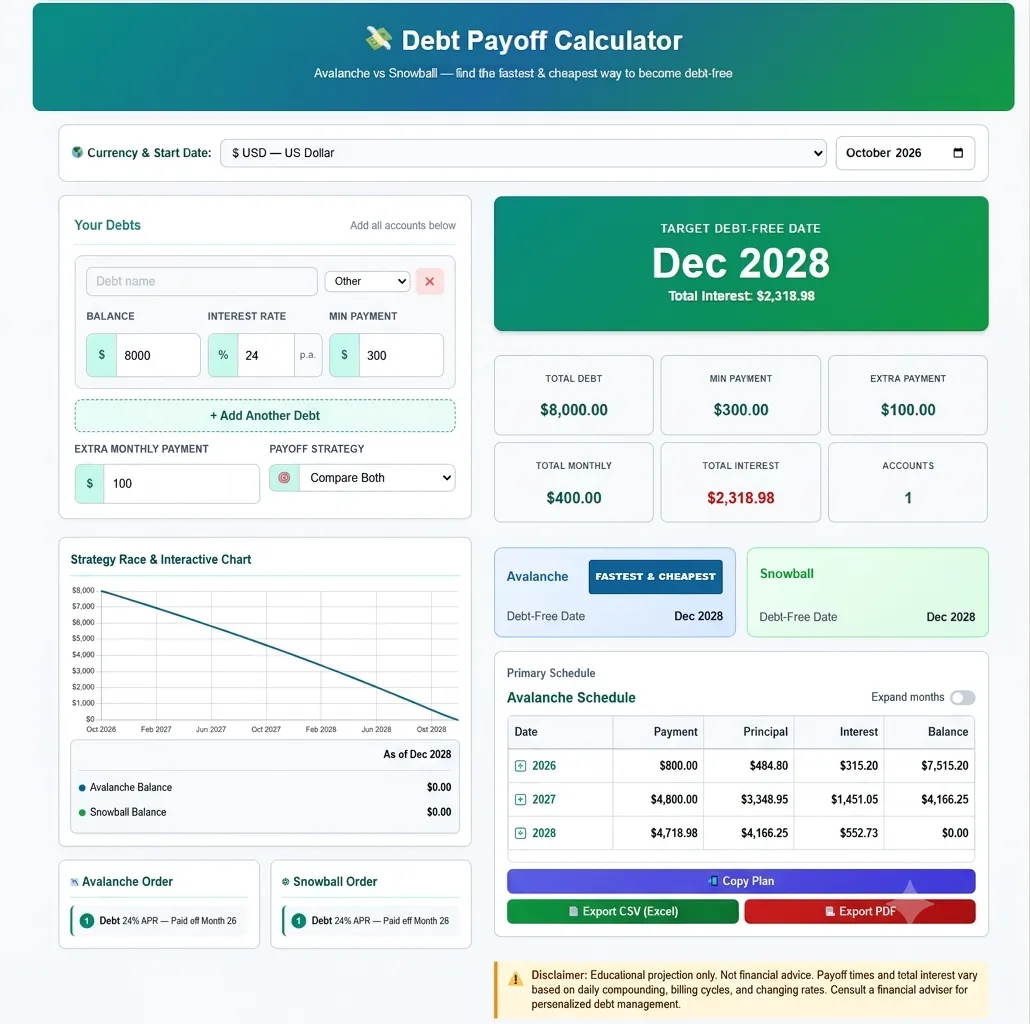
The research brief recommends running the math before committing to any strategy. Here’s the example from the brief — an $8,000 balance at 24% APR:
| Monthly Payment | Balance | APR | Est. Payoff Timeline | Est. Total Interest |
|---|---|---|---|---|
| $300/month | $8,000 | 24% | ~39 months (~3 yrs 3 mo) | ~$3,547 |
| $400/month | $8,000 | 24% | ~26 months (~2 yrs 2 mo) | ~$2,319 |
| Difference | — | — | 13 fewer months | ~$1,228 in interest saved |
Illustrative model using standard amortisation formula. Actual results depend on your specific balance, APR, and whether new charges are added. Run your own numbers below.
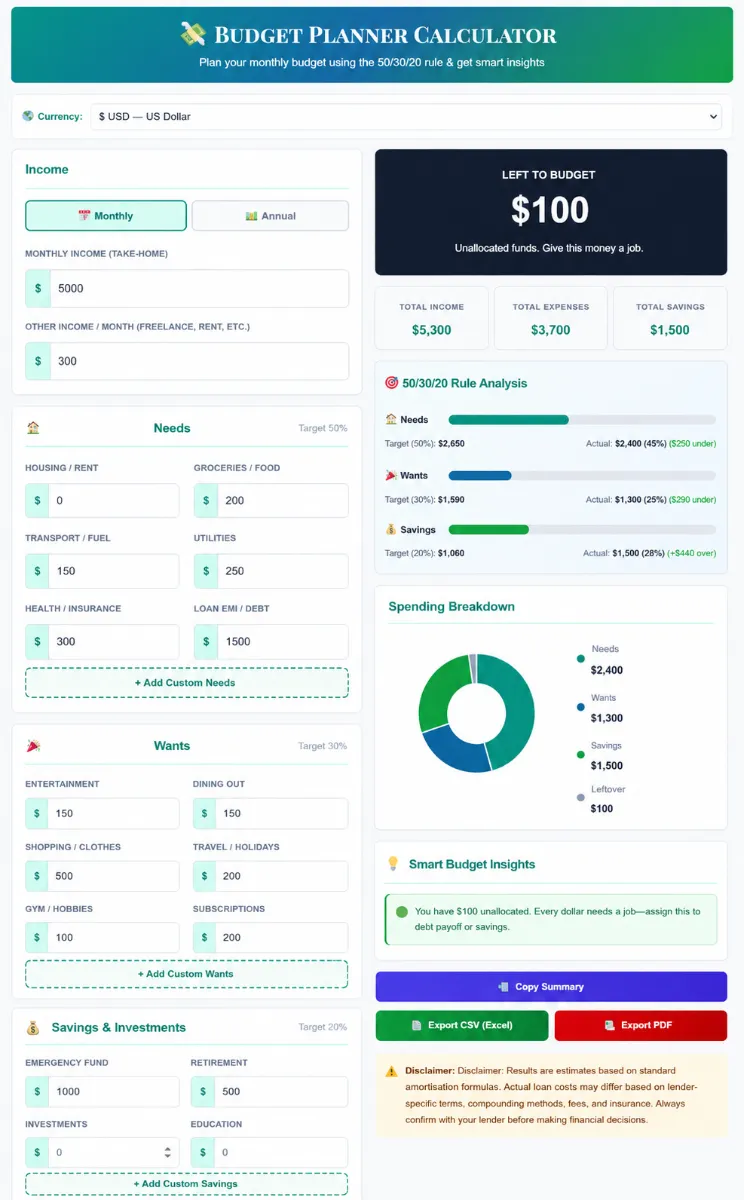
A $100 difference in monthly payment produces 13 fewer months of payments and approximately $1,228 in interest savings on an $8,000 balance. The point isn’t the specific numbers — it’s the principle: the payment amount drives the timeline more than any label attached to the strategy. The Budget Calculator helps identify what’s genuinely available after essential expenses; the Debt Payoff Calculator shows what that amount produces over time.
🧮 SaveXpert Debt Calculators — Free & No Signup
Start with the Budget Planner Calculator — enter your actual monthly income and essential expenses to find what’s genuinely available for debt payments after bills. Then take that number into the Debt Payoff Calculator — enter your balance, APR, and available monthly payment. The output shows the payoff timeline and total interest, plus the comparison when you increase the payment. That before-and-after is where the research findings become specific to your situation.
Educational note: Calculators model scenarios for informational purposes only. The calculator can’t predict future income or expenses. Source benchmarks: Federal Reserve G.19
Enter your income and top expenses to see where you stand.
What the Research Shows Works
Building a small emergency buffer before directing extra cash toward debt.
Federal Reserve data shows households with savings cover unexpected costs without new credit at more than double the rate of those without. For low-income households, that buffer prevents the emergency card charges that erase monthly payment progress.
Nonprofit credit counseling and Debt Management Plans with documented outcomes.
FDIC research on 6,000+ consumers found average debt reductions of $1,762–$3,600 within 18 months. Federal Reserve research links counseling to better credit profiles and fewer serious delinquencies over three years. NFCC reports 471,669 consumers counseled and 122,854 enrolled in DMPs in 2025 — showing the scale of legitimate nonprofit availability.
Medical-debt review as a credit-score action, not just a bill-payment decision.
CFPB research found a 25-point average credit-score increase in the first quarter after a medical collection’s removal. Pulling credit reports to check medical-collection status — separately from revolving debt — can identify credit-score opportunities that paying down card balances wouldn’t address.
Prioritising higher-APR debt in the payment order.
The research brief notes that ignoring APR differences when directing payments can increase total interest by 15%–25%. For a household with limited monthly payment capacity, each dollar directed toward the highest-APR balance produces the largest reduction in total interest accumulation.
What the research associates with worse outcomes:
Minimum-only payments — Federal Reserve data shows credit card balances rose more than 35% among people who reported finding it difficult to get by since 2023. Inconsistent payment patterns — which extend timelines. For-profit debt settlement — NCLC found average 161-point credit-score declines, high dropout rates, and fees for settlements creditors might have offered directly.

What Can Someone Realistically Expect?
The research gives timeframes — it doesn’t guarantee outcomes. Progress for lower-income households depends on debt type, available payment capacity, unexpected costs, and whether new debt continues building alongside repayment efforts.
| Approach | Research-Documented Timeframe | What Drives It |
|---|---|---|
| Nonprofit credit counseling | $1,762–$3,600 average debt reduction within 18 months | Structured counseling; FDIC-studied population; individual results vary |
| Debt Management Plan | Improved credit profiles and delinquency reduction over 3 years | Federal Reserve research on counseled consumers; NFCC 2025 enrollment data |
| Medical collection removal | Average 25-point credit-score increase in first quarter after last collection removed | CFPB research; depends on what’s on the individual report |
| Fixed payment (vs. minimum) | $8,000 example: $300/month = ~39 months; $400/month = ~26 months | Payment amount is the controlling variable per the brief’s model |
Source: FDIC research · NFCC 2025 · CFPB medical collections
The broader debt context from the New York Fed shows why the process can feel slow: $18.59 trillion in total US household debt in Q3 2025, with $1.23 trillion in credit card balances and a 4.5% delinquency rate across all debt types. Credit card delinquency transitions were especially elevated among adults 18–29. These figures describe the national environment — they don’t predict any individual household’s experience. But they do confirm that the structural pressure many lower-income households describe is documented at population scale, not imagined.
Bottom Line: 5 Steps for Getting Out of Debt on a Low Income
1. Build a $500–$1,000 emergency buffer before directing extra cash toward debt:
The Federal Reserve data is specific: households that could cover a $500 emergency borrowed from friends or family 11% of the time — compared with 27% for those who couldn’t. The buffer’s job isn’t to replace debt payments. It’s to stop the emergency card charges that erase them. A $500 buffer from reduced discretionary spending or a one-time extra income source changes the starting condition for everything that follows. Use the Budget Calculator to find what’s genuinely available for building the buffer without cutting essential expenses.
2. Pull your credit reports and check medical collections separately — before building any payoff strategy:
The three credit bureaus removed medical collections below $500 from reports starting April 11, 2023 — affecting 22.8 million consumers. CFPB research found an average 25-point credit-score increase in the first quarter after a medical collection disappeared. Pull all three reports at AnnualCreditReport.com. If medical collections appear, research their current credit-reporting status before prioritising payment on them over revolving debt. A medical balance that’s no longer on your credit report has a different strategic priority than one still affecting your score.
3. Contact a nonprofit credit counselor before signing anything with a for-profit debt-settlement company:
FDIC research found average debt reductions of $1,762–$3,600 within 18 months through structured nonprofit counseling. NCLC’s 2025 analysis of for-profit settlement found an average 161-point credit-score decline in six months, with most customers unable to settle every enrolled debt. The difference in documented outcomes between the two options is significant. The NFCC directory lists member agencies that offer free or low-cost counseling. Make that contact before agreeing to any fees or stopping payments to creditors.
4. Know your FDCPA rights when dealing with collectors — and separate them from debt reduction:
The Fair Debt Collection Practices Act gives consumers specific, enforceable protections: no calls before 8 AM or after 9 PM, no contact at work after notification, and a 7-calls-per-7-days limit on the same debt. Understanding these limits helps manage the stress of collection activity without creating a false belief that asserting rights reduces balances. If you believe a collector is violating these limits, file a complaint at FTC.gov or CFPB.gov.
5. Run the Debt Payoff Calculator with your actual balance, APR, and realistic monthly payment — and direct payments toward the highest-APR balance first:
The brief’s example shows a $100/month difference producing 13 fewer months and $1,228 in interest savings on an $8,000 balance. For households with multiple balances, the research brief notes that ignoring APR differences when directing payments can increase total interest by 15%–25% versus prioritising the highest-APR balance first. Use the Budget Calculator to find your realistic payment amount, then the Debt Payoff Calculator to see what that produces — for each individual balance, starting with the highest APR.
“The data point that reframes everything else in the low-income debt research is the 40% emergency savings gap. Forty percent of adults earning under $50,000 couldn’t cover a $100 emergency from savings in 2025. That’s not a failure of debt strategy — it’s a structural starting condition that makes any plan harder to sustain. A $300 car repair doesn’t erase a debt payment because the household was irresponsible. It erases it because there was no buffer. The Federal Reserve data linking emergency savings to reduced reliance on high-cost credit is the clearest case I found for why building even a small buffer and paying down debt are the same project, not competing priorities.”
— Kevin Brown, Lead Researcher at SaveXpert.com
Frequently Asked Questions
Ans: The Federal Reserve and CFPB data point to a structured sequence: build a small emergency buffer first to stop the unexpected expenses that add new debt; review medical collections separately on your credit reports; contact a nonprofit credit counselor through NFCC.org; and direct payments toward the highest-APR balance. FDIC research on 6,000+ consumers found average debt reductions of $1,762 to $3,600 within 18 months through structured nonprofit counseling. Progress typically takes months to years depending on debt type and available payment capacity.
Ans: Yes — and the research documents it at scale. The National Foundation for Credit Counseling reported that member agencies counseled 471,669 consumers in 2025, with 122,854 enrolling in Debt Management Plans. FDIC research found statistically significant debt reductions among counseled consumers compared with matched consumers who didn’t receive counseling. Federal Reserve research associated counseling with better credit profiles and fewer serious delinquencies over three years. Nonprofit credit counseling is a legitimate, large-scale, federally-studied service.
Ans: A Debt Management Plan (DMP) is a structured repayment programme facilitated by a nonprofit credit counselor. It consolidates multiple unsecured debt payments into a single monthly payment — in some cases at creditor-negotiated lower interest rates. The NFCC reported 122,854 DMP enrollments in 2025. Federal Reserve research in the brief associates DMP-connected counseling with improved delinquency outcomes over three years. A DMP doesn’t erase the underlying balance — it restructures how it’s repaid. Contact a nonprofit counselor to determine whether a DMP fits your specific debt situation.
Ans: The Federal Reserve data makes the case for protecting cash flow before maximising debt payments. Four in 10 adults earning under $50,000 couldn’t cover a $100 emergency from savings in 2025. When an unexpected expense forces new card use, it can erase a payment’s worth of progress even when the household makes every planned contribution. The research brief recommends building a small emergency buffer — $500–$1,000 — before directing every available dollar toward debt. Federal assistance programmes (SNAP, LIHEAP, TANF) may help with essential expenses; check eligibility at benefits.gov.
Ans: The FTC and the National Consumer Law Center’s 2025 analysis document specific warning patterns. For-profit debt settlement companies in the NCLC analysis charged substantial fees for settlements creditors might offer directly; most major credit card issuers don’t work with settlement companies; most customers couldn’t settle every enrolled debt; and the average credit-score decline was 161 points within six months. The FTC’s guidance at consumer.ftc.gov covers what debt-relief companies can and can’t legally promise. The clearest protective step: contact a nonprofit counselor through the NFCC before committing to any for-profit debt-relief service.
Ans: The National Consumer Law Center’s 2025 analysis found serious documented risks. Most customers in the studied population couldn’t settle every debt enrolled in the programme. Dropout rates were high. Unsettled balances grew during the process because customers typically stopped paying creditors while waiting for settlement offers. The average credit-score decline was 161 points within six months. Most major credit card companies don’t negotiate with settlement companies — meaning customers paid fees for intermediary services that creditors might have offered directly. By contrast, FDIC-studied nonprofit counseling produced average debt reductions of $1,762–$3,600 within 18 months. The outcome comparison between the two paths is the most useful data point in the research for this decision.