
ⓘ Educational Disclosure:
This article is for educational and informational purposes only. It does not constitute financial, legal, tax, lending, or investment advice. SaveXpert and its authors are not licensed financial or tax advisors. Always consult a qualified professional before making investment decisions.
How much should you save for Christmas 2026? There is no official U.S. government amount. No IRS, CFPB, Federal Reserve, or BLS rule sets a standard Christmas savings figure for American households. What the CFPB’s holiday-spending framework does provide is a clear three-step calculation: total all expected seasonal costs, subtract what you’ve already saved, then divide the remaining amount by the number of paychecks or months before Christmas. That formula produces a household-specific target — not a national average.
Key Takeaways
- Problem: American households often struggle to cover Christmas gifts, travel, and parties without reaching for a credit card — because no one ran the numbers before October.
- Solution: Calculate exactly how much to save for Christmas 2026 by totaling all seasonal costs, subtracting what you’ve already saved, then dividing the remainder across your remaining paychecks.
- Result: Data shows that households who plan and automate saving across more periods need less from each paycheck — and avoid the seasonal debt cycle the CFPB tracks every year.
- Source: CFPB Holiday Spending Framework, BLS Consumer Expenditures 2024
- Time To Read: 9 Minutes
Table of Contents
1. Why Christmas Saving Gets Difficult for American Households
2. How Much Should You Save for Christmas 2026?
3. How Early Should You Start Saving for Christmas?
4. What Does the Average American Spend on Christmas Gifts?
5. How to Build a Christmas Budget That Includes More Than Gifts
6. How Can You Save $1,000 for Christmas Without Going Into Debt?
7. Christmas Savings Accounts and the Rules Around Them
9. What Can Americans Realistically Expect?
Nearly $150 million per day flowed into Buy Now, Pay Later borrowing between Black Friday and Christmas Eve in 2022. That number came from a CFPB report published in January 2025. It’s the figure that changed how I looked at the whole question of how much to save for Christmas 2026.
Because that borrowing spike isn’t random, it’s what happens when households get to November without a savings plan. They know Christmas is coming — it’s the same date every year — but the costs still hit like a surprise.

Why Christmas Saving Gets Difficult for American Households
Christmas costs rarely stop at gifts. The CFPB’s holiday-spending framework includes travel, parties, decorations, and other seasonal expenses alongside gifts in its definition of holiday costs. A household that plans for presents but forgets travel and food can end up short by hundreds of dollars — even when the gift budget felt “under control.”
That happens against an already heavy spending backdrop. BLS data shows housing and transportation already represented 50% of household spending in 2024. Personal insurance and pensions accounted for another 12.5% ($9,797 of average annual spending), while entertainment represented 7.9%. (BLS: Housing and Transportation Spending 2024)
Christmas savings don’t get added on top of that picture without displacing something else. The research supports building the holiday amount around the household’s actual cash flow — not treating it as a separate category that exists outside the rest of the budget.
⚠️ The seasonal borrowing pattern is real: CFPB research found that end-of-year credit-card borrowing follows consistent seasonal patterns, rising sharply each holiday period. Households that reach November without a savings plan borrow to close the gap. The CFPB flags impulse purchases, unplanned credit-card use, and store financing as sources of fees, interest, and repayment problems that extend well into the following year. (CFPB: Three Ways to Enjoy the Holidays Without Going Into Debt)
How Much Should You Save for Christmas 2026?
The formula the CFPB framework supports is straightforward:
📐 The Christmas Savings Formula
(Total planned cost − Money already saved)
÷ Number of saving periods remaining
= Amount needed per period
Source: CFPB Holiday Spending Framework
Here’s what that looks like with real numbers. It’s August 2026 — roughly four months until Christmas. A household with a $1,000 target and $200 already set aside needs $800 more. Spread across four months, that’s $200 per month. Start in September instead of October, and the monthly requirement drops. The formula stays the same; the saving period changes everything.
| Planned Christmas Cost | Already Saved | Saving Periods Left | Required Amount |
|---|---|---|---|
| $600 | $0 | 12 months | $50 / month |
| $1,000 | $200 | 10 months | $80 / month |
| $1,500 | $300 | 12 paychecks | $100 / paycheck |
| $1,000 | $0 | 4 months (Aug start) | $250 / month |
These are mathematical illustrations, not government-recommended Christmas budgets. The formula is from the CFPB’s holiday-spending guidance; the amounts depend entirely on household-specific costs and existing savings.
💡 Research note: The research brief found no official U.S. government Christmas savings figure as of August 2026. No IRS, CFPB, Federal Reserve, BLS, HUD, SSA, or SEC rule prescribes a specific amount. The CFPB’s framework gives the calculation method — your household’s costs and timeline determine the number.
How Early Should You Start Saving for Christmas?
The research doesn’t set a universal start date. Instead, the CFPB framework centers the calculation around the number of saving periods available — and the math makes the case for starting as early as possible on its own.
A $600 target spread across 12 monthly periods requires $50 each month. The same $600 spread across six periods requires $100 each month. The target stays identical. Only the required periodic amount changes.
Here’s the practical point for August 2026: starting now gives four to five months of runway before Christmas spending begins in earnest. That’s not a long window — but it’s meaningfully better than starting in October. For households with nothing saved yet, the difference between a September start and a November start on a $1,000 target is $125 less per month. (CFPB: Plan Your Spending to Avoid Holiday Debt)
💡 Research note: The CFPB’s separate emergency-savings research found that automatic enrollment and default savings structures can increase both savings participation and accumulation. The same logic applies to holiday savings — automating a recurring transfer removes the monthly decision. (CFPB: Evidence-Based Strategies for Building Emergency Savings)
What Does the Average American Spend on Christmas Gifts?
This question needs careful sourcing — because the official data doesn’t give a 2026 national Christmas-gift average.
The research brief found no official U.S. government Christmas 2026 spending forecast. What it found instead was a private-market figure: a NerdWallet 2025 holiday survey reported that shoppers planned to spend an average of $1,107 on presents, which stood $182 above the prior year’s figure.
That $1,107 is private consumer-survey data from 2025. It does not represent an official U.S. government benchmark, and it isn’t a 2026 figure. The data doesn’t support treating it as a universal target — it supports treating it as consumer context from one private publisher’s research. (NerdWallet 2025 Holiday Spending Report — private publisher data)
The same NerdWallet research found 74% of 2025 holiday shoppers planned to use credit cards for at least part of their shopping, while 29% planned to use savings and 18% planned to use BNPL. Those figures tell a story about payment patterns more than they tell one about the right spending level for any given household.
There is one official CFPB figure worth noting: the CFPB’s analysis found that nearly 20% of annual retail sales occurred during November and December based on its review of holiday spending patterns. (CFPB: End-of-Year Credit-Card Borrowing) That helps explain why household cash flow feels unusually pressured in those two months — it isn’t imagination. The spending concentration is real.
Enter your income and top expenses to see where you stand.
How to Build a Christmas Budget That Includes More Than Gifts
I found one repeated theme in the CFPB material: a true Christmas budget starts with a complete list of seasonal costs, not just a gift total.
The CFPB specifically identifies gifts, travel, parties, decorations, and other seasonal expenses as parts of a holiday spending plan. That changes the starting number substantially for most households.
Here’s a plain example. A household plans $700 for gifts. That same household expects $200 for travel, $150 for food and holiday gatherings, and $50 for decorations. The CFPB framework treats those costs as part of the same $1,100 seasonal total — not as separate expenses that somehow don’t count against the Christmas budget.
| Holiday Cost Category | Example Amount | Often Forgotten? |
|---|---|---|
| Gifts | $700 | No — most households plan for this |
| Travel (flights, gas, hotels) | $200 | Yes — frequently omitted |
| Food, parties, and entertaining | $150 | Yes — especially hosting costs |
| Decorations and cards | $50 | Yes — treated as trivial, adds up |
| Total seasonal budget | $1,100 | Most only budget $700 |
Source: CFPB: Plan Your Spending to Avoid Holiday Debt — category framework; amounts are illustrative.
A separate Bankrate 2025 survey found 41% of respondents worried winter holiday gifts would cost more that year, while only 24% said they planned to budget for holiday spending. That gap between worry and action is exactly what the CFPB framework is designed to close. (Bankrate 2025 Holiday Spending Report — private publisher data)
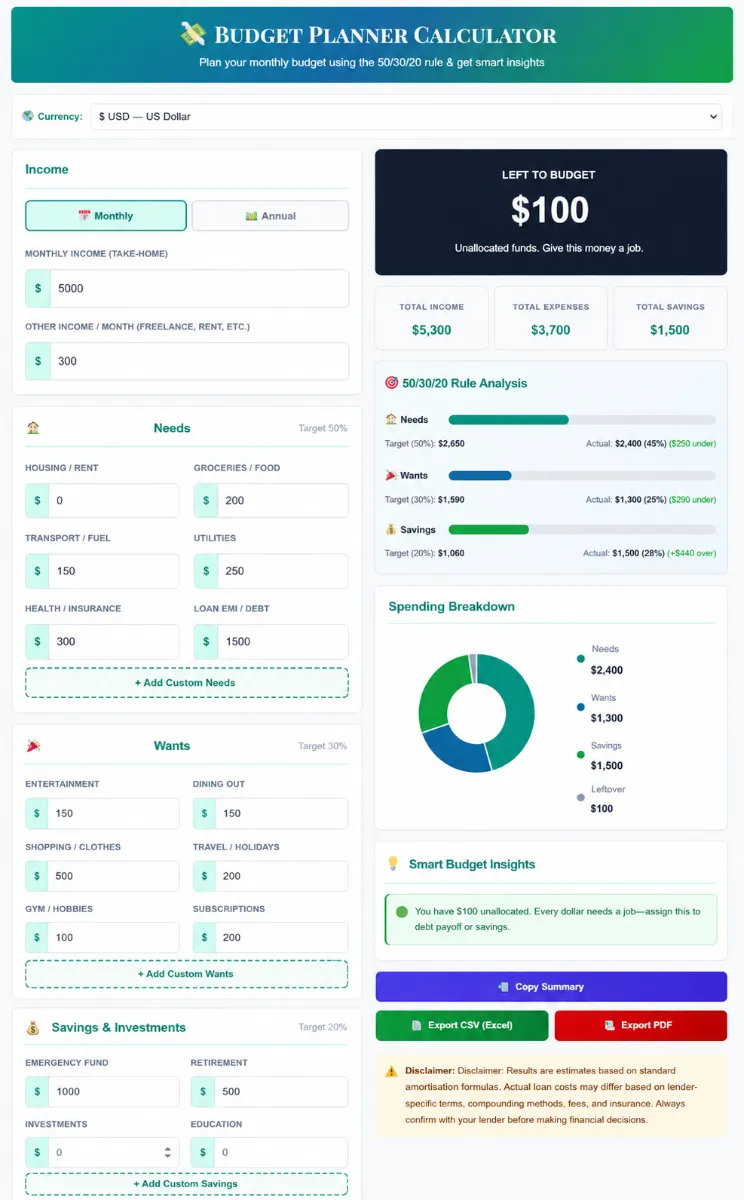
💰 Build Your Holiday Budget — Budget Planner Calculator
Before calculating the periodic savings amount, you need a complete holiday total — gifts, travel, food, parties, decorations. I ran the example categories above through SaveXpert’s Budget Calculator to map holiday costs against monthly cash flow. Try your own numbers here.
Educational note: This calculator models budgeting scenarios for illustrative purposes and does not provide personalized financial advice. Source: CFPB Holiday Spending Framework
See how long it takes to reach your target.
How Can You Save $1,000 for Christmas Without Going Into Debt?
The CFPB’s own worked example uses a $1,000 target. Starting with $200 already saved and 10 months remaining, the calculation produces $80 per month. The household doesn’t need to find the full $1,000 during the final months — it needs to find $80 during each of the 10 months available. (CFPB: Plan Your Spending to Avoid Holiday Debt)
The CFPB also discusses recurring transfers and direct-deposit allocations as specific mechanisms for consistent saving. Automating the transfer removes the monthly decision and reduces the chance of spending the money before it reaches the holiday fund.
Starting in August 2026 with zero saved and a $1,000 target, the math looks different — $250 per month for four months. That’s manageable for some households and not for others. The research doesn’t establish one universal method. It does show that the earlier the start, the smaller each required transfer.
💡 Research note — don’t confuse these figures: The CFPB’s financial empowerment toolkit identifies $500 as an initial emergency-savings goal and $1,000 as a subsequent goal. Those relate to emergency funds, not Christmas spending. The Federal Reserve’s finding that 63% of adults could cover a $400 emergency using cash measures financial resilience — it isn’t a Christmas budget figure. (Federal Reserve SHED 2024: Savings and Investments)
The Federal Reserve also reported that 23% of adults experienced major, unexpected medical expenses in the prior 12 months, with median amounts falling between $1,000 and $1,999. That puts holiday saving in a broader context. A Christmas fund sits alongside other financial needs — which is exactly why the budget-first step matters before the savings calculation.
🎯 Calculate Your Monthly Savings Target — Savings Goal Calculator
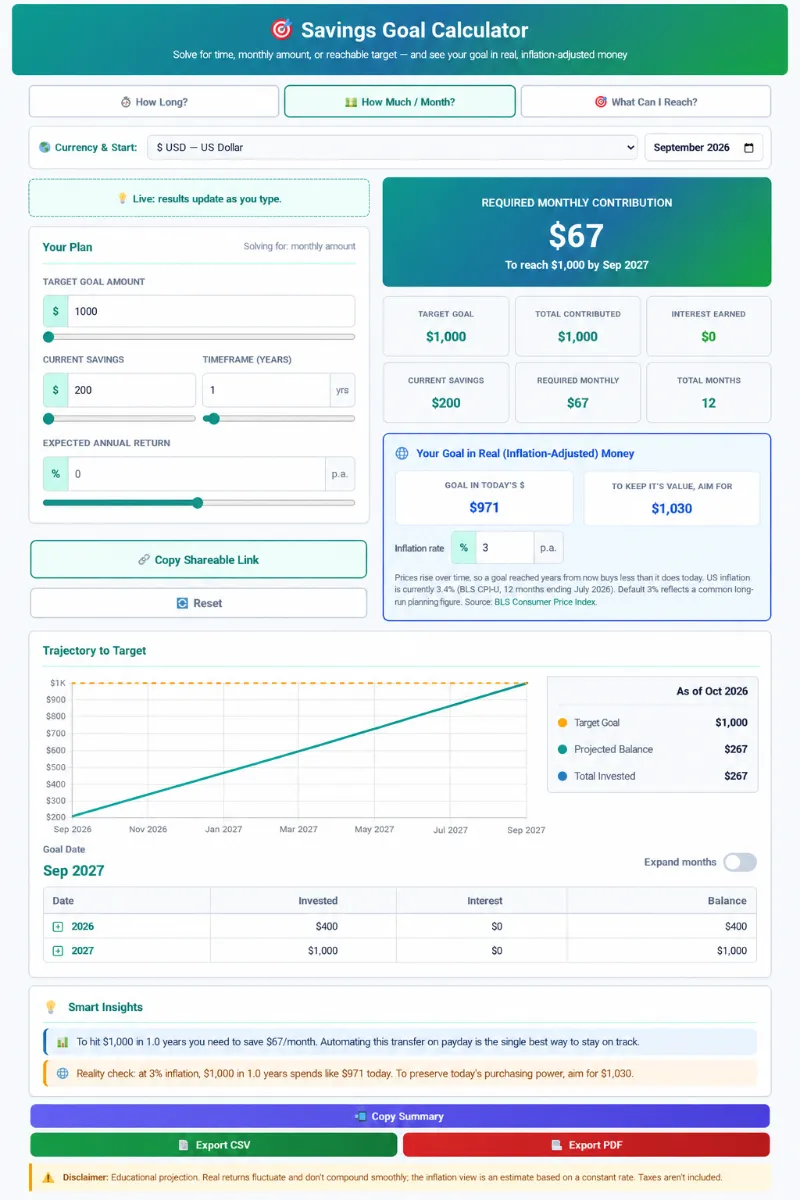
Enter your total Christmas target, what you’ve already saved, and the months remaining. The calculator runs the CFPB formula — (total minus saved) ÷ periods — and shows exactly how much each monthly transfer needs to be. I ran the $1,000 example (with $200 already saved in 1 year) and got $67/month. Try your household’s actual numbers.
Educational note: This calculator illustrates goal-based saving scenarios and does not provide personalized financial advice. Source: CFPB Holiday Spending Framework
Christmas Savings Accounts and the Rules Around Them
The research found no federal rule that creates a specific “Christmas savings account” category. A dedicated holiday fund is a standard deposit account — or an earmarked portion of one — subject to the same federal deposit rules that govern any bank account.
The CFPB’s Truth in Savings rules require banks to provide deposit-account disclosures covering interest rates, fees, and account terms. Those rules apply to any savings vehicle a household uses to hold Christmas funds, whether that’s a separate account, a sub-savings bucket, or a money-market product.
Credit-card rules also matter when holiday spending moves onto a card. CFPB rules generally require issuers to provide at least 21 days between the delivery of a periodic statement and the payment due date. That buffer is relevant for anyone planning to charge holiday purchases and pay them off within a billing cycle. (CFPB Consumer Tools)
Gift cards carry their own federal protections. Under federal law, gift cards generally cannot expire until at least five years after the date they were issued or last loaded with funds. Inactivity fees can only be charged after 12 months of inactivity, and only one fee per month. That matters for households buying gift cards early for holiday giving. (CFPB Consumer Tools)
💡 Research note: The research found no federal contribution limit or mandatory savings amount for a Christmas savings fund itself. The applicable rules cover the financial product or payment method being used — the deposit account, credit card, or gift card — not the holiday saving activity.

What the Data Shows Works
Based on what I found across CFPB, Federal Reserve, and BLS materials, the approach the data consistently supports has five parts.
Start with the full seasonal cost, not gifts alone.
The CFPB framework explicitly includes travel, parties, decorations, and other seasonal expenses alongside gifts. Budgeting only for presents leaves a gap that typically gets closed with a credit card. (CFPB)
Subtract existing savings before setting a target.
The calculation treats money already saved as a head start — not as proof the household is done saving. The remaining gap is what needs to be funded across the available periods.
Divide by periods, not months alone.
Some households have biweekly paychecks; others monthly. The CFPB framework supports weekly, monthly, or paycheck-based periods. The right period is whichever matches the household’s actual income cycle.
Automate the transfer.
The CFPB points to recurring transfers and direct-deposit allocations as mechanisms for consistent saving. Its separate emergency-savings research found automatic structures increase both participation and accumulation rates. (CFPB: Evidence-Based Emergency Savings Strategies)
Track spending as the season unfolds.
The CFPB framework supports assigning planned amounts to each holiday category and then tracking actual spending against the plan. A budget that exists in August but gets abandoned in November isn’t a plan — it’s a number.
What the data doesn’t support: a universal “right” Christmas spending amount for every American household, or a guaranteed debt-free outcome from any single method. The official sources provide a framework, not a promise.

What Can Americans Realistically Expect?
The research points back to the formula: total expected costs, minus existing savings, divided across the time remaining. Starting in August 2026 with four months until Christmas is a workable window — not a comfortable one, but a real one.
The broader context from BLS matters here. Average consumer-unit spending rose 1.8% in nominal terms during 2024, but fell 1.1% after inflation adjustment. Annual inflation for the average consumer unit measured 2.9% that year. (BLS Consumer Expenditures 2024) Household purchasing power tightened even as nominal spending rose — which is exactly the environment where planned holiday saving matters most.
The Federal Reserve’s SHED data for 2024 found 55% of adults said they had money set aside for three months of expenses. That figure measures financial resilience — not holiday readiness. A household can be three months of expenses solid and still hit November without a Christmas plan. The two questions are separate. (Federal Reserve SHED 2024: Executive Summary)
⚠️ National statistics don’t make individual budgets: The Federal Reserve’s 63% cash-emergency figure doesn’t create a Christmas target. A private survey’s $1,107 planned gift average doesn’t become an official 2026 benchmark. The research supports using national data as context — not as a spending goal. The source matters as much as the number.
Your 5-Step Christmas Savings Plan for 2026
1. List every seasonal cost — not just gifts:
Write down gifts, travel, food and hosting, decorations, and any other holiday spending. Total them. That number is your real savings target, and it’s almost always larger than the gift budget alone.
2. Subtract what’s already saved:
If you have anything set aside — holiday club account, loose savings, last year’s leftover fund — subtract it from the total. You only need to find the gap, not the full amount.
3. Divide by your remaining paychecks:
From August, that’s roughly 8–10 paychecks depending on your pay cycle. Divide the gap by that number to get your required transfer per period. Use the Savings Goal Calculator above to run the math.
4. Automate the transfer today:
Set up a recurring transfer to a dedicated savings account or sub-account the same day you run the calculation. The CFPB’s research supports automation as the most consistent mechanism for reaching a savings goal. Don’t leave the transfer as a monthly manual task.
5. Track actual spending against the plan in real time:
As holiday shopping begins — October through December — compare actual spending to your category budget. The plan only works if it’s active. Catching a category running over in October is fixable; catching it in December is not.
“I spent time going through the CFPB’s published holiday-spending guidance, and the biggest finding was simple: no federal agency sets a standard Christmas savings amount for Americans. The right number isn’t a national average. It’s the result of one calculation applied to your household’s specific costs and timeline.”
— Kevin Brown, Lead Researcher at SaveXpert.com
Frequently Asked Questions
Ans: According to the CFPB holiday-spending framework, there is no single mandated amount. The research shows households should total all expected seasonal costs — gifts, travel, food, parties, and decorations — subtract what they’ve already saved, then divide the remaining balance across available paychecks. That formula produces a household-specific goal. Starting in August 2026 with four months of runway, a $1,000 target with nothing saved requires roughly $250 per month; with $200 already saved, it drops to $200 per month.
Ans: The CFPB data shows the most mathematically sound approach starts with a full list of seasonal costs rather than a gift-only figure. The research supports totaling anticipated gifts, travel, meals, parties, and decorations into one seasonal number, then dividing by the number of saving periods remaining. The CFPB also identifies recurring automated transfers and direct-deposit allocations as the most reliable mechanisms for reaching the target consistently.
Ans: Official U.S. government data does not provide a 2026 national Christmas gift spending average. A NerdWallet 2025 holiday survey — a private publisher, not a federal source — found that shoppers planned to spend an average of $1,107 on presents that year. That figure provides private-market context from a prior year. It does not represent an official benchmark, and the research doesn’t support using it as a universal 2026 savings target.
Ans: According to federal deposit regulations, a Christmas savings account is a standard deposit account subject to the CFPB’s Truth in Savings rules, which require disclosures covering interest rates, fees, and account terms. These accounts work by accepting recurring transfers or direct deposits that build a dedicated holiday fund over time. The research found no federal rule that creates a specific “Christmas savings account” product category — the structure is a standard deposit account used for a specific purpose.
Ans: The CFPB data shows that saving $1,000 without relying on credit cards involves running the periodic savings calculation and automating the transfer. Starting with $200 already saved and 10 months remaining requires $80 per month. Starting from zero in August with four months left requires $250 per month. The CFPB’s framework supports setting up a recurring transfer immediately after calculating the required periodic amount — so the saving happens automatically across each period rather than as a lump sum in December.
Ans: Buy Now, Pay Later (BNPL) is a short-term financing product — typically a zero-interest loan repaid in four installments — that consumers use at checkout for retail purchases. The CFPB’s January 2025 research report found that BNPL borrowing is strongly seasonal, with consumers borrowing an average of nearly $150 million per day from Black Friday through Christmas Eve in 2022. The CFPB’s data also found that consumers who miss BNPL payments face fees, that 63% of BNPL borrowers had multiple simultaneous BNPL loans in 2021–2022, and that BNPL use is concentrated among consumers with subprime or deep subprime credit scores. The CFPB flags it as a risk factor in holiday spending — not a cost-free alternative to a savings plan.