
ⓘ Educational Disclosure:
This article is for educational and informational purposes only. It does not constitute financial, legal, tax, lending, or investment advice. SaveXpert and its authors are not licensed financial or tax advisors. Always consult a qualified professional before making investment decisions.
What goes on a year-end money checklist for 2026? A proper year-end money checklist for 2026 separates employer plan deadlines from individual tax limits. According to the IRS, the 2026 employee contribution limit for most 401(k) plans is $24,500, while the combined IRA limit reaches $7,500. Standard deductions — $16,100 for single filers, $32,200 for married filing jointly — also changed for 2026. The SSA’s 2.8% COLA and BLS 3.4% CPI-U data provide useful context, but neither sets a universal personal deadline.
Key Takeaways
- Problem: Changing IRS limits, inflation adjustments, and multiple financial deadlines make year-end money planning confusing — especially when people treat every deadline as December 31.
- Solution: Verify the actual 2026 IRS and federal figures — the $24,500 401(k) limit, $7,500 IRA limit, and updated standard deductions — against your personal situation rather than relying on generic checklists.
- Result: Organizing these specific tax, retirement, credit, and cash-flow data points before December 31 gives a clearer baseline for 2027 household planning.
- Source: IRS Tax Inflation Adjustments for 2026, CFPB Credit Reports
- Time To Read: 7 Minutes
Table of Contents
1. The Year-End Checklist Starts With Five Numbers
2. Use the 2026 Inflation and Social Security Numbers in Context
3. Turn the Checklist Into a Real Year-End Financial Review
5. Realistic Expectations for December 2026
December has a way of making financial tasks feel more urgent than they are — and less urgent than they should be. Some year-end money moves genuinely do close on December 31. Others have nothing to do with that date. And a few things most people skip entirely — like pulling their credit reports and checking the updated IRS numbers — quietly make the difference between a clean financial start to 2027 and an avoidable mess.

The Year-End Checklist Starts With Five Numbers
The research brief combines tax, retirement, credit, benefits, and budgeting items — and each area follows its own rules. Here are the five that carry the most weight heading into December 2026.
1. Review the 2026 retirement contribution limits
The IRS lists a $24,500 employee elective-deferral limit for most 401(k), 403(b), governmental 457 plans, and the federal Thrift Savings Plan. The limit rose from $23,500 in 2025. (IRS: 401(k) Limit Increases to $24,500 for 2026)
Participants age 50 or older can have a standard catch-up limit of $8,000 — creating a general combined amount of $32,500. Workers who turn 60 through 63 in 2026 have a higher SECURE 2.0 catch-up of $11,250 instead, bringing their total to $35,750. (IRS: Retirement Topics — Catch-Up Contributions)
Here’s a plain example of why this matters. Say an employee has contributed $18,000 so far in 2026. The gap to the $24,500 limit equals $6,500. But that doesn’t mean every employee can simply add $6,500 more. Plan type, compensation, age, participation, income, and employer-plan rules all affect actual eligibility. Check your plan documents and talk to HR before December payroll closes.
⚠️ The employer-plan deadline isn’t December 31 — it’s your last paycheck: Employee salary deferrals come from compensation paid through payroll. Once your employer’s final 2026 payroll runs, that window closes. For most workers, the real deadline is mid-to-late December, not the 31st.
2. Check IRA contributions separately
IRAs use a different limit and a different deadline logic. The IRS lists a $7,500 combined annual contribution limit for traditional and Roth IRAs in 2026, up from $7,000 in 2025. Eligible individuals age 50 or older can contribute up to $8,600 ($7,500 + $1,100 IRA catch-up). (IRS: Retirement Topics — IRA Contribution Limits)
The key distinction: unlike 401(k) salary deferrals, IRA contributions generally can be made up to the tax filing deadline of the following year. So the IRA limit is a 2026 tracking question — not a December 31 hard stop for everyone. The research supports checking where you stand against the $7,500 limit. It does not support assuming December 31 is the universal IRA deadline.
💡 Research note: The 2026 employee-plan limit ($24,500) and the combined IRA limit ($7,500) are governed by different IRC sections and follow different timelines. A year-end review should track both — but applying the employer-plan payroll deadline to IRA contributions is a common planning error.
3. Check whether an RMD applies
The IRS shows that applicable retirement-account owners generally begin required minimum distributions (RMDs) at age 73. Account type, birth date, and specific exceptions can affect the rule — including a different first-year deadline treatment for the very first RMD. (IRS: Retirement Plans)
This creates a year-end review item worth flagging rather than ignoring. Anyone approaching or exceeding the applicable RMD age can check the account rules and confirm the required distribution amount with their plan administrator. The research does not establish that every RMD must occur by December 31 — there are specific exceptions depending on account type and when the first RMD applies.
⚠️ Missing an RMD carries a penalty: The penalty for not taking a required minimum distribution is a 25% excise tax on the amount that should have been taken (reduced to 10% in some cases if corrected quickly). This is one area where the research strongly supports checking the rules with a qualified professional before year-end.
4. Review your 2026 tax-year numbers
The IRS published its 2026 inflation-adjusted figures on October 9, 2025. The standard deduction numbers to keep on hand for year-end tax planning:
| Filing Status | 2026 Standard Deduction | Change from 2025 |
|---|---|---|
| Single / Married Filing Separately | $16,100 | +$350 |
| Married Filing Jointly / Surviving Spouse | $32,200 | +$700 |
| Head of Household | $24,150 | +$525 |
💡 New for 2026 — IRS deductions most checklists miss: The One Big Beautiful Bill Act created several new above-the-line deductions effective for tax year 2026. These are available whether you itemize or take the standard deduction:
- Enhanced senior deduction: $6,000 per qualifying person age 65+ (available 2025–2028; subject to MAGI phase-out)
- Qualified tips: Up to $25,000 deductible for eligible workers
- Qualified overtime: Up to $12,500 ($25,000 for joint filers)
- Qualified passenger vehicle loan interest: Up to $10,000
The point of reviewing these at year-end isn’t to predict the final tax bill from one number. It’s to make sure your year-end records use the correct 2026 tax-year rules — and that you know which new deductions you may qualify for before filing.
5. Pull your credit reports before year-end
The CFPB says consumers have a federal right to one free credit report every 12 months from each nationwide consumer-reporting company — Equifax, Experian, and TransUnion. The research also found that additional Equifax reports remain available through December 2026 under a settlement. The official source is AnnualCreditReport.com. (CFPB: Credit Reports and Scores)
When reviewing, the CFPB specifically points consumers toward names, addresses, account ownership, balances, public records, and identity-theft indicators. If you find inaccurate or incomplete information, consumers have dispute rights under federal law — and a consumer-reporting company must conduct a reasonable investigation of a properly submitted dispute without charge.
⚠️ 2026 CFPB change — effective April 7, 2026: As of April 7, 2026, the CFPB requires consumers to first dispute inaccurate or incomplete information directly with the credit-reporting company before filing a related CFPB complaint. This changes the order of steps from what many guides previously described. Dispute with the bureau first; then escalate to CFPB if the issue isn’t resolved. (CFPB: Credit Reports)

Use the 2026 Inflation and Social Security Numbers in Context
Two national figures show up in almost every year-end financial discussion — and both need careful handling before applying them to a personal budget.
The BLS CPI-U reading for July 2026
BLS reported a 3.4% CPI-U increase over the 12 months ending July 2026. July’s seasonally adjusted monthly increase measured 0.1%. CPI-U excluding food and energy rose 2.5% over the same period. (BLS CPI News Release, July 2026)
But BLS is explicit: the CPI measures an aggregate consumer basket. That 3.4% is not your household’s personal inflation rate. A renter in a high-cost city with heavy medical spending faces a different cost picture than the national average. Year-end budgeting gets more useful when you compare actual household spending rather than applying a national percentage to your numbers.
The SSA 2026 COLA
The SSA announced a 2.8% cost-of-living adjustment for 2026. The average retirement-benefit increase came to roughly $56 per month, starting with January 2026 payments. Nearly 71 million Social Security beneficiaries received the adjustment. (SSA COLA Information, SSA 2026 COLA Fact Sheet)
The 2.8% figure is a CPI-W–based benefit adjustment — not a tax change, not a universal savings-rate recommendation. Individual dollar changes vary by benefit type and program. For someone budgeting around Social Security income, the practical step is checking the actual new benefit amount, not just applying 2.8% to a round number.
💡 Research note: The SSA also increased the Social Security taxable maximum to $184,500 for 2026 (from $176,100 in 2025). Higher earners whose wages exceed the old cap may see payroll-tax changes in their December paychecks that are worth reconciling before year-end.
Enter your income and top expenses to see where you stand.
Turn the Checklist Into a Real Year-End Financial Review
The most practical year-end financial review starts with actual income and spending — not with a generic template. Here’s the sequence the research consistently supports.
Start with actual household cash flow.
Log what the household actually spent versus what it expected to spend at the start of the year. Category by category — housing, food, transportation, debt payments — not a single round number.
Review recurring expenses and subscriptions.
The end of the year is the natural time to identify services that auto-renewed but no longer earn their cost. These are legitimate budget leaks that don’t show up in a tax calculation.
Check which budget categories shift for 2027.
Updated contribution limits, the new SSA benefit amount, and any changes in employer benefits all affect the forward-looking budget. Building those in now produces a more accurate 2027 starting point.
Note the Federal Reserve personal savings rate context.
The research brief reports a 3.9% preliminary personal savings rate for Q1 2026. That’s a national measure, not a personal savings target — but it gives a benchmark for how the household savings rate compares against the aggregate trend. (Federal Reserve)
⚠️ Federal funds rate — verify before acting on it: The research brief flagged the August 2026 federal funds target range for confirmation against the latest FOMC statement before publication. Interest-rate decisions can change quickly. Check the current rate at FederalReserve.gov before any rate-sensitive decision.
Estimate your future nest egg from your current savings.
Model the retirement contribution gap
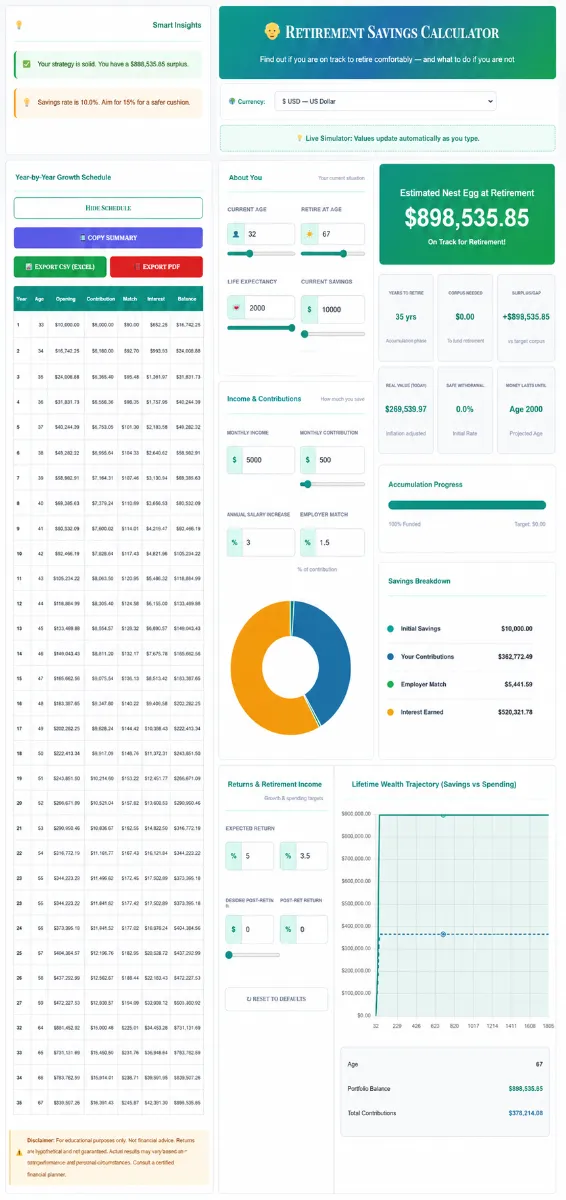
I ran a simple scenario through SaveXpert’s Retirement Saving Calculator: $18,000 already contributed to an eligible employer plan during 2026. The IRS limit is $24,500. That leaves a $6,500 gap before considering any plan restrictions, compensation limits, or eligibility rules.
📈 Check Your Contribution Gap — Retirement Savings Calculator
Plug in your year-to-date contribution, your salary, and your employer match to see how the $24,500 limit, catch-up amounts, and combined §415(c) ceiling interact for your specific situation
Educational note: This calculator models contribution scenarios for illustrative purposes and does not provide personalized financial advice. Source: IRS 401(k) Contribution Limits
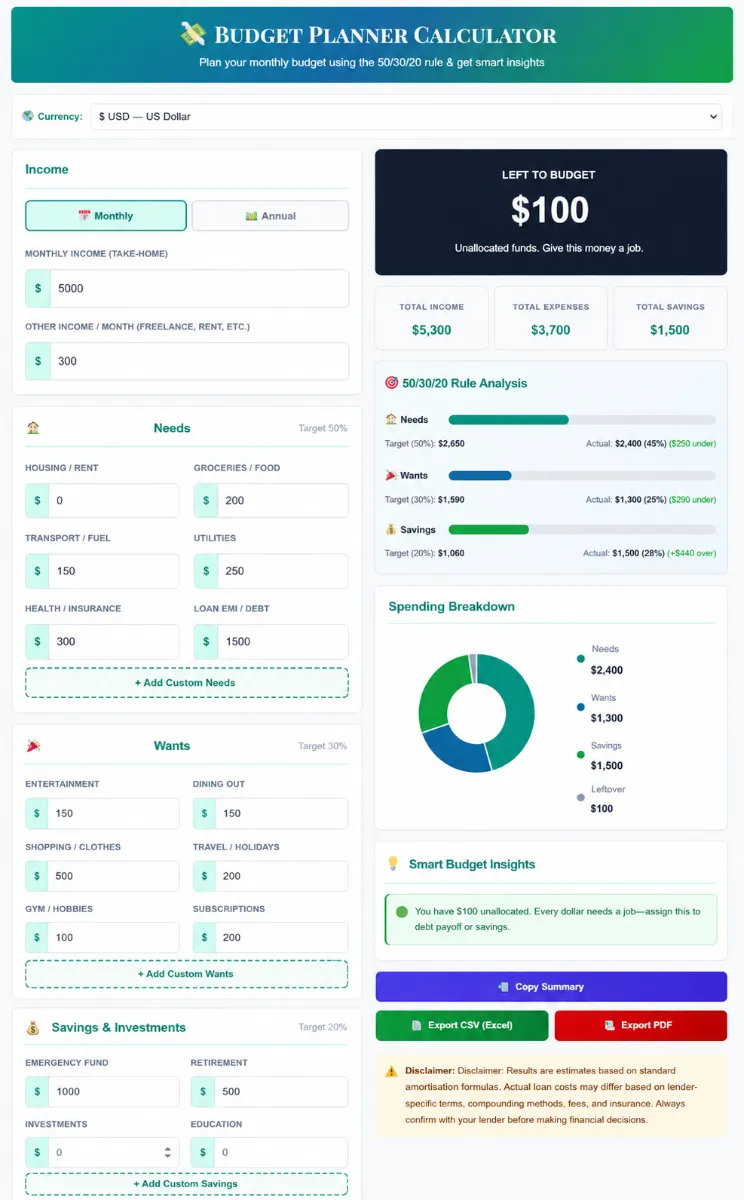
The research brief also identifies the Budget Calculator as a second tool suited to this review — specifically because the year-end exercise centers on actual income, spending categories, recurring expenses, and what needs to change for the next budget year.
💰 Map Your 2027 Budget — Budget Planner Calculator
I ran the updated 2026 figures — new contribution limits, revised SSA benefit, 2026 standard deductions — through SaveXpert’s Budget Calculator to build a realistic 2027 starting budget. Try your own numbers here.
Educational note: This calculator illustrates budgeting scenarios and does not provide personalized financial advice. Source: BLS Consumer Expenditure Surveys
What the Data Shows Works
Based on what I found across IRS, CFPB, SSA, BLS, and Federal Reserve materials, these are the five research-supported steps the data consistently backs for a year-end review.
Separate account types.
The IRS gives different limits for employer plans ($24,500) and IRAs ($7,500). They also follow different deadline mechanics. Treating them as interchangeable produces errors in both directions — missed contributions and false urgency. (IRS 401(k) Limits)
Check plan-specific eligibility.
The IRS states that limits depend on plan type, compensation, age, participation, income, and employer rules. A published limit is not an automatic personal entitlement to that full amount.
Review credit reports for errors.
CFPB data supports checking reports for inaccurate or unauthorized information. The April 2026 change in the complaint process means the dispute sequence now runs bureau-first before CFPB escalation. (CFPB Credit Reports)
Update the budget against real spending.
National averages — CPI-U, savings rate, COLA — provide context but not a personal number. Comparing actual household spending by category gives a more accurate read than applying a national percentage.
Treat private publisher checklists as guidance, not rules.
Bankrate, NerdWallet, and Investopedia offer editorial guidance. IRS, CFPB, SSA, BLS, and Federal Reserve publications govern the official figures. A year-end review should be grounded in the official numbers while using private guides as organizational aids, not as authority.

Realistic Expectations for December 2026
A year-end review can identify contribution gaps, credit-report errors, budget changes, and updated tax-year numbers before the calendar year closes. But the research also shows that some items need more time than a December sprint can deliver.
CFPB dispute procedures generally give furnishers or reporting agencies about 30 days to investigate and respond. Credit-report corrections rarely finish by December 31 if you start in late December. Starting in November gives the process room to run.
The retirement and tax review also depends on specific account and taxpayer situations. The research supports checking the applicable 2026 limits and rules. What it doesn’t establish:
| Item | What Research Supports | What Research Doesn’t Establish |
|---|---|---|
| 401(k) salary deferral deadline | Tied to final eligible payroll period | Universal December 31 cutoff for every plan |
| Roth IRA contribution deadline | Different from employer-plan mechanics | An exact December 31 hard stop (generally Tax Day 2027) |
| RMD deadline | General starting age is 73 | That every RMD must be December 31 (exceptions exist) |
| Tax-loss harvesting deadline | Realized losses must be in a tax year | A blanket “always December 31” rule without consulting tax records |
Source: IRS Retirement Plans, CFPB
Your 5-Step Year-End Money Checklist for 2026
1. Check your employer plan balance now:
Find your year-to-date 401(k) contribution. Compare it to $24,500 (or $32,500/$35,750 if you qualify for catch-up). If there’s room and you want to close the gap, talk to HR about the last eligible payroll date — not December 31.
2. Track your IRA against $7,500 — but don’t panic at December 31:
Unlike employer plans, IRA contributions can generally be made until Tax Day 2027. Still, tracking your 2026 progress now avoids a scramble in April.
3. Pull all three credit reports at AnnualCreditReport.com:
Review names, addresses, accounts, balances, and public records for errors. If you find something wrong, dispute it with the bureau directly first — that’s the new CFPB sequence as of April 7, 2026.
4. Update your budget with the 2026 numbers:
New contribution limits, the revised SSA benefit amount, updated standard deductions, and any OBBBA deductions you qualify for (senior $6,000, tips, overtime) all feed into an accurate 2027 budget baseline.
5. Flag any item that needs a professional:
RMD calculations, tax-loss harvesting timing, Roth IRA eligibility, and any new OBBBA deductions with phase-out ranges all benefit from a tax professional’s review before December 31. The checklist identifies the issues; the professional closes them.
“The most useful thing I found in going through the official data is how many separate systems feed into a year-end review. No single federal rule creates a universal money checklist. A retirement deadline doesn’t match an IRA deadline. A Social Security increase doesn’t automatically change your personal inflation rate. The checklist works when you separate these.”
— Kevin Brown, Lead Researcher at SaveXpert.com
Frequently Asked Questions
Ans: According to IRS and CFPB guidelines, a year-end money checklist 2026 should prioritize updating household cash flow, verifying 401(k) contributions against the $24,500 limit, and reviewing credit reports for accuracy. The data shows that separating tax, retirement, and budgeting tasks is what ensures people address rigid employer payroll deadlines — which close with the final December paycheck — before the calendar year ends.
Ans: IRS data shows that individual retirement accounts use different limits and timelines than employer plans. A year-end financial review should track progress toward the $7,500 combined IRA limit for 2026 — but IRA contributions generally are not subject to a strict December 31 cutoff. Taxpayers typically have until the tax filing due date in 2027 to make 2026 IRA contributions. The research supports tracking the limit now; it does not support treating December 31 as a hard IRA stop.
Ans: According to the IRS, applicable retirement-account owners generally begin required minimum distributions at age 73. While many account holders must complete RMDs by December 31 of the current tax year to avoid a 25% excise tax penalty, the official rules include exceptions based on account type and birth date — particularly for the very first RMD. The research supports identifying whether an RMD applies and confirming the rules with a plan administrator or tax professional rather than assuming a universal December 31 deadline.
Ans: Tax-loss harvesting involves selling securities at a loss to offset capital gains liability in a tax year. Realized losses generally must be finalized by December 31 to count for the 2026 tax year — that part of the deadline is real. However, the wash-sale rule (which disallows the deduction if you buy a substantially identical security within 30 days) and your specific tax situation require review against current IRS guidance before executing any year-end sale. The research points to IRS materials on capital assets rather than a generic “always do it by December 31” rule.
Ans: Federal Reserve and CFPB research indicates the most effective financial review starts with comparing actual household spending against expected budget categories. A practical review logs actual cash flow, checks debt payments, reviews credit reports, and updates 2027 budget expectations based on the latest BLS CPI-U data and the SSA cost-of-living adjustment. The IRS 2026 updated limits — $24,500 for employer plans, $7,500 for IRAs, and new standard deductions — provide the official numbers to build around.
Ans: The One Big Beautiful Bill Act introduced several new above-the-line deductions for tax year 2026, per IRS IR-2025-103. These include a $6,000 enhanced senior deduction for taxpayers age 65 or older (available 2025–2028, subject to MAGI phase-out), a deduction of up to $25,000 for qualified tips, up to $12,500 ($25,000 for joint filers) for qualified overtime, and up to $10,000 in qualified passenger vehicle loan interest. These deductions are available to both itemizers and non-itemizers, and they are separate from the standard deduction — not a replacement for it.