
ⓘ Educational Disclosure:
This article is for educational and informational purposes only. It does not constitute financial, legal, tax, insurance, lending or advice. SaveXpert and its authors are not licensed financial, insurance, tax, lending or benefits advisors. Always consult a qualified professional before making financial decisions.
The number that caught my attention when I started this research was 26. Not because it’s unusual — because it breaks every standard monthly budget template that assumes 12 equal income months. If you’re paid every two weeks, your income doesn’t arrive monthly. It arrives on a 26-paycheck-a-year schedule, and most budgeting advice doesn’t account for that.
Key Takeaways
- Problem: Many Americans struggle to cover monthly bills on time because their income arrives every two weeks, creating a frustrating cash-flow mismatch between 26 paydates and 12 billing months.
- Solution: CFPB research supports using a cash-flow calendar that places your actual pay dates and bill due dates on the same timeline — rather than a standard monthly budget — to prevent cash shortages before your next paycheck arrives
- Result: This timing-based approach creates clearer visibility into cash flow and makes the two three-paycheck months visible before they arrive, allowing deliberate allocation rather than surprise.
- Source: CFPB — Your Money, Your Goals Toolkit · Federal Reserve — 2025 Household Well-Being Report
- Time To Read: 6 Minutes
Table of Contents
1. Why 26 Paychecks Can Make Budgeting Feel Strange
2. Biweekly vs. Semimonthly Pay: The Difference Matters
3. How to Budget When You Get Paid Biweekly Around Monthly Bills
4. What to Do With the Two Extra Biweekly Paychecks
5. How Much Should You Save From Each Biweekly Paycheck?
6. The Research-Backed Approach to Biweekly Budgeting
7. What Americans Can Realistically Expect
Here is what the research shows: To effectively solve how to budget when you get paid biweekly, build your budget around your actual 26 annual paydays and specific bill due dates. The Consumer Financial Protection Bureau recommends using a cash-flow calendar rather than a standard monthly budget — placing paydates and bill due dates on the same timeline to prevent cash shortages before your next paycheck arrives.
Why 26 Paychecks Can Make Budgeting Feel Strange
The IRS uses 26 annual pay periods for employees paid every other week. Semimonthly workers, by comparison, use 24 pay periods. That two-period difference is where the biweekly budgeting problem originates.
It creates two additional pay periods across the year — and explains why some months contain three biweekly paychecks instead of two. The problem isn’t simply having more paydays. Many bills arrive monthly, while your paycheck arrives every two weeks. This timing mismatch can make a monthly budget look fine on paper while cash feels genuinely tight before certain due dates.
I went through published research from the CFPB, IRS, Bureau of Labor Statistics, and Federal Reserve. Here is what the data says about building a workable biweekly budget.

Biweekly vs. Semimonthly Pay: The Difference Matters
The Bureau of Labor Statistics defines biweekly pay as every two weeks and semimonthly pay as twice per month. Those schedules sound similar, but they don’t produce the same number of paydays — and that difference directly affects how workers plan annual expenses.
| Payroll Frequency | Paychecks Per Year | Share of Private Establishments (Feb 2023) |
|---|---|---|
| Biweekly (every 2 weeks) | 26 | 43.0% |
| Weekly | 52 | 27.0% |
| Semimonthly (twice per month) | 24 | 19.8% |
| Monthly | 12 | 10.3% |
Source: Bureau of Labor Statistics — February 2023 establishment survey. Described by the BLS as a point-in-time snapshot, not a continuous time series.
Biweekly payroll is the most common schedule among U.S. private establishments — used by 43.0% of employers as of February 2023. That means most American workers facing the biweekly budgeting challenge aren’t outliers. They’re the majority.
One common mistake is treating the two extra paychecks as automatic bonuses. The research doesn’t support that assumption. The extra pay periods come from the mathematical difference between 26 biweekly periods and 24 semimonthly periods — not from any additional compensation. The IRS Form W-4 handles annual withholding amounts by dividing them across the applicable number of pay periods. It doesn’t designate a third paycheck as a bonus.
How to Budget When You Get Paid Biweekly Around Monthly Bills
The strongest official finding in this area centers on cash-flow timing — not a named budgeting formula.
CFPB research found that mismatches between income timing and bill timing can create cash-flow problems. Its research also found that changing bill due dates to better align with income flow could help some consumers manage cash flow. That finding changes how a biweekly budget should be viewed.
Instead of looking only at total monthly income and total monthly expenses, the cash-flow approach places paydays and bills on the same timeline. A household can identify which bills fall before each payday — creating a clearer picture of when money needs to remain available and which paycheck covers which obligation.
💡 CFPB timing guidance: The CFPB’s bill-calendar tools recommend leaving a timing buffer before each payment. For bills paid by mail, the CFPB tool uses a 7-day lead time. For online or in-person payments, it uses 2–3 days. These aren’t federal rules — they show how the CFPB structures a practical bill calendar around real payment processing time. The CFPB updated its Your Money, Your Goals toolkit in April 2026, including bill calendars, spending trackers, and cash-flow budgeting tools.
The research suggests that matching your money’s arrival dates to your expenses’ due dates is the most effective shift a biweekly budgeter can make — more effective than simply recategorizing spending or switching to a different budget framework.
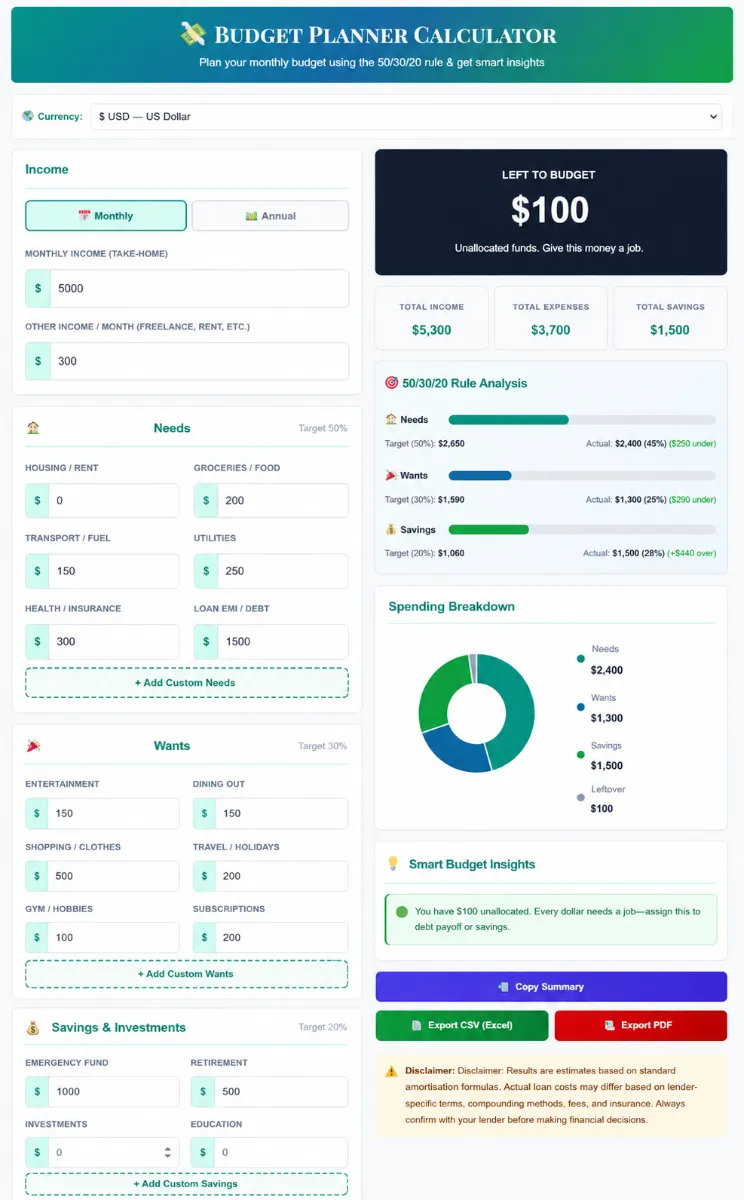
Enter your income and top expenses to see where you stand.
What to Do With the Two Extra Biweekly Paychecks
The research does not identify one universally correct use for the two additional pay periods. No official U.S. government source designates them as financial windfalls or establishes a required allocation.
Consumer finance guides covering this topic suggest identifying when those three-paycheck months will arrive before deciding how to use the extra money. Common approaches include debt reduction, adding to emergency savings, funding long-term goals, prepaying upcoming bills, and discretionary spending. The most useful step is deciding before those months arrive — rather than letting the money disappear into general spending.
Retirement contributions are one possible destination for additional paycheck money, but the IRS limits still apply regardless of pay frequency. For 2026:
General catch-up limit for eligible participants age 50 or older: $8,000
Higher catch-up limit for eligible participants ages 60 through 63: $11,250
Those limits don’t create a rule for extra paychecks. They only matter when someone directs those additional funds toward a tax-advantaged account.
How Much Should You Save From Each Biweekly Paycheck?
This is one of the clearest gaps in the research. No official U.S. source establishes a universal savings percentage for biweekly workers. There is no federal rule requiring someone to save 20% of every paycheck.
Below FRA all year: $23,400 → $24,480 (+$1,080)
Reaching FRA during the year: $62,160 → $65,160 (+$3,000)
The SSA announced a 2.8% cost-of-living adjustment for 2026, with an estimated average increase of approximately $56 per month for Social Security retirement benefits beginning January 2026.
55% of adults reported having emergency or rainy-day savings covering three months of expenses.
63% said they could cover a hypothetical $400 emergency using cash, savings, or a credit card paid off at the next statement.
70% said they could pay an expense of at least $500 using only current savings.
Only 41% of adults said they always or often had money left over at month-end.
30% experienced income variation at least occasionally during the year.
11% struggled to pay bills because their income varied.
Those figures help explain why a single savings percentage doesn’t fit everyone. The same report found that 86% of adults who always had money left over reported three months of emergency savings — compared with just 13% of adults who never did. The Federal Reserve presents this as an association rather than a causal finding.
The CFPB identifies automatic paycheck deposits and splitting direct deposit between checking and savings as mechanisms for consistent contributions — without specifying a dollar amount or percentage. The research therefore supports starting with an annual savings target, then dividing that target across your actual 26 pay periods.
💰 Try SaveXpert’s Budget Planner Calculator for Your Biweekly Setup
I ran a sample biweekly cash-flow setup through SaveXpert’s Budget Calculator. The most useful result came from mapping annual or monthly expenses against actual pay periods and bill dates — rather than treating every month as identical. Enter your own income and expense figures to see how the timing lines up across your 26 pay periods.
Educational note: This calculator models budget scenarios for educational purposes. It doesn’t constitute financial advice. For official budgeting resources, visit the CFPB’s budgeting tools page.
The Research-Backed Approach to Biweekly Budgeting
Based on what I found in the CFPB, IRS, BLS, and Federal Reserve data, the budgeting method that consistently shows the strongest support is cash-flow budgeting tied to actual pay dates — not a named method applied generically.
First finding: income and bill timing together.
The CFPB supports looking at income and bill timing on the same timeline, rather than relying on monthly totals alone. This is the core distinction between a standard monthly budget and a cash-flow calendar.
Second finding: bill date alignment.
CFPB research found that aligning bill dates more closely with income flow could help some consumers manage cash flow. The finding applies to some consumers, not all — results depend on individual bill flexibility and servicer policies.
Third finding: automated saving.
The CFPB identifies automatic paycheck deposits and splitting direct deposit between checking and savings as mechanisms for consistent contributions. No required percentage appears in the official sources.
Fourth finding: the money-left-over relationship.
The Federal Reserve found that adults who always had money left over at month-end were more likely to report three months of emergency savings — 86% versus 13% among those who never did. The Federal Reserve presents this as an association, not a proven cause-and-effect relationship.
Fifth finding: named budgeting systems have limited official support.
The official sources reviewed don’t provide controlled evidence proving that zero-based budgeting, the 50/30/20 framework, envelope budgeting, or any other named method works best for every household. Consumer finance publications present these as options, not research-proven winners. The research points more strongly toward the underlying cash-flow discipline than toward any specific named system.
What Americans Can Realistically Expect
The research suggests that budgeting around actual pay dates can make cash-flow timing easier to see. It doesn’t guarantee extra savings, faster debt payoff, or fewer financial problems.
The Federal Reserve’s 2025 data shows that financial conditions vary widely. Thirty percent of adults experienced at least occasional income variation, while only 41% always or often had money left over at month-end. At the same time, 55% had three months of emergency savings and 63% could handle a hypothetical $400 emergency using cash, savings, or a credit card paid off at the next statement.
Those statistics describe household conditions in 2025. They don’t provide a timetable for how quickly any individual can build savings or stabilize cash flow.
The IRS uses 26 pay periods for employees paid every other week, and IRS Publication 15-T provides separate withholding tables for biweekly and semimonthly payroll periods. That distinction matters whenever a household converts an annual goal into per-paycheck contribution amounts — a $6,000 annual savings target, for example, becomes $230.77 per biweekly paycheck rather than $250 per semimonthly one.
The Bottom Line: 5-Step Biweekly Budget Plan
Here is the timing-based approach the CFPB, IRS, and Federal Reserve data supports:
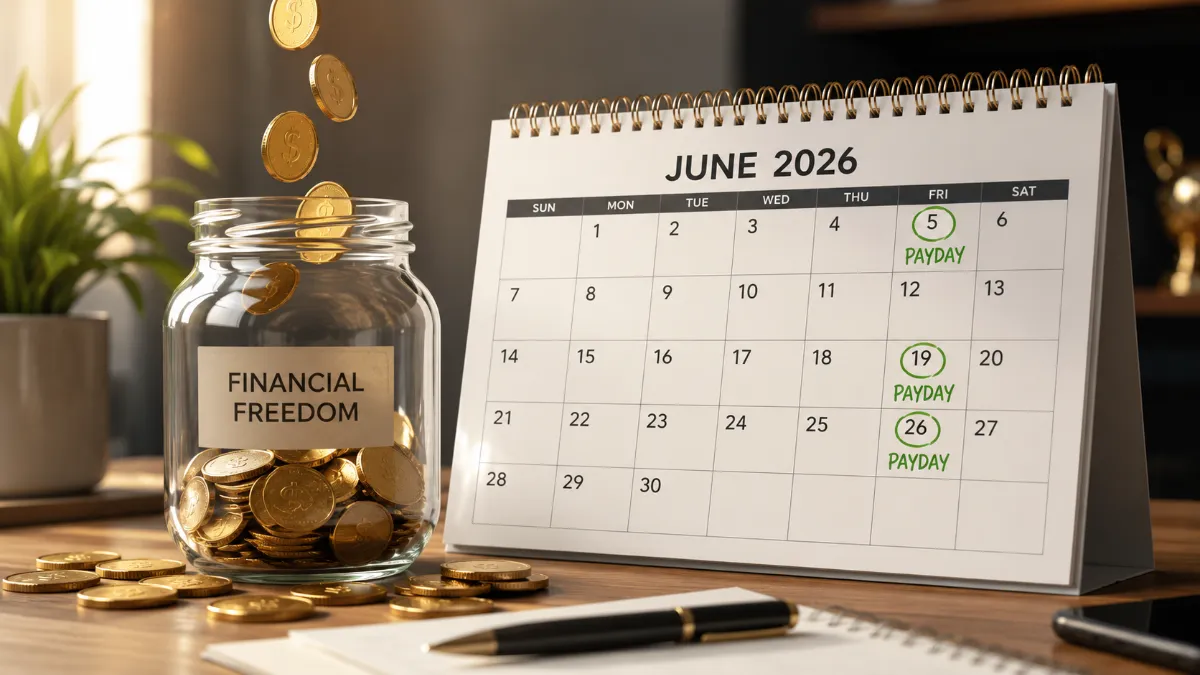
1. Put all 26 paydays on a calendar for the full year — now, before you do anything else:
This is the starting point the CFPB’s cash-flow approach is built on. Most budgeting tools start with spending categories. A biweekly budget has to start with income dates.
2. Add every recurring bill to the same calendar with its exact due date:
Housing, utilities, subscriptions, insurance, minimum debt payments — each with its due date visible next to the relevant paycheck. Leave the CFPB’s recommended buffer: 7 days for mail payments, 2–3 days for online or in-person payments.
3. Assign each bill to the paycheck that will cover it — not the month it’s due:
This is where cash-flow budgeting diverges from monthly budgeting. Some bills may need to wait for the second paycheck of the month. The calendar makes that visible in advance rather than as a surprise.
4. Identify the two three-paycheck months before they arrive:
With all 26 dates on the calendar, those months are visible. Consumer finance guides recommend deciding how to use those paychecks — emergency savings, debt payoff, annual expenses — before the month begins. An unplanned extra paycheck tends to disappear into general spending.
5. Set up automatic savings transfers on payday, not at month-end:
The CFPB supports splitting direct deposit between checking and savings accounts as a mechanism for consistent savings. If the contribution moves automatically on each of the 26 paydays, it doesn’t compete with the decision to spend. Use SaveXpert’s Budget Calculator to model your specific pay-period amounts before setting up the splits.
The data doesn’t say that a particular percentage, envelope, or named formula works for everyone. It points more strongly toward knowing when money arrives, when bills fall due, and how each of the 26 paychecks fits into the annual picture.
“When I went through the CFPB toolkit, the Federal Reserve household data, and the BLS payroll figures, the finding that changed how I framed this topic was also the simplest. The problem isn’t that biweekly pay is complicated. The problem is that monthly budget templates account for months — not 26 pay dates. Once you put those pay dates on the same calendar as bill due dates, the cash-flow picture becomes immediately visible.”
— Kevin Brown, Lead Researcher at SaveXpert.com
Frequently Asked Questions
Ans: According to the Bureau of Labor Statistics and IRS guidelines, the main difference is the number of pay periods. A biweekly pay schedule provides 26 paychecks per year, occurring every two weeks. A semimonthly schedule provides 24 paychecks per year, typically issued on specific dates such as the 1st and 15th of each month. The IRS uses separate withholding tables for each pay frequency — 26 periods for biweekly payroll and 24 for semimonthly — because the two schedules produce different per-paycheck withholding amounts even at identical annual salaries.
Ans: The IRS uses exactly 26 pay periods per year for employees on a biweekly schedule, reflecting 52 weeks divided by two-week intervals. Because there are 52 weeks in a year, two specific months each year contain three biweekly paychecks instead of the usual two. Which months those are depends on the employer’s specific payroll calendar and the first payday of the year.
Ans: No federal rule establishes a required allocation for the two additional pay periods. Consumer finance guidance generally suggests identifying in advance when those three-paycheck months will arrive and assigning a purpose before the money arrives. Common uses include accelerating debt reduction, padding emergency savings, funding long-term goals such as retirement, or prepaying upcoming annual bills. The IRS 2026 retirement account limits — $24,500 for most 401(k) accounts — can also become more reachable when extra paychecks are directed there deliberately.
Ans: The CFPB’s research supports a cash-flow budgeting approach as the most practical method for biweekly earners — placing your 26 pay dates and specific bill due dates on the same calendar rather than relying on monthly spending totals. The official sources reviewed don’t provide controlled evidence that any one named system (zero-based budgeting, 50/30/20, envelope budgeting) produces the best outcome for every household. The research evidence is stronger for the underlying discipline of matching income timing to bill timing than for any specific named method.
Ans: According to CFPB research on cash-flow management, the most effective approach is to map which bills fall due before each specific payday. The CFPB’s guidance recommends adjusting bill due dates to align more closely with paycheck timing when possible, and building in a timing buffer — 7 days for mail payments, 2–3 days for online or in-person payments — to ensure funds are available before the due date. Treating one paycheck as covering the first half of the month and the next as covering the second half is a practical starting point.
Ans: The research doesn’t establish that one pay frequency produces better household financial outcomes than the other. Each schedule has a different number of pay periods — 26 biweekly versus 24 semimonthly — which creates different per-paycheck amounts at the same annual salary and different cash-flow patterns around bill due dates. BLS data from February 2023 shows biweekly is the most common frequency among U.S. private establishments (43.0%). The key budgeting adjustment under either schedule is using actual pay dates — not assumed monthly income — as the foundation of your cash-flow plan.