
ⓘ Educational Disclosure:
This article is for educational and informational purposes only. It does not constitute financial, legal, tax, lending, or investment advice. SaveXpert and its authors are not licensed financial or tax advisors. Always consult a qualified professional before making investment decisions.
What is the 3-3-3 rule for savings? There is no standardized federal definition. No IRS, CFPB, Federal Reserve, SEC, or federal law uses the phrase “3-3-3 rule for savings” as an official designation. The strongest official connection points to the Federal Reserve’s benchmark of three months of living expenses as a financial-resilience measure — not a legal requirement, and not the same as the $400 emergency measure the same report tracks separately.
Key Takeaways
- Problem: Many Americans are confused by conflicting definitions of the “3-3-3 savings rule” and struggle to know exactly how much they should save for emergencies.
- Solution: Research from the Federal Reserve shows that while there is no official federal “3-3-3” definition, saving three months of expenses is the standard benchmark for household financial resilience.
- Result: Data indicates that reaching this three-month expense baseline provides meaningful protection against job loss, economic downturns, or unexpected financial shocks — though the right target depends on household expenses, not a universal dollar amount.
- Source: Federal Reserve SHED 2025, CFPB Emergency Savings Research
- Time To Read: 8 Minutes
Table of Contents
1. The “3-3-3 Rule” — What the Official Sources Actually Say
2. What the Latest Federal Reserve Numbers Show
3. Comparing Savings Frameworks: 3-3-3 vs. 50/30/20
4. What the CFPB and Federal Reserve Actually Recommend
5. Is the Three-Month Benchmark Realistic on a Low Income?
6. Applying the Three-Month Benchmark
7. What the Data Shows Works — and What It Doesn’t
8. Your 5-Step Emergency Savings Plan Using the Federal Reserve Benchmark
Only 55% of U.S. adults reported having savings covering three months of expenses in 2025. That figure comes from the Federal Reserve’s most recent Survey of Household Economics and Decisionmaking, published in May 2026. It’s the same 55% the Fed recorded in 2024. And it’s below the 59% peak reported in 2021. (Federal Reserve SHED 2025)
The same report found that 63% of adults could handle a hypothetical $400 emergency using cash or its equivalent. That’s a different number — and a different question. The distinction between those two figures is exactly why “what is the 3-3-3 rule for savings?” keeps generating confusing answers.

The “3-3-3 Rule” — What the Official Sources Actually Say
The definition problem
The phrase “3-3-3 rule for savings” sounds like a formal federal standard. It isn’t. I went through the Federal Reserve, CFPB, IRS, and SEC materials and found no agency using that specific label as an official designation. Different publishers use the phrase differently — some tie it to three savings categories, some to three months of expenses, some to a three-way income allocation — and none of those interpretations trace back to a federal definition.
That creates a real practical problem. One reader searching “what is the 3-3-3 rule for savings” might be thinking about an emergency fund. Another might be thinking about a budgeting split. The search leads to different answers because the phrase itself isn’t anchored to a single official source.
The strongest official anchor: three months of expenses
The clearest official connection is the Federal Reserve’s use of three months of expenses as a resilience benchmark in its annual household survey. The Fed asks specifically whether households have funds covering three months of expenses if they face illness, job loss, an economic downturn, or another financial shock. That’s the metric. (Federal Reserve SHED 2025)
Notice the wording. The Fed uses expenses, not income. Someone spending $3,000 per month has a three-month benchmark of $9,000. Someone spending $5,500 per month has a benchmark of $16,500. The right number is personal — it comes from the household’s actual monthly outgoings, not a universal figure.
Expenses vs. Income — The Distinction That Changes Everything
| If monthly expenses are | Three-month benchmark | Six-month benchmark |
|---|---|---|
| $2,000 | $6,000 | $12,000 |
| $3,000 | $9,000 | $18,000 |
| $4,500 | $13,500 | $27,000 |
| $6,000 | $18,000 | $36,000 |
These are illustrative calculations using the Federal Reserve’s expense-based framework — not mandated savings targets. Source: Federal Reserve SHED 2025
The research brief specifically warns against treating the Federal Reserve’s survey benchmark as an individualized adequacy test. The 55% figure tells us how many adults reported reaching that level. It doesn’t tell any individual household whether $9,000 or $18,000 is the “right” amount for their specific situation.
What the Latest Federal Reserve Numbers Show
55% vs. 63% — two separate measures
The 2025 SHED report captures two frequently cited figures, and conflating them is where most of the confusion starts. (Federal Reserve Press Release, May 2026)
| Federal Reserve Measure | 2025 Result | What It Actually Measures |
|---|---|---|
| Three-month emergency savings | 55% of adults | Whether households report having savings sufficient to cover three months of expenses in an emergency |
| $400 emergency coverage | 63% of adults | Whether adults would cover a hypothetical $400 unexpected expense using cash or its equivalent |
Source: Federal Reserve: Economic Well-Being of U.S. Households in 2025
Paying a $400 expense doesn’t prove someone has a three-month emergency fund. These two questions measure different thresholds of resilience. That’s why the report presents them separately — and why treating either figure as equivalent to the other misrepresents what the Fed found.
The 10-year trend in three-month savings
The Federal Reserve has tracked the three-month savings measure since 2015. The data shows the share has grown over time but remains below the 2021 peak — meaning roughly 45% of adults still don’t report having that buffer. (Federal Reserve Emergency Savings Data Visualization)
| Year | Adults with 3-Month Emergency Savings | Notable Context |
|---|---|---|
| 2015 | 47% | Baseline measurement year |
| 2019 | 53% | Pre-pandemic high at that point |
| 2021 | 59% | Series peak — stimulus and reduced spending |
| 2022 | 54% | Post-peak decline as inflation rose |
| 2023 | 54% | Held flat |
| 2024 | 55% | Edged up slightly |
| 2025 | 55% | Unchanged — 45% still below benchmark |
Source: Federal Reserve SHED Data Visualization: Emergency Savings Table
💡 Research note — a separate supplemental figure: The 2025 Federal Reserve supplemental data also asked what share of adults could cover three months of expenses after losing their primary income source through borrowing, savings, or selling assets. That figure was lower than 55% — measuring a narrower, more demanding resilience scenario. These two figures measure different things and shouldn’t be combined into a single statistic. (Federal Reserve SHED Data)
Comparing Savings Frameworks: 3-3-3 vs. 50/30/20
Why they’re not the same thing
The research brief treats the “3-3-3 rule” and the 50/30/20 rule as separate concepts — and for good reason. They answer different questions.
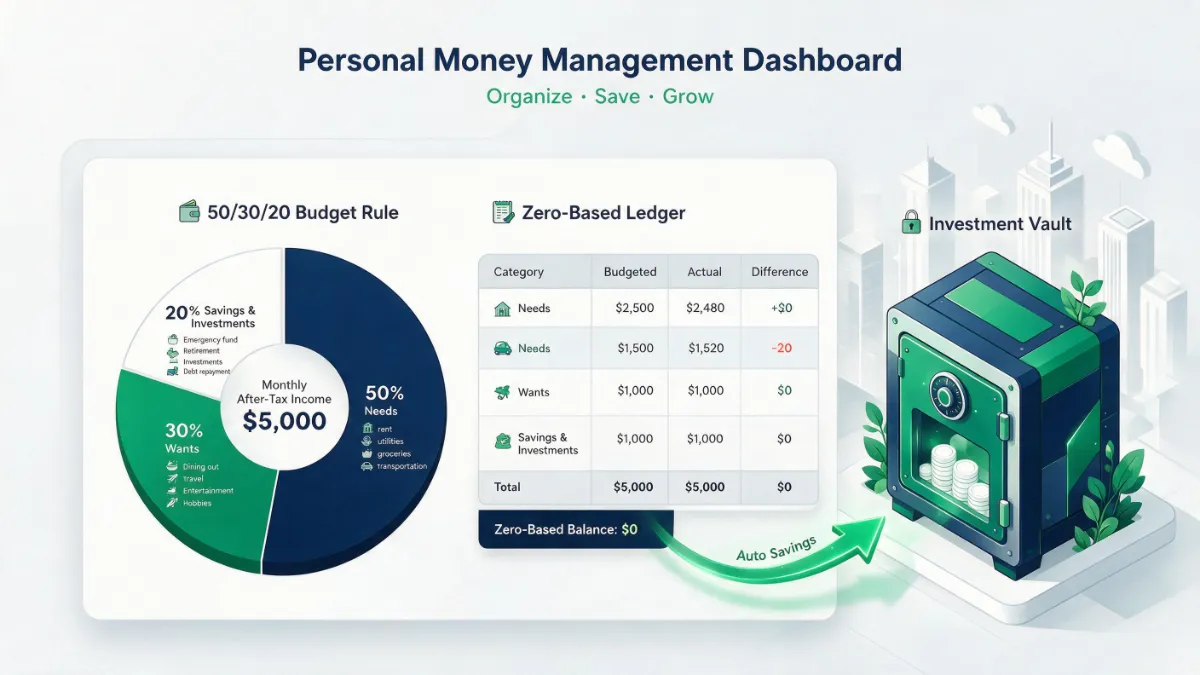
The 50/30/20 rule is a budget-allocation framework. It divides take-home income: roughly 50% toward needs, 30% toward wants, 20% toward savings and debt repayment. It tells you how to slice income going forward. The 50/30/20 rule comes from private financial publications — Bankrate, NerdWallet, and others cite it commonly — but it does not appear as an official federal savings standard in IRS, CFPB, or Federal Reserve materials.
The three-month emergency fund benchmark from the Federal Reserve tells you the target balance to aim for — not how to get there. One framework is about flow; the other is about stock. Using the 50/30/20’s 20% savings rate and the Federal Reserve’s three-month target together is reasonable. Treating them as definitions of the same thing is not.
The “3 rule for retirement” — a separate concept entirely
The research found no official IRS rule creating or modifying a “3-3-3 savings rule” for retirement. IRS retirement rules involve specific contribution limits, tax provisions, distribution requirements, and plan type distinctions — none of which appear in the materials as a “3-3-3” designation.
The Federal Reserve’s three-month emergency-savings benchmark is an emergency liquidity measure. It isn’t a retirement-savings formula. Treating the two as related — or as versions of the same rule — misframes both concepts. (IRS: Retirement Plans)
What the CFPB and Federal Reserve Actually Recommend
No mandatory amount — but clear behavioral evidence
The CFPB discusses emergency savings extensively but doesn’t impose a mandatory savings percentage or universal dollar target. That’s an important distinction from what many readers assume. The CFPB’s role is consumer protection and education — it doesn’t set required savings amounts the way tax law sets contribution limits. (CFPB: Evidence-Based Strategies to Build Emergency Savings)
What the CFPB research does establish is behavioral evidence around how people save. The data shows that people who reported they “don’t save” were nearly three times more likely to report difficulty paying bills than those who reported saving. That association doesn’t prove saving alone causes better financial outcomes — but it’s a meaningful relationship from the CFPB’s own research.
The CFPB’s evidence also found that automatic enrollment, automatic escalation, recurring transfers, and payroll-based saving all showed promise for consistent contributions. The mechanism matters. Setting a target without building a reliable system for reaching it is where most savings plans stall. (CFPB: Evidence-Based Strategies to Build Emergency Savings)
⚠️ CFPB enforcement warning — automated tools carry real risks: The CFPB’s evidence shows that automated saving tools can increase contributions. But automated tools have also created problems when they trigger checking-account overdrafts and generate fees that erase the benefit. The CFPB took enforcement action against Hello Digit LLC specifically for this issue — automatic transfers that caused overdrafts consumers didn’t expect. Any automated saving tool is worth reviewing for overdraft risk before connecting it to a checking account. (CFPB: Hello Digit LLC Enforcement Action)
See how long it takes to reach your target.

Is the Three-Month Benchmark Realistic on a Low Income?
The research doesn’t give one answer for every income level — and the official sources are careful not to claim it does.
CFPB research from 2020 found that more than half of Americans reported having $3,000 or less in combined checking and savings balances. At the same time, half of Americans believed they needed $10,000 or more in emergency savings. That gap between perceived need and reported liquid balances is wide. The data doesn’t say one side is wrong — it shows that closing this gap is where the real work of emergency-fund building sits. (CFPB: Evidence-Based Strategies to Build Emergency Savings)
The CFPB’s behavioral research also suggests that for households with tight cash flow, the mechanism of saving matters as much as the target. Recurring automated transfers and payroll-based saving show the most consistent evidence for building a fund over time — even when the periodic amounts are small. The research doesn’t claim every household can quickly reach a three-month target. It focuses on how to make the process more consistent regardless of starting point.
💡 Research note: Private financial publishers (NerdWallet, Bankrate) often recommend three to six months of expenses as a general guideline. The research brief keeps those separate from the official Federal Reserve evidence. A three-to-six-month range from a private publisher isn’t the same as the Federal Reserve’s specific three-month survey benchmark — even though both involve the same number.
See your target safety net and how close you are.
Applying the Three-Month Benchmark
A calculation example using the Federal Reserve’s framework
The three-month benchmark is built around expenses, so the starting point is knowing monthly outgoings — housing, food, transportation, utilities, insurance, and other fixed or recurring costs. For someone spending $3,000 per month, the three-month target is $9,000. For someone spending $2,000 per month, it’s $6,000. The math is consistent; only the inputs change.
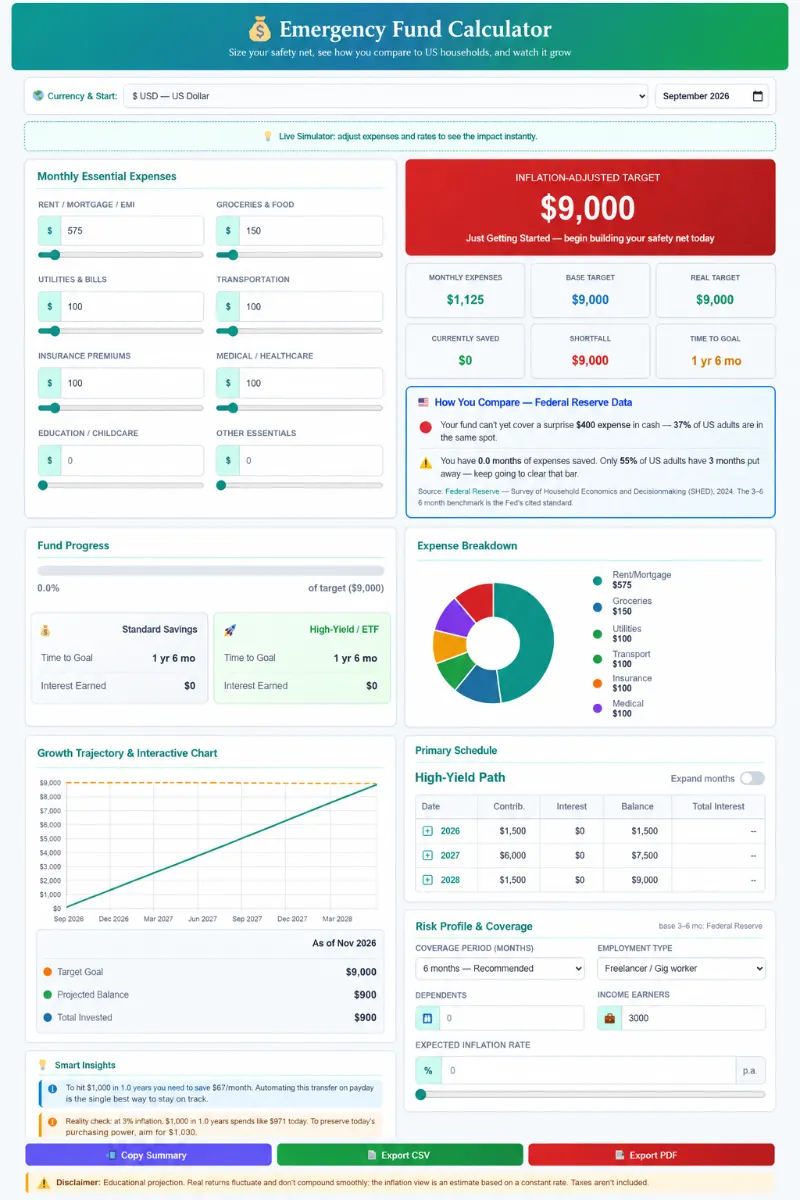
I ran a $3,000/month scenario through SaveXpert’s Emergency Fund Calculator. Here’s the finding: at $500 per month in contributions, reaching a $9,000 target takes 18 months from zero — before accounting for any withdrawals. That’s a real timeline, not a dramatic shortcut. The value of the calculation isn’t the destination; it’s seeing the monthly amount required to get there on a specific schedule.
🛡️ Find Your Three-Month Target — Emergency Fund Calculator
Enter your actual monthly expenses — not income — and the calculator applies the Federal Reserve’s three-month benchmark to show your household-specific target. I used it to confirm the $9,000 example above. Try your own numbers.
Educational note: This calculator converts the Federal Reserve’s three-month expense benchmark into a household-specific figure for planning purposes. It does not provide personalized financial advice. Source: Federal Reserve SHED 2025
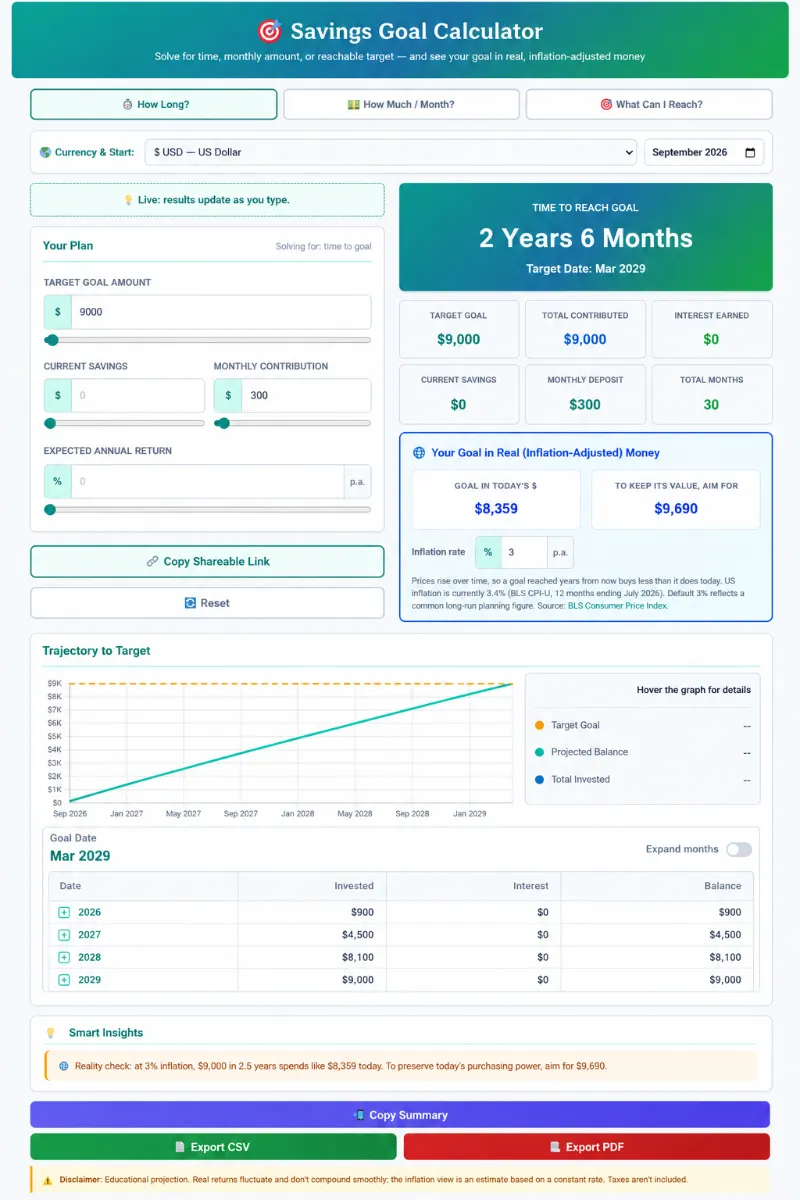
Once you have a target, the next step is converting it into a monthly contribution and estimated timeline — which is exactly what the Savings Goal Calculator is designed for. Knowing that your target is $9,000 is useful. Knowing that you need to save $300 per month to reach it in 30 months — or $500 per month to reach it in 18 months — makes it actionable.
🎯 Map Your Monthly Savings Path — Savings Goal Calculator
Enter your emergency fund target, current balance, and how much you can save per period. The calculator shows the timeline to reach your goal — so the three-month benchmark stops being a number and starts being a plan. I ran the $9,000 example and got a clear monthly savings schedule.
Educational note: This calculator illustrates savings timelines using user-supplied inputs and does not provide personalized financial advice. Source: CFPB: Evidence-Based Strategies to Build Emergency Savings
What the Data Shows Works — and What It Doesn’t
Based on what I found in the Federal Reserve and CFPB research, several findings stand out clearly.
The Federal Reserve uses expenses, not income, as the measure.
Three months of expenses produces a different — and usually lower — number than three months of gross income. The difference matters when setting a target. (Federal Reserve SHED 2025)
55% reported reaching the benchmark in 2025 — unchanged from 2024.
That means 45% of adults still don’t report having three months of emergency savings. The benchmark is achievable but not the norm.
The $400 measure and the three-month measure are separate.
Being able to cover a $400 emergency doesn’t mean you have a three-month emergency fund. The 63% and 55% figures measure different thresholds.
Automatic mechanisms support consistent saving.
CFPB research finds recurring automatic transfers and payroll-based saving show the most promise for households trying to build savings over time. The goal without the mechanism rarely holds. (CFPB Evidence-Based Savings Research)
What the research doesn’t support:
a universal dollar target for all households, a fixed percentage of income as a mandatory rule, or a claim that dividing savings into exactly three categories produces measurably better outcomes. The research brief also flags that no approved official source validates a fixed three-way percentage split as the “3-3-3 rule.”

Your 5-Step Emergency Savings Plan Using the Federal Reserve Benchmark
1. Start with actual monthly expenses:
Add up your real monthly outgoings — housing, food, transportation, utilities, insurance. Use expenses, not income. This is the input the Federal Reserve benchmark requires, and it’s the only number that produces your household-specific target.
2. Multiply by three to get your target:
That’s the Federal Reserve’s three-month benchmark. Use the Emergency Fund Calculator above to confirm the number, then treat it as the destination for your savings plan — not a universal standard.
3. Divide the gap by your available saving periods:
Subtract what you’ve already saved from the target, then divide by the months or paychecks available. The Savings Goal Calculator does this automatically. The result is the recurring amount that closes the gap.
4. Automate the transfer — with an overdraft check first:
CFPB research supports recurring automated transfers as the most consistent mechanism. But review any automated saving tool for overdraft risk before connecting it to your checking account — the Hello Digit enforcement case shows that risk is real.
5. Don’t stop at $400:
Handling a $400 emergency and having a three-month emergency fund are two separate thresholds. The Federal Reserve measures both — and the gap between 55% and 63% shows that millions of Americans can handle the small shock but not the big one.
“When I went through the Federal Reserve and CFPB material, the most useful finding was what the official sources don’t say. They don’t call it the ‘3-3-3 rule.’ They don’t set a universal dollar amount. And they specifically treat the $400 measure and the three-month measure as two separate questions about financial resilience — not two versions of the same thing.”
— Kevin Brown, Lead Researcher at SaveXpert.com
Frequently Asked Questions
Ans: According to Federal Reserve data, there is no standardized federal definition for this phrase. No IRS, CFPB, Federal Reserve, or SEC publication uses “3-3-3 rule” as an official designation. The strongest official connection points to the Federal Reserve’s benchmark of three months of living expenses as a financial-resilience measure — used as a survey metric in the annual Survey of Household Economics and Decisionmaking, not as a legal requirement.
Ans: The Federal Reserve survey data shows that the three-month measure works by calculating three months of actual living expenses, not income. If monthly expenses are $3,000, the three-month benchmark is $9,000. If monthly expenses are $4,500, the benchmark is $13,500. The Federal Reserve doesn’t specify one universal dollar amount — the target is household-specific and expense-based.
Ans: The research treats these as separate concepts. The three-month emergency savings benchmark from the Federal Reserve defines a target balance — how much to have saved. The 50/30/20 rule is a budgeting framework from private financial publishers that allocates income across spending, discretionary, and savings categories — how to use income going forward. One is a stock target; the other is a flow allocation. No official federal source defines the “3-3-3 rule” as a version of the 50/30/20 rule.
Ans: The research found no official IRS rule creating a “3 rule” for retirement savings that dictates tax provisions or contribution limits. IRS retirement rules involve specific contribution ceilings, distribution requirements, and plan type rules — none of which appear in the reviewed materials as a “3-3-3” designation. The Federal Reserve’s three-month emergency-savings benchmark is a liquidity measure, not a retirement-savings formula.
Ans: According to the CFPB’s own research, there is no mandatory savings percentage or universal dollar amount. The CFPB doesn’t function as a savings rule-setter the way tax law sets contribution limits. What CFPB research does establish is behavioral evidence: people who reported not saving were nearly three times more likely to report difficulty paying bills, and automatic enrollment and recurring automated transfers showed promise for consistent saving over time.
Ans: The timeline depends entirely on the gap between your current balance and your expense-based target, divided by how much you can save each period. Using the Federal Reserve’s framework: someone with $3,000 in monthly expenses targeting $9,000 who can save $300 per month from zero takes 30 months. At $500 per month, that drops to 18 months. The CFPB research supports automating the recurring transfer as the most consistent path — the amount matters less than the reliability of the mechanism.