
ⓘ Educational Disclosure:
This article is for educational and informational purposes only. It does not constitute financial, legal, tax, or lending advice. SaveXpert and its authors are not licensed financial advisors. Always verify current eligibility, loan type, and repayment rules with a qualified financial-aid professional before making borrowing decisions.
The finding that caught my attention from the CFPB research wasn’t about budgeting methods at all. It was this: 96% of survey respondents had made a budget at some point — but only 12% compared their actual spending with their budget daily. That gap between creating a budget and actively using one is where zero-based budgeting either earns its reputation or doesn’t.
Key Takeaways
- Problem: Many Americans struggle to manage their finances due to income uncertainty, lack of time, and the daily hassle of tracking expenses — even when they know budgets exist.
- Solution: Zero-based budgeting assigns every dollar of monthly take-home income to specific expenses, debt payments, and savings until the unassigned balance reaches exactly $0 — based on consumer-finance models documented by the CFPB.
- Result: Research indicates that actively tracking money and receiving timely spending feedback can reduce overall spending by up to 9.6%. The data supports tracking and feedback more strongly than any specific budgeting method.
- Source: CFPB — “Consumer Insights on Managing Spending” · Federal Reserve 2025 Household Well-Being Report
- Time To Read: 9 Minutes
Table of Contents
1. Why Zero-Based Budgeting Gets Attention
2. What Is Zero-Based Budgeting, According to the Research?
3. Zero-Based Budgeting vs. the 50/30/20 Rule
4. Is Zero-Based Budgeting Good for Beginners?
5. How Do I Set Up a Zero-Based Budget for the First Time?
7. What Are the Main Disadvantages of Zero-Based Budgeting?
8. What Can Americans Realistically Expect?
What is zero-based budgeting? It’s a detailed financial planning method that assigns every dollar of your planned take-home income to specific expenses, debt payments, and savings until the remaining unassigned balance reaches exactly $0. According to the Consumer Financial Protection Bureau, executing this framework and tracking allocations closely can help consumers significantly reduce unnecessary spending. A zero balance doesn’t mean every dollar gets spent — some dollars get assigned to savings, retirement, or debt payoff goals.
The federal sources I reviewed don’t publish a consumer-facing definition specifically titled “zero-based budgeting.” The working definition here follows standard consumer-finance usage, consistent with how the CFPB describes budgeting as a plan for expected income and how money will be saved or spent during a defined period.
Why Zero-Based Budgeting Gets Attention
A CFPB-reviewed study found that consumers who received timely spending feedback spent 9.6% less during the trial than those without that feedback. That points to something grounded: knowing where money stands can affect spending decisions — when the tracking is actually happening.
The problem for many Americans isn’t simply not knowing that budgets exist. CFPB research found that consumers struggle with income and expense uncertainty, lack of time, and the hassle involved in creating or following a budget. The research also found that many people don’t regularly compare actual spending with planned amounts.
💡 Research note: The CFPB’s Consumer Insights research specifically found that guaranteed saving rules outperformed spending-contingent rules. Guaranteed saving rules were associated with a roughly 1.5-to-3.5-times larger increase in maximum savings or likelihood of reaching selected milestones. That’s evidence for structured, committed saving — not just category creation.

What Is Zero-Based Budgeting, According to the Research?
Picture your take-home monthly income as money that needs a planned destination. Instead of leaving an unexplained amount sitting in the budget, the method assigns income to spending, savings, debt payments, and financial goals until nothing remains unassigned. That zero balance is the signal that every dollar has a purpose — not that every dollar gets consumed.
CFPB budgeting materials include savings as a budget category, and Investor.gov tells consumers to track income and expenses while including saving and investing. The working categories that define the zero-based approach — income, expenses, debt payments, savings, and financial goals — align directly with how those federal sources describe budgeting in practice.
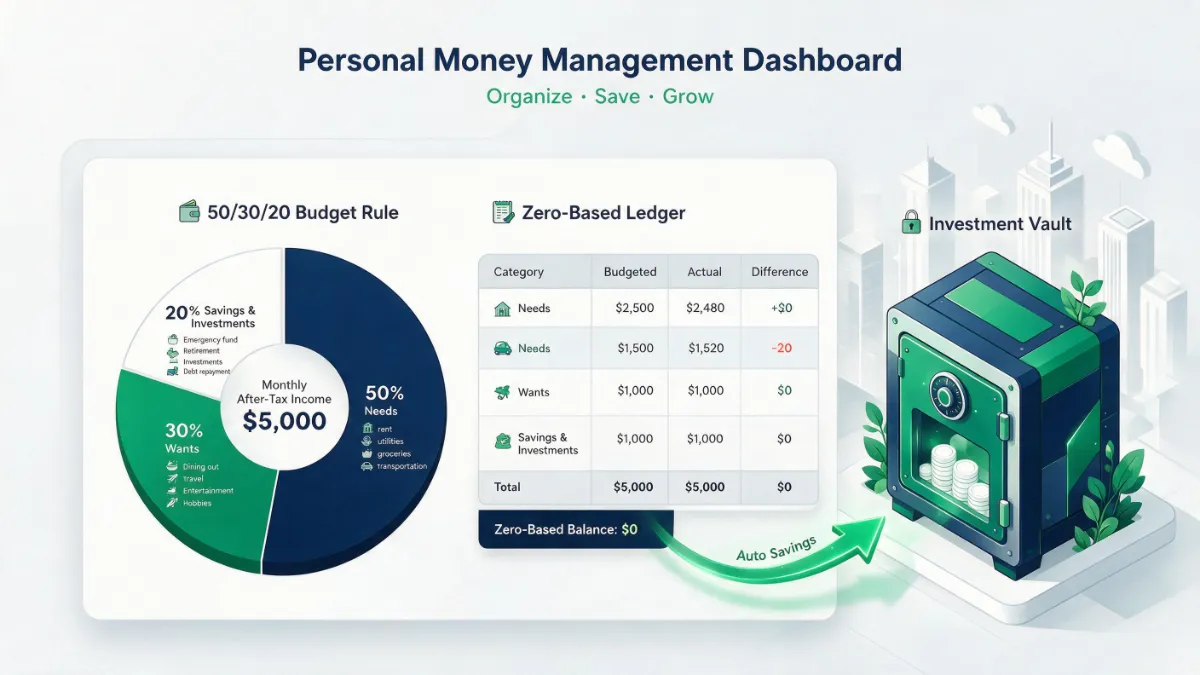
A simple example shows the structure. A household with $5,000 in monthly take-home income allocates that amount across housing, transportation, food, debt payments, savings, and other planned categories. When the total reaches $5,000, the calculation reaches $0. Every dollar has an assigned purpose, whether that purpose is spending, saving, or paying down debt.
Zero-Based Budgeting vs. the 50/30/20 Rule
The biggest difference is how the budget gets constructed. Zero-based budgeting assigns available income to specific purposes until the remaining unassigned amount reaches zero. The 50/30/20 rule starts with broad percentages instead.
The CFPB published a budgeting worksheet using 50% for needs, 30% for wants, and 20% for savings. The CFPB also published a separate spending worksheet using 50% for needs, 20% for savings and debt payments, and no more than 30% for wants. These examples show that even CFPB materials treat percentage-based budgeting as a framework rather than a mandatory formula.
The research doesn’t establish that zero-based budgeting produces better long-term outcomes than the 50/30/20 rule. The government studies reviewed for this article didn’t directly compare those two methods over long periods. That distinction matters because a popular budgeting framework isn’t automatically an evidence-based winner.
The difference becomes clearer with a real household example. Suppose someone earns $4,000 after taxes. A percentage-based rule could divide that income into broad buckets. A zero-based budget could instead assign exact dollar amounts to rent ($1,400), utilities ($120), groceries ($400), transportation ($300), insurance ($150), debt payments ($300), retirement savings ($200), emergency fund ($130), and discretionary spending ($1,000) — each category a deliberate decision, not a residual.
Is Zero-Based Budgeting Good for Beginners?
The CFPB research gives a mixed answer. Budgeting can provide structure, but creating and maintaining one can also create friction. In its 2017 research, 40% of survey respondents cited income or expense uncertainty as a reason they didn’t follow or create a budget. Another 23% cited lack of time, and nearly 20% cited excessive hassle.
The same research found that 96% of respondents had made a budget at some point. Yet only 12% compared spending with their budget daily, while 13% did so weekly. More than half compared monthly or less often. That gap suggests that creating a budget and actively tracking it are genuinely different tasks — and the second task is where most budgets break down.
💡 Research note: More than 90% of CFPB participants expressed interest in a tool or app that could provide real-time spending feedback. Only about 2% reported already having a tool that instantly showed how much money remained available. The CFPB stressed that this prototype research wasn’t statistically representative — so those figures are suggestive rather than conclusive. But the directional finding is strong: people want timely feedback and most don’t have it.
Another complication involves income. Federal Reserve data shows that 30% of adults experienced income that varied at least occasionally during 2025. Another 11% said they struggled to pay bills because their income varied. That makes a rigid monthly budget harder for a meaningful share of households, and the research supports treating income variability as a real factor rather than an exception.
Zero-based budgeting is potentially useful for a beginner who wants detailed visibility into spending. But the CFPB evidence is stronger for timely feedback and regular tracking than for simply creating more categories. Detail without tracking doesn’t produce the outcome.

How Do I Set Up a Zero-Based Budget for the First Time?
The research points toward a process rather than a magic formula. Start with the income figure available for the budgeting period — actual take-home pay, not gross salary. Then account for planned expenses, debt payments, savings, and financial goals until the amount left unassigned reaches zero.
For a household with $5,000 in monthly take-home pay, the budget could contain housing, utilities, food, transportation, insurance, debt payments, savings, retirement contributions, and discretionary spending. The exact dollar amounts depend on the household’s actual obligations rather than a universal percentage.
Current tax and retirement rules can affect those allocations. For 2026, the IRS sets the 401(k), 403(b), governmental 457, and TSP elective-deferral limit at $24,500. The general catch-up limit for eligible participants age 50 and older is $8,000, while eligible participants ages 60 through 63 have a higher $11,250 catch-up limit. The combined traditional and Roth IRA contribution limit for 2026 is $7,500, with an $8,600 limit for people age 50 and older. Those limits don’t define a budgeting method, but they do shape how a retirement allocation fits into a zero-based budget.
For a first budget, the research supports the idea that tracking matters as much as the initial allocation. The CFPB found that consumers often spend more than intended and struggle to know how much remains available. Checking actual spending against the plan is a critical part of the process — not a bonus step.
What the Numbers Look Like in a Real Household
BLS data gives useful scale for what American households actually spend. In 2024, average consumer-unit income before taxes was $104,207, while average annual expenditures reached $78,535 — roughly $6,545 per month.
| Spending Category | 2024 Average Annual Amount | Share of Total Expenditures |
|---|---|---|
| Housing | $26,266 | 33.4% |
| Transportation | $13,318 | 17.0% |
| Personal insurance & pensions | $9,797 | 12.5% |
| Food | $10,169 | 12.9% |
| Healthcare | $6,197 | 7.9% |
| Top 5 categories combined | $65,747 | 83.7% |
| All other expenditures | $12,788 | 16.3% |
Source: BLS 2024 Consumer Expenditure Survey. Figures represent averages across all consumer units and will differ for individual households.
This data matters for zero-based budgeting because it shows how much of a typical household’s income is already committed before any discretionary category appears. A zero-based budget built around the average spending profile would assign more than 83% of income to just five categories — leaving the remaining budget decisions concentrated in the last 17%.
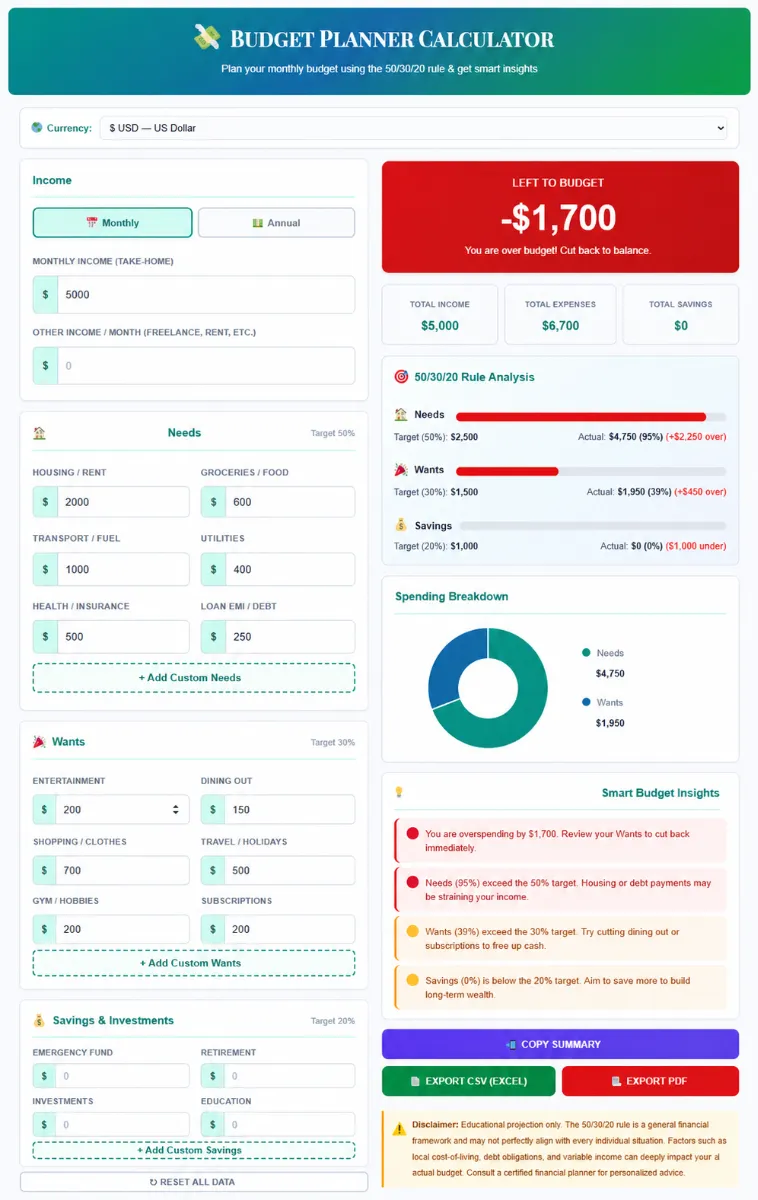
I also ran a $5,000 monthly income scenario through SaveXpert’s Budget Calculator. The structure exposes exactly how much income remains after assigning planned spending, debt, and savings categories — and the Federal Reserve data shows why that number can be smaller than expected. Only 41% of adults said they always or often had money left over at the end of the month in 2025. Among adults with family income below $25,000, that figure dropped to 19%.
Enter your income and top expenses to see where you stand.
What the Data Shows Works
Based on what I found in the CFPB and Federal Reserve data, several approaches consistently show useful signals.
First,
research supports tracking actual spending against a planned budget. CFPB findings show that consumers often struggle to know how much money remains and don’t always compare actual spending with planned amounts. The act of comparing — not just the act of planning — is where the evidence is strongest.
Second,
timely spending feedback can improve spending decisions. The peer-reviewed study cited by the CFPB found a 9.6% reduction in spending among consumers who received composite spending information on credit-card receipts. The feedback mechanism mattered more than any particular budgeting structure.
Third,
CFPB research indicates that guaranteed saving rules outperform spending-contingent rules in certain measured outcomes. In its analysis of proprietary Qapital data, guaranteed saving rules were associated with a roughly 1.5-to-3.5-times larger increase in maximum savings or likelihood of reaching selected milestones. That’s a meaningful signal for households trying to build savings within a zero-based structure.
Fourth,
the data supports treating irregular expenses and income variability as real budget inputs — not special cases. The Federal Reserve found that 30% of adults experienced at least occasional income variation in 2025. CFPB research also found that consumers can underestimate spending on infrequent purchases. A budget built to handle only predictable months isn’t built for how most households actually function.
What the evidence doesn’t support: that zero-based budgeting is superior to the 50/30/20 rule, or that it works equally well for every household. The CFPB identifies time, uncertainty, hassle, irregular expenses, and limited resources as real barriers — not reasons to try harder, but real constraints on which approach makes sense for a specific household.
💰 Build Your Zero-Based Budget with the SaveXpert Budget Planner Calculator
I ran a $5,000 monthly income scenario through SaveXpert’s Budget Calculator. A zero-based structure makes visible exactly how much income remains after assigning every planned spending, debt, and savings category — and the result is often smaller than expected. The BLS data shows the average American household spends $6,545 per month; the Federal Reserve found that only 41% of adults had money left over at month’s end in 2025. Enter your own income and expense figures to see where your budget currently stands.
Educational note: This calculator models budget scenarios for educational purposes. It doesn’t constitute financial advice. For official budgeting resources, visit the CFPB’s budgeting tools page.
What Are the Main Disadvantages of Zero-Based Budgeting?
The clearest disadvantages in the research involve time, complexity, and changing circumstances. Consumer finance publications describe the method as more complex and time-consuming than a traditional approach, and identify the planning demands and challenges created by fluctuating income as practical friction points.
CFPB research adds another layer: consumers often find budgeting and tracking burdensome. The evidence doesn’t show that simply adding more budget categories improves financial outcomes. The stronger evidence points toward timely feedback, structured saving mechanisms, and regular comparison between planned and actual spending.
⚠️ Income variability warning: Zero-based budgeting assumes stable, predictable income to assign to categories. The Federal Reserve found that 30% of adults experienced variable income in 2025 — making a rigid monthly allocation harder to maintain. If your income changes month to month, building a budget from the lowest expected income and treating income above that as a separate allocation decision can reduce the disruption.
That distinction is important for beginners. A detailed zero-based budget can create clarity, but the same detail creates maintenance work. Research doesn’t identify a universal point where more category detail becomes better — and more categories doesn’t automatically mean more financial progress.

What Can Americans Realistically Expect?
The research doesn’t support promises that a zero-based budget will create extra income or guarantee financial stability. In 2025, the Federal Reserve found that 73% of adults reported doing okay or living comfortably financially, while 63% said they could cover a hypothetical $400 emergency expense with cash, savings, or a credit card paid off at the next statement.
The same research found that 58% of adults said price changes had made their finances worse, while 35% said their monthly spending increased from the prior year. Those findings show why a budget may need regular adjustment rather than a one-time setup. A zero-based budget written in January doesn’t automatically reflect what’s happening in August.
The timeframe also matters. The evidence doesn’t establish a fixed number of weeks or months required for zero-based budgeting to improve household finances. The clearest research signal concerns ongoing tracking and feedback — not a guaranteed outcome after a defined period.
The Bottom Line: 5-Step Zero-Based Budget Starter Plan
What should you actually do if you want to try zero-based budgeting? Here’s what the CFPB, Federal Reserve, BLS, and IRS data supports as a practical starting sequence:
1. Start with real take-home income, not gross salary:
Zero-based budgeting is traditionally designed around a monthly cycle, which can create frustrating cash shortages if you are budgeting with a biweekly paycheck and your pay dates don’t align with your bill due dates.
2. List every planned obligation in priority order:
Housing, utilities, food, transportation, and minimum debt payments come first — the BLS data shows these categories already represent more than 83% of the average household budget. Assign a specific dollar amount to each. Not a percentage — a real number based on what you actually owe or plan to spend.
3. Assign savings and debt payoff as fixed categories — not leftovers:
CFPB research shows guaranteed saving rules outperform spending-contingent ones by 1.5–3.5x in certain outcomes. Treat savings as an obligation assigned at the start, not a residual after discretionary spending.
4. Track actual spending at least weekly — not just monthly:
The CFPB data showed 9.6% spending reduction came from timely feedback, not elaborate category design. Checking actual versus planned at least weekly is where the evidence is strongest. Daily comparison is even better — but 12% of budgeters actually do this.
5. Rebuild the budget each month — irregular income and expenses are expected, not exceptions:
The Federal Reserve found 30% of adults had variable income in 2025 and CFPB research shows consumers routinely underestimate infrequent purchases. A zero-based budget is a monthly plan, not a permanent formula. Use SaveXpert’s Budget Calculator to rebuild it each month from your actual income figure.
After reviewing the CFPB, Federal Reserve, BLS, and IRS sources, what is zero-based budgeting is best understood as a strict framework for assigning available income a planned purpose. The strongest research evidence supports tracking, timely feedback, structured saving, and accounting for irregular income — not promising that one budgeting method works for every household.
“When I went through the CFPB research, the Federal Reserve household data, and the BLS spending figures, the most useful finding was a gap most budgeting content skips over. The CFPB found that 96% of respondents had made a budget at some point — but only 12% compared spending with their budget daily. That means the hardest part of zero-based budgeting isn’t building the categories. It’s maintaining the tracking that gives the method its actual evidence base.”
— Kevin Brown, Lead Researcher at SaveXpert.com
Frequently Asked Questions
Ans: Zero-based budgeting is a strict framework that assigns all planned take-home income across specific expenses, debt payments, savings, and financial goals until the unassigned balance reaches exactly $0. According to the CFPB, a budget serves as a plan for expected income and how money gets intentionally saved or spent during a specific period. A zero balance means every dollar has a purpose — not that every dollar gets spent.
Ans: The CFPB data shows that the 50/30/20 rule uses broad percentage targets — allocating roughly 50% for needs, 30% for wants, and 20% for savings — across three buckets. Zero-based budgeting assigns specific dollar amounts to individual categories until the remaining unassigned balance is exactly zero. One approach is faster to set up; the other gives more category-level visibility into where money is going.
Ans: According to the CFPB, budgeting provides structure but creating and maintaining one generates significant friction. Survey data shows 40% of respondents cited income uncertainty and 23% cited lack of time as key hurdles. The research indicates beginners get more measurable benefit from timely spending feedback than from building highly specific budget categories without also tracking them consistently.
Ans: The primary disadvantages in the research centre around time commitments, complexity, and rigidity when circumstances change. Federal Reserve and CFPB research both show consumers find detailed tracking burdensome, and creating specific allocations is particularly challenging when income varies month to month or when irregular expenses occur.
Ans: Federal Reserve and CFPB operational definitions identify the five foundational elements as: income, standard expenses, debt payments, savings allocations, and long-term financial goals. A zero-based budget assigns every dollar of monthly income across those categories, ensuring no income sits unallocated. The BLS Consumer Expenditure Survey shows that for the average American household, just the top five spending categories (housing, transportation, food, healthcare, and personal insurance) account for 83.7% of total annual expenditures.
Ans: The Federal Reserve found that 30% of adults experienced variable income at least occasionally in 2025 — so this isn’t an edge case. The most research-supported approach is building each month’s zero-based budget from the lowest expected income figure. Assign obligations first (housing, minimum debt payments, essential expenses, savings). If income exceeds that baseline, allocate the additional amount at the start of the month rather than treating it as unbudgeted. The CFPB research also found that consumers routinely underestimate irregular expenses — building a dedicated irregular-expense category into the monthly budget directly addresses this.