
ⓘ Educational Disclosure:
This article is for educational and informational purposes only. It does not constitute financial, legal, tax, lending, or investment advice. Kevin Brown is a researcher, not a licensed financial advisor, CPA, or attorney. Figures come from the sources linked in this article, can change, and may not match your situation. All data comes from publicly available government and institutional sources. Always consult a qualified professional before making investment decisions.
Key Takeaways
- Problem: Most homeowners can’t explain why their property-tax bill changed year to year, even when their home’s market value appears stable.
- Solution: The formula — (Assessed Value × Millage Rate) ÷ 1,000 — uses local inputs set independently by state and county governments. Understanding each input is what makes the formula useful in practice.
- Result: Knowing which input changed — assessed value, mill rate, or an exemption lapse — is how homeowners catch billing errors and anticipate future bills.
- Source: IRS Publication 530 · U.S. Census Bureau ACS
- Time To Read: 8 Minutes
Table of Contents
1. How Are Property Taxes Calculated Step by Step?
2. What Is Assessed Value Versus Market Value?
3. What Is a Mill Rate or Millage Rate?
4. Why Did My Property Taxes Go Up?
5. Are Property Taxes Included in My Mortgage Payment?
6. Are Property Taxes Tax Deductible?
7. What Research Shows About Property Tax Appeals and Assessment Outcomes
The median American homeowner paid $3,018 in property taxes in 2024, according to U.S. Census Bureau ACS data. In New Jersey, that figure reached $9,590. In Autauga County, Alabama, it was $627. Same formula, wildly different results — because the inputs depend entirely on where you live.
The formula itself takes about five seconds to run. The harder part is knowing which numbers go into it, and understanding that local governments — not the IRS, not any federal agency — set each input independently.
I went through materials from the IRS, the U.S. Census Bureau, the Tax Foundation, the Lincoln Institute of Land Policy, and several state revenue departments — including Montana, Georgia, and South Carolina — to pull together what official sources actually say about each step.
The Property Tax Formula
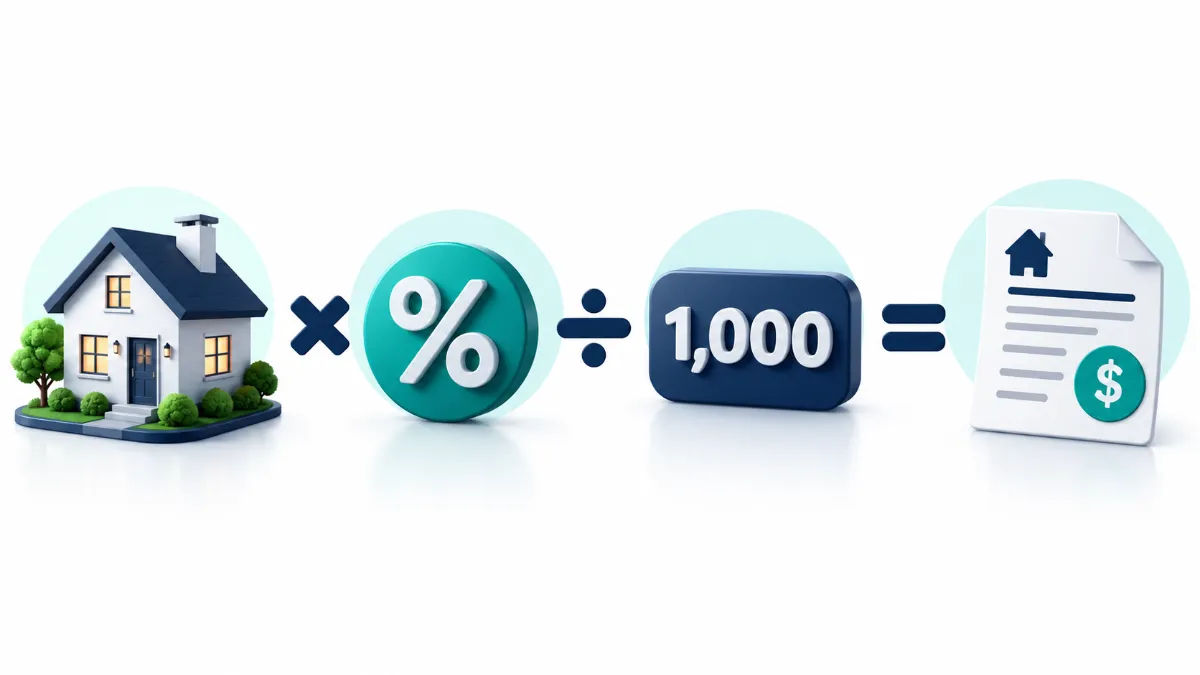
Property Tax = (Assessed Value x Millage Rate) ÷ 1,000
One mill = $1 of tax per $1,000 of assessed value · Assessment ratio set by local jurisdiction
Property taxes use one formula across every US jurisdiction — (Assessed Value × Millage Rate) ÷ 1,000 — but each local input varies independently. Your assessed value comes from your home’s market value multiplied by an assessment ratio that ranges from 4% to 45%, per state revenue departments. Two homes priced identically can carry very different annual tax bills because of that ratio alone.
How Are Property Taxes Calculated Step by Step?
Property taxes follow one baseline formula across every US jurisdiction, but the inputs — assessment ratio, assessed value, and mill rate — are all set locally, which is why homes with identical market values produce such different bills. What changes from county to county are the numbers that go into the formula, not the formula’s structure.
| Step | What You Need | Example Value |
|---|---|---|
| 1. Find market value | County appraisal or recent sale price | $400,000 |
| 2. Apply assessment ratio | Set by local jurisdiction (varies widely) | 20% |
| 3. Calculate assessed value | Market value × assessment ratio | $80,000 |
| 4. Find your millage rate | Set by local taxing authority | 30 mills |
| 5. Run the formula | (Assessed value × mills) ÷ 1,000 | $2,400 annual tax |
Source: Tax Foundation · Montana Department of Revenue · Georgia Department of Revenue
🧮 How this was calculated
Inputs: Market value = $400,000 · Assessment ratio = 20% (illustrative local example) · Millage rate = 30 mills
Main scenario ($2,400):
- $400,000 × 20% = $80,000 assessed value
- $80,000 ÷ 1,000 = $80 (taxable base per mill)
- $80 × 30 mills = $2,400 annual property tax
- $2,400 ÷ 12 = $200/month escrow contribution
Comparison (4% ratio — South Carolina residential, per SC Department of Revenue):
- $400,000 × 4% = $16,000 assessed value
- $16,000 ÷ 1,000 = $16 (taxable base per mill)
- $16 × 30 mills = $480 annual property tax
Result: $2,400/year or $480/year · Simple arithmetic · Assumptions: illustrative examples only; no exemptions applied; assessment ratios and mill rates are jurisdiction-specific
Why the Assessment Ratio Determines Most of Your Bill
In that example, a $400,000 home with a 20% assessment ratio produces an $80,000 assessed value. At 30 mills, the annual tax comes to $2,400. Change the assessment ratio to 4% — South Carolina’s residential rate, per the South Carolina Department of Revenue — and the same $400,000 home produces a $16,000 assessed value and a $480 annual tax at the same mill rate. Same market value, same mill rate, dramatically different bill. The assessment ratio does most of the heavy lifting.
Research from the Montana Department of Revenue and Georgia Department of Revenue confirms this baseline definition: one mill equals $1 of tax per $1,000 of assessed value. That structure holds across states even when surrounding rules differ significantly.
What Is Assessed Value Versus Market Value?
Most property-tax confusion starts with one misunderstanding: assessed value is not what your home would sell for today, and in many jurisdictions the gap between them is intentional. Market value reflects what a buyer would pay in current conditions. Assessed value is what your local government uses in the tax formula after applying a jurisdiction-specific ratio to that market value.
That ratio can shrink the taxable base dramatically. A home worth $400,000 on the open market might carry an assessed value of $16,000 in South Carolina or $180,000 in certain New York City property classes — because the assessment ratios differ, not the homes.
| Jurisdiction Example | Residential Assessment Ratio | Assessed Value on $400,000 Home |
|---|---|---|
| South Carolina (owner-occupied residential) | 4% | $16,000 |
| Mid-range illustrative example | 20% | $80,000 |
| New York City Class 2+ properties | 45% | $180,000 |
Source: South Carolina Department of Revenue · NYC Department of Finance
The difference matters because assessed value feeds directly into the formula. A home assessed at $16,000 and one assessed at $180,000 generate very different tax bills even at the same mill rate.
How Assessment Caps Affect Long-Term Owners
Some jurisdictions cap how fast assessed value can rise from year to year. New York City limits Class 1 residential property increases to 6% annually and Class 2 cooperatives and condominiums to 8%, according to the NYC Department of Finance. Those caps can create a widening gap between market value and assessed value over time — benefiting long-term owners, but creating unexpectedly large bill changes when a property sells or is reassessed.
Research published in the Harvard Journal on Legislation flags a systematic pattern across many US jurisdictions: lower-value properties tend to be over-assessed relative to their market value, while higher-value properties are under-assessed. The researchers identify this as a distributional concern — the tax burden can fall disproportionately on lower-income homeowners in jurisdictions where this pattern exists.
Assessment errors can occur. Assessors can use outdated sales data, mass appraisal models, or incomplete property information. If your assessed value looks inconsistent with nearby comparable sales, an appeal may be worth researching. Note that appeal deadlines are typically set shortly after the assessment notice — not when the final tax bill arrives.
What Is a Mill Rate or Millage Rate?
The millage rate converts assessed value into a dollar amount — one mill equals $1 of property tax for every $1,000 of assessed value, a definition confirmed by the Montana Department of Revenue and the Georgia Department of Revenue. That definition holds consistently across state materials even when the surrounding rules vary.
At 10 mills, a $100,000 assessed value produces $1,000 in property tax. At 20 mills, $2,000. At 30 mills, $3,000. The relationship is linear, but the millage rate isn’t fixed. Local taxing authorities adjust it based on annual budget needs. A homeowner whose property value hasn’t changed can still see a higher tax bill if the rate rises. Those two variables — assessed value and millage rate — move independently of each other and independently of what the home is worth on the open market.
The Tax Foundation’s 2026 analysis adds national context. Property taxes represented 28.9% of total state and local tax collections in fiscal year 2023, and 70.0% of local tax collections specifically. That level of local dependence explains why millage rates respond to local budget pressures: for most local governments, property tax is the primary revenue source.
| State | Effective Property Tax Rate (2024) | Median Annual Bill |
|---|---|---|
| New Jersey (highest) | 2.11% | $9,590 |
| Illinois | ~2.0% | ~$5,000+ |
| U.S. National Median | — | $3,018 |
| Alabama (Autauga County) | — | $627 |
| Hawaii (lowest) | 0.27% | ~$1,900 |
Source: Tax Foundation 2026 · U.S. Census Bureau ACS 2024. State bill figures are illustrative medians; county-level data varies.
The mini calculator below shows how your annual property tax amount translates into a monthly housing-payment impact. For example, the $2,400 annual tax from the 30-mill scenario above adds $200 per month to your PITI. Enter your own assessed value and rate to see what your local inputs produce.
Estimate your monthly payment and total interest in seconds.
Why Did My Property Taxes Go Up?
A property-tax bill can rise because of a higher assessed value, a higher millage rate, or a lapsed exemption — and any one of those can happen without any action on the homeowner’s part. Only one of those inputs is directly tied to what a home would sell for.
A new appraisal can raise your assessed value, which pushes the formula result higher. A local government can raise the millage rate to fund budget needs, which also raises the result — even when your assessed value stayed flat. An exemption that was reducing your taxable value can lapse if it wasn’t renewed or if a qualifying condition changed.
Assessment Cycles and Exemption Lapses
Assessment timing adds another layer. Most jurisdictions reassess properties on a cycle — annually, every few years, or after a sale. If your county last appraised your home three years ago and local prices have risen since, a new assessment can reflect a jump that wasn’t visible on previous bills.
Research on property-tax appeals notes that homestead, senior, and veteran exemptions aren’t always renewed automatically. Missing a renewal deadline or failing to reapply after a move can cause an exemption to lapse and increase taxable value, even when the property itself hasn’t changed.
The Census Bureau’s 2024 ACS data shows how wide that range can run: from $627 in Autauga County, Alabama, to $9,590 in New Jersey — all under the same formula. Identifying which input drove your specific change — assessed value, millage rate, or exemption lapse — is the first step in evaluating whether the bill is accurate.
Are Property Taxes Included in My Mortgage Payment?
For most homeowners with a mortgage, property taxes appear in the monthly payment through an escrow account managed by the mortgage servicer — they don’t go directly from you to the county. The monthly payment follows the PITI structure: principal, interest, taxes, and insurance.
The taxes portion represents approximately one-twelfth of the estimated annual tax bill. At the $3,018 national median, that tax contribution alone adds about $251.50 per month to the housing payment before other costs.
🧮 How this was calculated
Inputs: National median annual property tax = $3,018 (Census Bureau ACS 2024)
- $3,018 ÷ 12 months = $251.50 per month
Result: $251.50/month · Simple arithmetic · Assumptions: national median only; actual escrow depends on the specific local tax bill
IRS Publication 530 draws an important distinction that affects the federal deduction. Money deposited into a mortgage escrow account isn’t the same as property taxes paid to the taxing authority. For deduction purposes, only the amount actually disbursed from escrow and paid to the local tax collector counts. The deposit date and the payment date are two separate events under IRS rules.
Use the Mortgage Calculator to See the Full PITI Picture
Entering your actual property tax amount into SaveXpert’s Mortgage Calculator shows exactly how that cost affects your full monthly PITI payment. The calculator adds it alongside principal, interest, and insurance automatically.
🏠 Try the SaveXpert Mortgage Calculator
Enter your estimated annual property tax alongside your loan amount, rate, and insurance to see your full monthly PITI breakdown. Run your own numbers — it takes about a minute.
Educational note: This calculator models monthly housing costs and does not provide personalized financial or tax advice. Escrow rules: CFPB Regulation X 1024.17
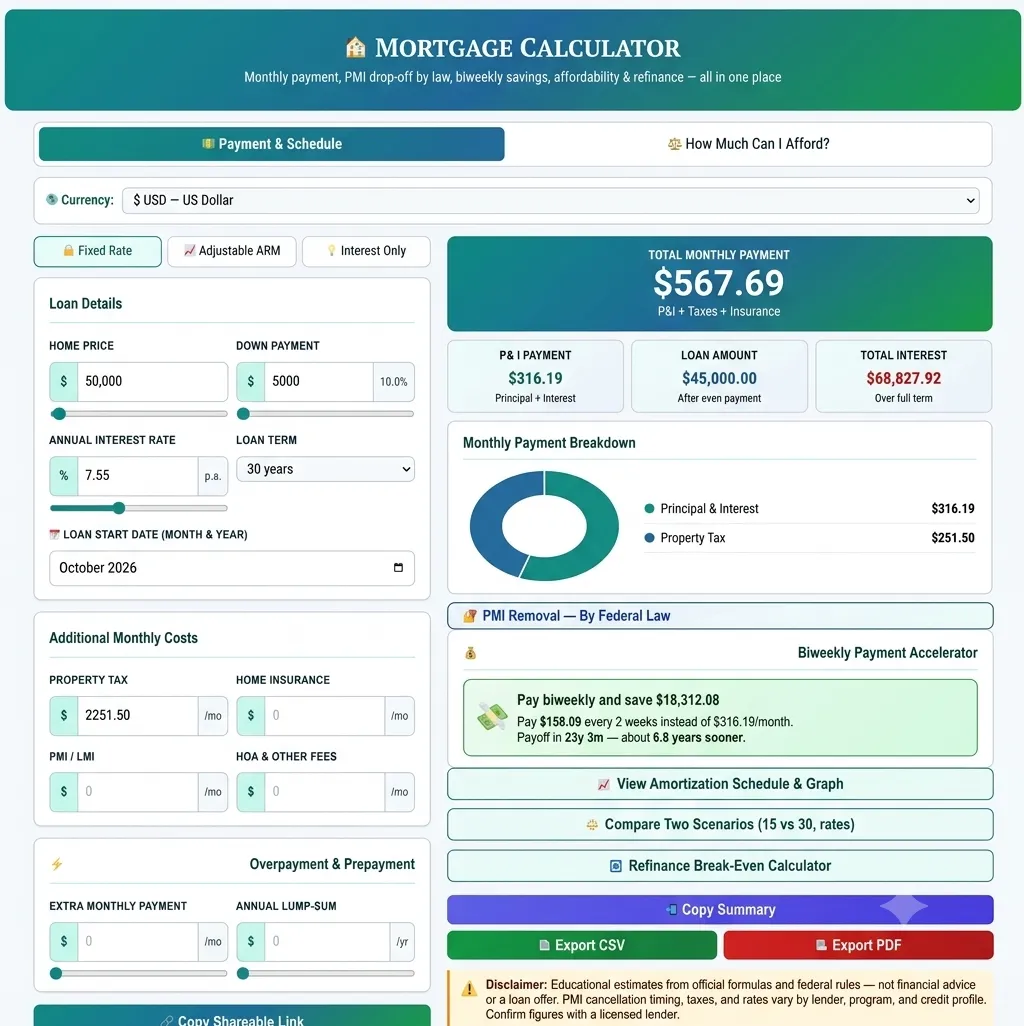
What this shows: The SaveXpert Mortgage Calculator lets you enter your estimated annual property tax to see its monthly contribution to your full PITI payment. The interface breaks out principal, interest, taxes, and insurance separately, with a payment breakdown chart and amortization schedule.
Are Property Taxes Tax Deductible?
Property taxes can qualify for a federal SALT deduction, but the rules changed significantly in 2025, and not every charge on a property-tax bill qualifies. The deduction is only available to taxpayers who itemize on Schedule A — and the 2025 update raised the combined SALT cap substantially from the prior $10,000 limit.
For tax year 2025, IRS Publication 530 cites a SALT deduction limit of $40,000 for individual filers and $20,000 for married taxpayers filing separately. This combined limit covers state and local income taxes, sales taxes, and property taxes together — not property taxes alone. The increase came from the One Big Beautiful Bill Act, according to Congressional Research Service materials.
| Tax Year | SALT Limit (Individual) | SALT Limit (MFS) | Income Phaseout Threshold |
|---|---|---|---|
| 2025 | $40,000 | $20,000 | Above $500,000 MAGI ($250,000 MFS) |
| 2026 | $40,400 (projected) | $20,200 (projected) | Inflation-adjusted |
| 2027–2029 | Inflation-adjusted annually | Inflation-adjusted annually | Inflation-adjusted |
| After 2029 | $10,000 (sunset provision) | $5,000 | $10,000 cap returns |
Source: IRS Publication 530 (2025) · IRS Schedule A Instructions · Congressional Research Service Report RL32781
The phaseout matters for higher-income filers. The deduction begins to reduce above $500,000 in modified adjusted gross income ($250,000 for married filing separately), and cannot fall below $10,000 for most individual filers under current rules.
What Qualifies and What Doesn’t
Not every charge on a property-tax bill qualifies as a deductible real-estate tax. The IRS requires that the tax apply uniformly to real property and that proceeds support general governmental purposes. Charges that generally don’t qualify include water and trash fees, HOA assessments, transfer taxes, and local improvement assessments that increase property value. These distinctions appear in IRS Tax Topic 503 and Publication 530.
💡 Research note: The SALT sunset provision means the $40,000 limit runs through 2029, after which the $10,000 cap is scheduled to return unless Congress acts again. Planning assumptions for multi-year decisions should account for that scheduled change. Source: Congressional Research Service

What Research Shows About Property Tax Appeals and Assessment Outcomes
Research from the Lincoln Institute and Tax Foundation identifies three findings that directly affect what homeowners pay and what they can do when a bill looks wrong. After going through the Census Bureau, IRS, and state revenue department materials, several practical patterns emerged.
Appealing inaccurate assessments can produce measurable results.
Research using parcel-level data from Detroit between 2012 and 2019 found that tax reductions from reassessment increased both tax compliance and homeownership rates. A Lincoln Institute working paper reports that an 80% reduction in taxable value improved tax-payment compliance probability from 66% to 93% in the studied cohort. That’s a significant outcome from an assessment correction — not a new policy program.
Understanding assessment caps helps predict future bills.
Where jurisdictions impose annual assessed-value increase limits — such as NYC’s 6% and 8% caps — long-term owners can accumulate a widening gap between market value and assessed value. That gap can reverse sharply after a sale or major reassessment, creating unexpectedly large bill changes for new owners.
Separating the formula from the inputs resolves most confusion.
The Tax Foundation’s analysis frames property taxes as relatively stable and transparent compared with other revenue options precisely because they use rule-based calculations. Homeowners who understand both the formula and the local inputs behind it are better positioned to spot discrepancies and evaluate what they owe.
One Lincoln Institute study on split-rate taxation produced a striking finding.
Taxing land at five times the building rate in Detroit would lower tax bills for 96% of homeowners, with average savings of about 18%. That’s a policy result, not a homeowner action — but it illustrates how sensitive the formula’s outcome is to which inputs get adjusted.
Realistic Expectations
Property-tax calculations can look simple while the underlying inputs vary significantly. A homeowner can face very different results because assessment ratios, assessed values, exemptions, and millage rates are all set independently by local governments and can change independently year to year. Research also shows that appeals operate on fixed deadlines — often tied to the assessment notice, not the final tax bill. Getting the formula right requires the right local inputs, and confirming those inputs typically means going directly to your county assessor rather than any federal source.

The Bottom Line: 5-Step Action Plan
The baseline property-tax formula takes five seconds to run, but getting accurate inputs requires going directly to your county assessor — every local input is set independently and isn’t available from any federal source. Here’s the research-backed sequence:
1. Get your assessment notice and find your assessed value:
Your county assessor’s office sends this annually or following a reassessment. The assessed value — not the market value — is what goes into the formula. Note the assessment ratio if it appears on the notice, or look it up on your state’s department of revenue website.
2. Find your local millage rate:
This appears on your tax bill or your county or city taxing authority’s website. One mill equals $1 per $1,000 of assessed value. If your millage rate changed from the previous year, that alone can explain a higher bill even if your assessed value stayed flat.
3. Run the formula:
(Assessed Value × Millage Rate) ÷ 1,000 gives your annual property tax. Divide by 12 for the monthly escrow contribution. Plug both into SaveXpert’s Mortgage Calculator to see how the tax component fits into your full monthly PITI.
4. Check your exemptions and confirm annual renewal:
Homestead, senior, and veteran exemptions aren’t always renewed automatically. Missing a deadline or failing to reapply after a move can cause one to lapse and increase your taxable value. Confirm the renewal status with your local assessor annually.
5. Review SALT deduction eligibility on your federal return:
Under IRS Publication 530, qualifying property taxes paid to the taxing authority may be deductible on Schedule A up to the applicable SALT limit ($40,000 for individuals in 2025). The deduction applies when escrow pays the county — not when you make the monthly deposit. Consult a qualified tax professional for your specific situation.
“What surprised me most in this research was how much work happens before the formula. The calculation itself takes five seconds. But the inputs — assessed value, assessment ratio, millage rate, exemptions — are all set by local governments using their own rules. Understanding that separation is what makes the formula actually useful.”
— Kevin Brown, Lead Researcher at SaveXpert.com
Frequently Asked Questions
Ans: According to the Tax Foundation and state government sources, the formula is: Property Tax = (Assessed Value × Millage Rate) ÷ 1,000. Your assessed value comes from your property’s market value multiplied by your local assessment ratio. Your millage rate is set annually by your local taxing authority. Assessment ratios can range from 4% to 45% depending on jurisdiction and property class, which is why two homes with the same market value can produce very different bills.
Ans: Market value is what your property would sell for in current conditions. Assessed value is the number your local tax authority uses in the property-tax formula. Many jurisdictions apply an assessment ratio to market value, meaning assessed value is often much lower than market value. A 4% residential ratio (used in South Carolina) produces a $16,000 assessed value on a $400,000 home. A 45% ratio (used for some NYC property classes) produces $180,000 on the same home. That gap explains why the tax formula produces such different results across states.
Ans: According to the Montana Department of Revenue and Georgia Department of Revenue, a millage rate represents the tax charge per $1,000 of assessed value. One mill equals $1 of property tax for every $1,000 of assessed value. A millage rate of 30 mills means a homeowner owes $30 for every $1,000 of assessed value. Millage rates are set by local governments based on annual budget needs and can change year to year even when a property’s value does not.
Ans: Census Bureau and local government data, a property-tax bill can rise because of a new appraisal that increased your assessed value, a local government decision to raise the millage rate to fund budget needs, or the lapse of an exemption you previously held. Research shows your bill can increase even if your home’s market value stayed flat if the millage rate changed. Identifying which input changed — assessed value, millage rate, or exemption — is the first step in evaluating whether the bill is accurate.
Ans: For most mortgaged homeowners, lenders require an escrow account where a portion of the annual property-tax bill is collected monthly alongside principal, interest, and insurance. This is a loan-servicing arrangement, not a universal legal requirement for all homeowners. According to IRS Publication 530, property taxes become deductible when they are actually paid from escrow to the taxing authority, not when the monthly escrow deposit is made.
Ans: According to IRS Publication 530 and Congressional Research Service materials, the combined SALT deduction limit for 2025 is $40,000 for individual filers and $20,000 for married taxpayers filing separately. This covers state and local income taxes, sales taxes, and property taxes combined — not property taxes alone. A phaseout applies above $500,000 in modified adjusted gross income. The limit adjusts with inflation through 2029, after which a $10,000 cap is scheduled to return under the current sunset provision.