

ⓘ Educational Disclosure:
This article is for educational and informational purposes only. It does not constitute financial, legal, tax, lending, or investment advice. SaveXpert and its authors are not licensed financial advisors, CPAs, attorneys, or tax advisors. All data comes from publicly available government and institutional sources. Always consult a qualified professional before making investment decisions.
How do you appeal a property tax assessment in 2026? There is no single nationwide federal process or deadline. Property tax appeals are governed by state and local taxing authorities — your county assessor’s office, municipal review board, or state tax board, depending on jurisdiction. To appeal, homeowners must file a formal petition with the authority that issued the assessment, within the locally set filing window (often 30–90 days after the assessment notice), and present evidence that the assessed value is incorrect. The IRS Independent Office of Appeals handles federal tax disputes — not local property valuations. Local rules control every aspect of the property tax appeal process.
Key Takeaways
- Problem: Homeowners searching for a universal, standardised process for appealing property tax assessments in 2026 won’t find one — because no federal nationwide process exists.
- Solution: Property tax assessments fall under state and local taxing authorities. The rules, deadlines, evidence requirements, and hearing procedures are all set by the government body that issued the assessment — not by any federal agency.
- Result: A successful appeal lowers your assessed value — but the actual tax savings depend on your local tax rate and applicable exemptions. The research found no verified national success rate, no federal deadline, and no uniform evidence standard.
- Source: IRS Independent Office of Appeals (defines federal scope) · State and local assessor authority (controls property tax appeals)
- Time To Read: 8 Minutes
Table of Contents
1. The Core Finding: No Nationwide Federal Rules for Property Tax Appeals
2. Your Local Government Controls the Process — Not the IRS
3. What Is the Deadline to Appeal a Property Tax Assessment?
4. How Do You Know If Your Property Is Over-Assessed?
5. What Evidence Do You Need to Win a Property Tax Appeal?
6. Assessed Value and Your Final Tax Bill Are Not the Same Thing
7. How Much Can You Save — and Can an Appeal Backfire?
8. Common Misconceptions: Federal Processes That Don’t Apply Here
9. What Changed for Property Tax Appeals in 2025 and 2026?
10. What the Research Shows Works (and What Doesn’t)
11. Realistic Expectations for a 2026 Property Tax Appeal
12. Bottom Line: 5 Steps to Appeal Your Property Tax in 2026
The most important finding from researching how to appeal a property tax assessment in 2026 isn’t a deadline. It isn’t a success rate. It isn’t a federal process. It’s that none of those things exist at the national level. Property tax assessments are controlled by state and local taxing authorities — not the IRS, not a federal board, and not any agency whose rules apply uniformly across the country. That single finding changes how every other question about this topic needs to be answered.
The Core Finding: No Nationwide Federal Rules for Property Tax Appeals
I spent time reviewing available government-source data on property tax appeals, specifically looking for federal standards that would give homeowners a universal checklist. The research came back with a clear answer: that checklist doesn’t exist at the federal level.
No federal source provides a nationwide appeal deadline, a national success-rate dataset, a universal filing form, or a uniform evidence standard for property tax assessment challenges. What the federal sources do confirm is the boundary of their own authority — and that boundary stops at the county line.
| What the Research Looked For | What It Found |
|---|---|
| Nationwide federal appeal deadline | Does not exist — set by local authority only |
| Federal filing form for property tax appeals | Does not exist — local forms required |
| National evidence standard | Does not exist — local procedures apply |
| Verified national success rate | Not established — private-sector figures conflict significantly |
| Federal body handling property assessment disputes | IRS handles federal tax matters only — not local valuations |
| Nationwide change in 2025–2026 | No federal change identified affecting local assessment appeals |
Source: Research review of federal sources including IRS Independent Office of Appeals · State and local taxing authority rules govern all items above
This doesn’t mean the appeal process is inaccessible. It means the process is entirely local — and the rules come from the government body that issued your specific assessment.

Your Local Government Controls the Process — Not the IRS
The IRS Independent Office of Appeals handles certain disputes involving federal tax matters — audits, collections, and tax determinations made by the IRS. It does not serve as an appeals board for a county or municipal property assessment. A county assessor’s valuation isn’t an IRS assessment, and the IRS appeal process has no jurisdiction over it.
State statutes and local assessor or review-board rules control property tax procedures. Different states use different systems — some route appeals through a local assessor’s office, others through county boards of equalization, county tax appeals boards, or state-level administrative tribunals. Some jurisdictions allow informal hearings before formal ones; others require immediate formal filing.
The first practical finding from the research is straightforward: the rules need to come from the government body that actually assessed the property. Start there, not with a national guide.
💡 Research note: Search your county assessor’s website and your state tax agency’s website directly. Most publish their specific appeal procedures, filing deadlines, required forms, and hearing schedules. That information overrides anything a national guide says about the process.
What Is the Deadline to Appeal a Property Tax Assessment?
The research found no applicable federal source that establishes a nationwide property tax appeal deadline. Homeowners can’t use an IRS deadline, a Federal Reserve date, or a federal tax-calendar date as a universal appeal deadline — those systems don’t govern property assessments.
Local filing windows are strictly enforced — but they vary. Non-federal contextual sources reviewed during the research suggest appeal periods in many jurisdictions typically open for a window of 30 to 90 days following the mailing of the annual assessment notice. That’s contextual guidance, not a federal rule — the actual window in any specific jurisdiction requires direct verification with the local authority.
⚠️ Missing a local deadline typically ends the appeal for that assessment year: Most jurisdictions don’t grant extensions for missed appeal filing periods. The deadline in the notice that came with your assessment is the one that controls — not a date from a national article, this one included. Verify the exact date with your local assessor’s office immediately upon receiving your notice.
How Do You Know If Your Property Is Over-Assessed?
The research doesn’t provide a nationwide federal test for determining whether a property has an excessive assessment. What it consistently points back to is the local assessment process — and specifically, the assessment record itself.
Non-federal procedural guides reviewed during the research commonly identify three types of potential assessment errors:
Factual errors in the assessment record.
These include incorrect square footage, wrong number of bedrooms or bathrooms, condition data that doesn’t reflect the property’s actual state, or improvements that were never made but appear on the record. These are the most straightforward grounds for an appeal because they require minimal subjective judgment — the record either matches the property or it doesn’t.
Assessed value above comparable sales.
If properties similar in size, age, condition, and location recently sold for less than your assessed value, that gap forms the basis for a market-value argument. Most assessors are required to value properties at or near fair market value — evidence that comparable sales don’t support the assessed figure is the core of most successful appeals.
Unequal treatment.
Some jurisdictions allow appeals based on equity — the argument that similar properties in the same area are assessed at lower rates without a justified basis. The research doesn’t establish a federal framework for equity appeals, but local rules in many states permit this argument.
None of these tests come from a federal standard — they reflect common procedural approaches in local assessment review. Your specific jurisdiction may use different language, different evidence requirements, or different legal standards for what counts as an over-assessment.

What Evidence Do You Need to Win a Property Tax Appeal?
The research doesn’t establish a nationwide evidence standard. No approved federal dataset tells homeowners exactly which documents produce a successful appeal in every jurisdiction.
What the research did find is that private-sector sources reporting appeal success rates conflict substantially. Some published figures run between 20% and 40%. Others report 62% or more. One source explicitly states no national rate exists. That range of conflict means the research can’t responsibly cite one probability figure — and any source that gives you a confident national success rate is going beyond what the data supports.
Common types of evidence discussed in non-federal procedural guides:
| Evidence Type | What It Shows | Research Caution |
|---|---|---|
| Recent comparable sales (comps) | Similar properties sold for less than your assessed value | Comps must be local, recent, and genuinely comparable — assessors review them critically |
| Independent professional appraisal | Licensed appraiser’s opinion of fair market value | Adds credibility but carries a cost; may not be required in all jurisdictions |
| Assessment record corrections | Documented factual errors in the existing record | Usually the simplest argument — requires documentation of the discrepancy |
| Property condition documentation | Photos or reports showing deferred maintenance or defects not reflected in the record | Local assessors weight condition differently; procedures vary |
Source: Non-federal procedural guidance reviewed during research · Specific evidence requirements set by local assessment authority
💡 Research note: The research doesn’t support telling homeowners “bring these three documents and you have a 70% chance of winning.” No approved nationwide study establishes that statement. What it does support is gathering the strongest local evidence available and presenting it within the local jurisdiction’s specific format requirements.
Enter your income and top expenses to see where you stand.
Assessed Value and Your Final Tax Bill Are Not the Same Thing
This distinction is one the research flags specifically — and it’s important enough to state clearly before any homeowner goes through the appeal process.
A property tax appeal generally concerns the assessed or taxable value. The final tax bill can depend on more than that figure alone. Local tax rates (sometimes called millage rates or levy rates), applicable exemptions (homestead, senior, veteran, and others), and phase-in rules all affect the final dollar amount.
This means a successful appeal that reduces the assessed value doesn’t automatically produce a specific, predictable dollar reduction in the tax bill. A lower assessed value multiplied by the local rate, minus any exemptions, produces the actual tax liability. Depending on the jurisdiction, exemptions may reduce the taxable portion of the assessed value — changing the calculation further.
The research therefore warns against budgeting for a specific tax saving before verifying how the local rate and exemption structure would apply to a reduced assessment.
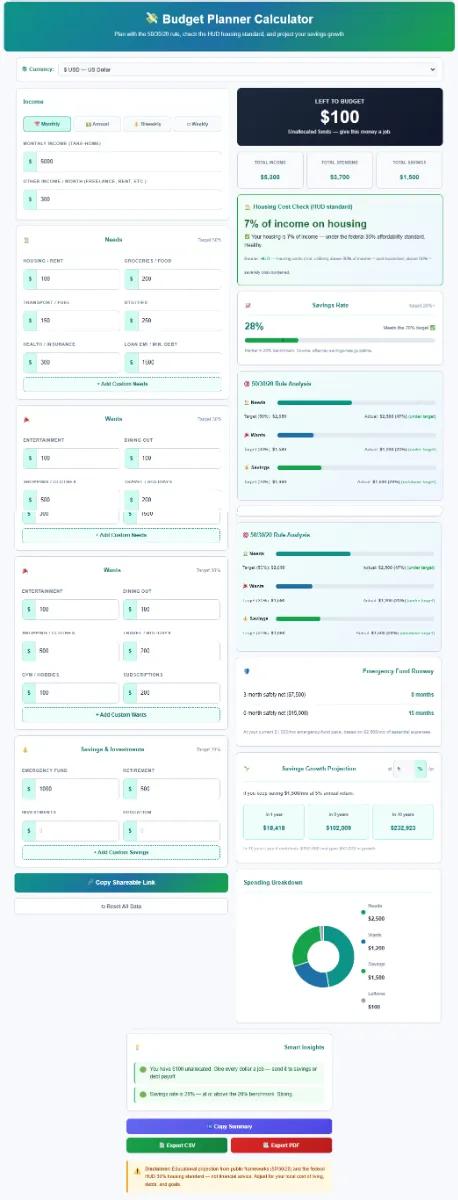
🏠 Model the Impact: SaveXpert Budget Calculator
I ran a property-tax-reduction scenario through the Budget Calculator to see how a change in an annual recurring housing expense ripples through a monthly budget. Even a modest reduction in annual property taxes — say $600 to $1,200 — shifts the monthly picture meaningfully when set alongside mortgage, insurance, and utilities. The calculator doesn’t know your local tax rate or exemptions, but it can show what a hypothetical change in annual property expense means for your monthly spending capacity. Put your own numbers in before assuming what a successful appeal would save.
Educational note: This calculator models budget scenarios for informational purposes only. Actual property tax savings depend on your local tax rate, exemptions, and the outcome of your specific appeal.
How Much Can You Save — and Can an Appeal Backfire?
The savings question
The research doesn’t provide a reliable nationwide savings figure. The approved federal sources don’t contain a national dataset showing average dollar savings from successful property tax appeals. Private-sector success claims conflict, and the relationship between assessed value, local tax rate, and exemptions means the actual savings is always jurisdiction-specific.
This is one of the clearest conclusions from the research: the dollar impact of a successful appeal can only be estimated once you know the local rate structure and what a specific reduction in assessed value would produce under it.
The risk: an appeal can go both ways
The research identifies one important risk that many national guides downplay. Filing an appeal doesn’t automatically guarantee a lower tax bill — and in some jurisdictions, it can result in a higher one.
When you open a formal assessment appeal, reviewers gain the opportunity to evaluate the entire property more closely. If undisclosed improvements — an addition, a finished basement, a new outbuilding — weren’t captured in the original assessment, a review could surface them. The result in some jurisdictions could be an assessment increase rather than the decrease the homeowner was seeking.
⚠️ Before filing, review your property record completely: Pull your assessor’s property record card — most counties make this available online — and confirm that every item listed accurately reflects the property’s actual condition and improvements. An appeal filed without this review could expose undisclosed improvements to reassessment. The research specifically flags that “appealing can only help” goes beyond what the evidence supports.
Common Misconceptions: Federal Processes That Don’t Apply Here
The IRS Appeals confusion
The IRS Independent Office of Appeals is a legitimate federal resource — for federal tax matters. It handles disputes involving IRS determinations: income tax audits, penalty assessments, collection actions. It does not provide a route for challenging a county or municipal real-property valuation. These are separate legal systems with separate authorities.
The Fair Credit Reporting Act confusion
The Fair Credit Reporting Act governs the accuracy of consumer credit reporting information. It doesn’t govern valuation decisions made by a local county assessor. The research specifically identifies the misconception that credit-reporting law could provide a shortcut around the local property tax appeal system — it can’t. FCRA rules are irrelevant to the assessment appeal process.
The “national guide” shortcut that doesn’t work
Online guides — including this one — can explain the general structure of property tax appeals. But no national guide can substitute for the actual rules published by the authority that issued your specific assessment. The procedures, forms, deadlines, hearing formats, and evidence requirements differ enough across jurisdictions that a checklist built for one state may actively mislead a homeowner in another.
What Changed for Property Tax Appeals in 2025 and 2026?
The research found no nationwide federal change specifically affecting local property tax assessment appeals during 2025 or 2026. The federal sources don’t identify any statutory change that would create a new national process or alter local appeal rights during that period.
That doesn’t mean every state and county kept identical procedures. Local changes could involve new deadlines, digital filing systems, reassessment cycles, revised hearing requirements, or changed appeal fees. Those changes require verification through the applicable state legislature, state tax agency, county assessor, or local review board.
This is precisely why the answer to “how to appeal property tax assessment 2026” can’t responsibly rely on a single national checklist. The jurisdiction controls the timeline.

What the Research Shows Works (and What Doesn’t)
What the evidence consistently supports
Starting with the authority that issued the assessment.
The local assessor’s office or review board is the source of the rules, the filing form, and the applicable deadline. Everything else — including national guides — is context. The local rules are the controlling source.
Reviewing the assessment record before filing.
Most counties make the property record card available online. Checking it for errors — incorrect square footage, missing condition data, improvements that don’t match the property — is the first and most straightforward step. Factual errors are among the easiest grounds for a successful appeal because they don’t require valuation expertise, just documentation of the discrepancy.
Gathering specific, local comparable sales data.
Comparable properties (similar size, age, condition, location) that sold recently for less than your assessed value represent the core of most market-value arguments. The comparables need to be genuinely similar and from the same local market — assessors scrutinise comps that differ significantly in relevant characteristics.
Budgeting for the possibility of no reduction — and for the possibility of an increase.
The research doesn’t establish a national success rate, and in some jurisdictions a review can surface undisclosed improvements. Going in with accurate expectations is more useful than assuming an appeal automatically saves money.
What the data says doesn’t work
Using federal tax appeal resources or processes for a local property tax dispute.
The IRS, the FCRA, and federal tax courts don’t have jurisdiction over county assessments. Pursuing those channels delays the actual local appeal and in some jurisdictions, could mean the local filing deadline passes in the meantime.
Assuming a national success-rate figure applies to your jurisdiction.
Published figures range from 20% to 62%+ depending on the source — and no federal dataset confirms any of them as a national standard. Local success rates in specific appeal boards may be higher or lower than any published estimate.
Filing before reviewing the full assessment record.
Appealing without first verifying what’s in the record creates the risk that previously undiscovered improvements become part of the review. Review the record first, then file.
Realistic Expectations for a 2026 Property Tax Appeal
The realistic expectation from this research is uncertainty at the national level — and specificity at the local level.
There is no federal nationwide deadline, no verified success rate, no standard filing fee, and no uniform evidence requirement. The research also doesn’t establish a national timeframe for how long an appeal takes from filing to decision — that varies by jurisdiction, case volume, and whether a formal hearing is required or simply available as an option.
What the research does support is a clear preparation framework: identify the correct local authority, confirm the specific 2026 deadline, review the assessment record for errors, gather local comparable sales, and understand how a reduced assessed value would interact with the local tax rate and exemptions before calculating any expected savings.
For homeowners in jurisdictions where assessment records and comparable sales data are publicly accessible, the preparation work is largely a matter of time. For those who want professional help, a property tax consultant or real estate attorney familiar with the local appeal board can assess whether the facts of a specific case support filing.
Bottom Line: 5 Steps to Appeal Your Property Tax in 2026
1. Find the authority that issued your assessment and get the 2026 rules directly from them:
Your county assessor’s office, municipal review board, or state tax agency sets the rules — not a federal agency. Search your county assessor’s website and your state tax board’s website. Look for the specific 2026 appeal procedures, the filing form, the submission deadline, and the hearing format. That information overrides everything in any national guide, including this one.
2. Note the filing deadline immediately — local windows are strict and typically 30–90 days from the assessment notice:
Missing the deadline ends the appeal for that assessment year. The research found no federal deadline that applies universally, so the local deadline in your notice is the one that controls. Calendar it for the day the notice arrives.
3. Pull your property’s assessment record card and check it for errors before filing:
Most counties make this available online. Compare it against what you know about the property: square footage, number of rooms, condition, and any improvements. Factual errors — incorrect data the assessor used — are among the most straightforward grounds for a correction. Doing this before filing also protects against the risk that a review surfaces undisclosed improvements you weren’t aware were missing from the record.
4. Gather comparable sales from your local market — recent, genuinely similar properties that sold for less than your assessed value:
This forms the core of most market-value arguments. Comparables should be close in location, size, age, and condition. An assessor reviewing your appeal will look for differences that could justify the higher valuation — the stronger your comparables, the harder that argument is to make.
5. Run the Budget Calculator with a realistic reduction estimate — knowing that savings depend on local rates and exemptions, not just the assessed value change:
A reduced assessed value doesn’t automatically produce a specific dollar saving. Your local tax rate and applicable exemptions determine the actual difference. Model a conservative reduction estimate through the Budget Calculator to see what the impact looks like before deciding whether the appeal is worth the time investment for your household.
“When I went through the research on property tax appeals, the clearest finding was the one that seems obvious in retrospect: this isn’t a federal topic. The IRS handles federal tax disputes. Your county assessor handles property valuations. Those are separate systems, separate evidence standards, and separate appeal routes. Treating them as the same thing is one of the most common homeowner mistakes the research turned up.”
— Kevin Brown, Lead Researcher at SaveXpert.com
Frequently Asked Questions
Ans: There is no single federal process. Property tax appeals are filed with the local government body that issued the assessment — typically a county assessor’s office, county board of equalization, or municipal review board, depending on the state. Homeowners must use the local authority’s specific forms and procedures, file within the locally set deadline, and present evidence that the assessed value is incorrect. The IRS Independent Office of Appeals handles federal tax matters — not local property assessments. Your state tax agency’s website and your county assessor’s website are the primary sources for jurisdiction-specific rules.
Ans: No federal deadline applies. Local jurisdictions set their own appeal windows — and the research found these periods typically run 30 to 90 days from the mailing of the annual assessment notice, based on non-federal contextual sources. That figure is contextual, not a universal rule. The actual deadline in your jurisdiction is printed on or accompanying your assessment notice. Missing a local deadline typically closes the appeal for that assessment year with no extension granted.
Ans: The research found no federal test for determining excessive assessment. Common grounds identified in non-federal procedural guides include factual errors in the assessment record (wrong square footage, inaccurate condition data, improvements that don’t exist), assessed value above what comparable recent sales support, and — in some jurisdictions — inequitable treatment relative to similar nearby properties. The first step most procedural guides recommend is pulling the property’s assessment record card and comparing it against the actual property. Your local assessor’s office typically makes this record available online.
Ans: No nationwide evidence standard exists in the approved federal sources. The research found private-sector success-rate estimates ranging from roughly 20% to 40% in some sources and 62% or more in others — with one source explicitly stating no national rate exists. That conflict means no reliable probability applies universally. Non-federal guides commonly discuss comparable property sales, independent appraisals, and documented assessment-record errors as typical evidence categories. Your local review board’s specific requirements — which may differ — take precedence over any general list.
Ans: The research doesn’t identify a federal rule saying a property tax appeal automatically produces penalties. However, it does identify a risk worth understanding: filing a formal appeal can invite a closer review of the entire property. If improvements or features weren’t captured in the original assessment — a finished basement, an addition, a structure not on the record — a review could surface them. In some jurisdictions, that can result in an increased assessment rather than the decrease the homeowner was seeking. Reviewing the full assessment record for accuracy before filing helps avoid this scenario.
Ans: The research identified this as a common question but found no verified national government statistic. Local procedures determine the timeline entirely. Some jurisdictions schedule informal hearings within weeks of filing; others queue formal board hearings that run six months to over a year depending on caseload and local rules. The filing itself can typically be completed in under an hour once the required form and documentation are gathered. The wait between filing and a decision depends on local board schedules, case volume, and whether a formal hearing is required or optional.