

ⓘ Educational Disclosure:
This article is for educational and informational purposes only. It does not constitute financial, legal, tax, lending, or investment advice. SaveXpert and its authors are not licensed financial advisors, CPAs, attorneys, or tax advisors. All data comes from publicly available government and institutional sources. Always consult a qualified professional before making investment decisions.
What is the health insurance open enrollment period for 2026? According to CMS data, the federal health insurance open enrollment period for 2027 coverage runs from November 1, 2026 through January 15, 2027 on HealthCare.gov. Coverage starts January 1, 2027 if you enroll by December 15, 2026. Enrolling after December 15 and before the January 15 deadline results in February 1 coverage in most cases. The two most important changes for this enrollment cycle: enhanced premium tax credits expired December 31, 2025, restoring the 400% Federal Poverty Level subsidy cliff, and all Bronze and Catastrophic plans are now HSA-eligible — a change that expanded access for approximately 1.6 million consumers. The 2026 individual maximum out-of-pocket limit is $10,600; the family limit is $21,200.
Key Takeaways
- Problem: Two significant changes for 2026 make this year’s open enrollment more consequential than most — the enhanced premium tax credits that expanded subsidy eligibility above 400% of the Federal Poverty Level expired December 31, 2025, and all Bronze and Catastrophic plans became HSA-eligible. Many re-enrollees don’t know about either change.
- Solution: Compare plans actively — don’t auto-renew. CMS data shows nearly 60% of eligible re-enrollees had access to a plan costing $50 or less per month after tax credits. The average lowest-cost plan rose to $50/month in 2026, up $13 from 2025. The decision that matters most is getting the MAGI estimate right before advance credits are calculated.
- Result: Active comparison shopping — across at least three plans and both metal tier and HSA eligibility dimensions — is what the CMS data consistently points toward. The window opens November 1, 2026, and closes January 15, 2027. Coverage starts January 1 if enrolled by December 15.
- Source: CMS — 2026 Marketplace Open Enrollment · HealthCare.gov
- Time To Read: 7 Minutes
Table of Contents
1. Health Insurance Open Enrollment Dates for 2026–2027
2. Review the Full Cost Picture Before Choosing a Plan
3. The Restored 400% FPL Cliff and What It Means for Premium Tax Credits
4. The 2026 Bronze and Catastrophic Plan Change: All Plans Now HSA-Eligible
5. Compare Plan Choices: Metal Tiers and What Each Covers
6. What Happens If You Miss Open Enrollment
7. HealthCare.gov vs. State-Based Marketplaces
8. Documents You Need Before You Start the Application
9. What the Research Shows Works (and What Doesn’t)
10. Bottom Line: 5 Steps for Health Insurance Open Enrollment 2026
The next federal health insurance open enrollment window opens November 1, 2026, and closes January 15, 2027. Two changes in 2026 make this year’s enrollment more consequential than most: the enhanced premium tax credits that expanded subsidy eligibility well above 400% of the Federal Poverty Level expired December 31, 2025, and all Bronze and Catastrophic Marketplace plans became HSA-eligible. CMS data shows the average lowest-cost plan after tax credits costs $50 per month in 2026 — $13 more than 2025. For most households, the decisions made during this enrollment window determine coverage for the full 2027 calendar year.
Health Insurance Open Enrollment Dates for 2026–2027
For states using HealthCare.gov, the standard open enrollment period follows a consistent annual structure. This year’s window — for 2027 coverage — is:
| Date | What It Means |
|---|---|
| November 1, 2026 | Open enrollment begins; plans and prices available to compare |
| December 15, 2026 | Enrollment deadline for coverage starting January 1, 2027 |
| January 15, 2027 | Final deadline for enrollment; coverage begins February 1 (in most cases) |
Source: CMS — 2026 Marketplace Open Enrollment Period · HealthCare.gov
The December 15 deadline is the one most households should treat as the hard cutoff. Coverage enrolled after that date doesn’t begin January 1 — it starts February 1, meaning January is uncovered unless you qualify for a Special Enrollment Period or have other active coverage.
⚠️ State marketplace deadlines may differ: States that operate their own marketplace platforms — including California, New York, Massachusetts, and others — can set deadlines that differ from the federal schedule. Some state-based marketplaces extend enrollment through January 31 or later. Check your specific state’s marketplace website before assuming the HealthCare.gov timeline applies.

Enter your income and top expenses to see where you stand.
Review the Full Cost Picture Before Choosing a Plan
The monthly premium is the number most consumers focus on during open enrollment. The research identifies this as the most common planning mistake — because premiums tell only part of the cost story.
| Cost Component | 2026 Figure / Range | What It Covers |
|---|---|---|
| Average lowest-cost Marketplace premium (after credits) | $50/month ($600/year) | Monthly payment to maintain coverage; excludes deductibles, copays, coinsurance |
| Maximum out-of-pocket — individual | $10,600 | The most you pay for covered in-network services in the plan year; plan pays 100% after this |
| Maximum out-of-pocket — family | $21,200 | The most a family pays for covered in-network services before the plan covers 100% |
| Deductible | Varies by plan tier and issuer | Amount paid before the plan begins sharing costs (except for preventive care) |
Source: CMS 2026 Marketplace Plan Prices
The gap between $600 in annual premiums (at $50/month) and the $10,600 individual maximum out-of-pocket is $10,000 in potential additional exposure. That number doesn’t mean every consumer will reach the maximum — it means a plan with a lower premium and higher cost-sharing could cost more in a year with significant healthcare use.
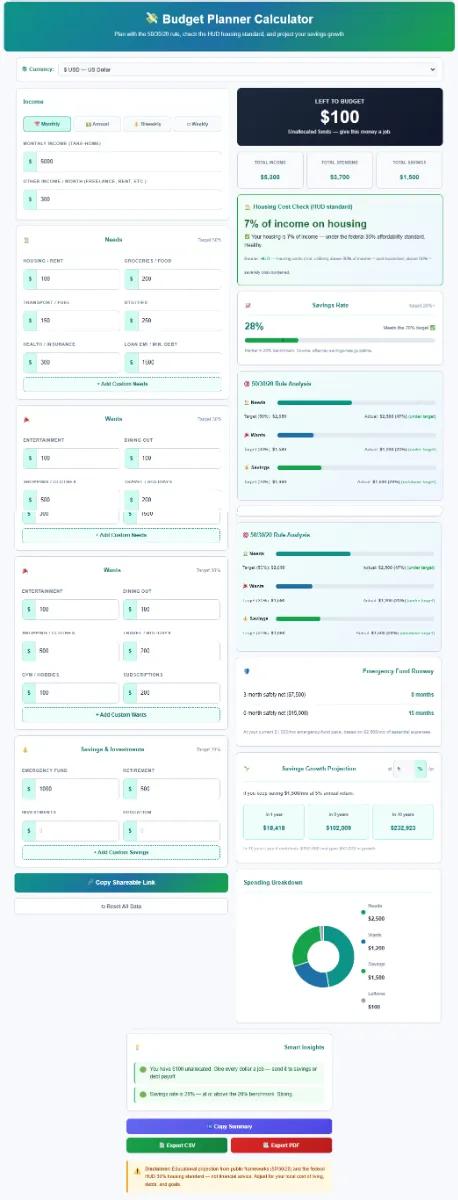
The research brief specifically recommends the Budget Calculator for comparing premiums, out-of-pocket exposure, and household cash flow before making this decision. Running the monthly premium plus an estimated deductible against your actual healthcare use patterns converts the abstract plan comparison into a number specific to your household.
🏥 Model the Full Annual Cost: SaveXpert Budget Planner Calculator
I ran the $300/month premium figure through a household budget scenario — adding the estimated deductible exposure for a typical Bronze plan against a Silver plan with cost-sharing reductions. The numbers showed that the plan with the lower monthly premium produced a higher total-cost outcome for a household with moderate annual healthcare use. Running your own numbers — with the actual premium, deductible, and expected use — shows whether the lowest-premium plan is actually the lowest-cost plan for your household.
Educational note: This calculator models budget scenarios for informational purposes only. Source: CMS 2026 Marketplace Data
The Restored 400% FPL Cliff and What It Means for Premium Tax Credits
This is the most consequential policy change for 2026 enrollment, and the research brief identifies it as one consumers planning their coverage most need to understand.
From 2021 through 2025, enhanced premium tax credits under the American Rescue Plan (and extended by the Inflation Reduction Act) made Marketplace subsidies available to households with income well above 400% of the Federal Poverty Level. That enhancement expired December 31, 2025.
For 2026 coverage, premium tax credits once again follow the traditional ACA structure: credits are available on a sliding scale for households with income between approximately 100% and 400% FPL. Income above 400% FPL is no longer eligible for premium tax credits.
| Income Range (% of FPL) | Premium Tax Credit Eligibility | Notes |
|---|---|---|
| Below 100% FPL | Not eligible for PTCs (Medicaid may apply) | Medicaid eligibility in expansion states; consult your state program |
| 100%–400% FPL | Eligible for premium tax credits (sliding scale) | Amount depends on household income and benchmark Silver plan premium |
| 100%–250% FPL | Also eligible for cost-sharing reductions (CSRs) | CSRs only available with Silver plan enrollment |
| Above 400% FPL | Not eligible for premium tax credits in 2026 | This is the restored “subsidy cliff” — present until 2025 enhanced credits, now returned |
Source: CMS Marketplace Subsidy Data · IRS Premium Tax Credit guidance
Why accurate MAGI estimates matter more in 2026
Advance Premium Tax Credits (APTCs) are paid directly to insurers to reduce monthly premiums. The amount is based on the income estimate you enter during enrollment. At the end of the year, you reconcile your advance credits against your actual income on IRS Form 8962.
Two errors the research brief specifically warns against:
Underestimating income:
If your actual income ends up higher than projected — particularly if it crosses the 400% FPL threshold — you may owe repayment of advance credits when you file your tax return. Under the pre-2026 enhanced rules, this repayment was capped. The research brief warns that the cap structure changes with the return to traditional rules.
Overestimating income:
You may receive smaller advance credits than you’re eligible for, meaning you pay more monthly than necessary. You’d receive any eligible refundable amount when filing taxes — but managing cash flow during the coverage year requires the most accurate estimate possible at enrollment.
⚠️ If you received enhanced subsidies during 2021–2025 and your income is near or above 400% FPL, review your eligibility before November 1: Households that benefited from enhanced credits may not qualify for advance credits under the restored rules. Enrolling without checking can result in unexpected repayment obligations at tax time if income exceeds the 400% threshold during the coverage year.
The 2026 Bronze and Catastrophic Plan Change: All Plans Now HSA-Eligible
For 2026, all Bronze and Catastrophic Marketplace plans became HSA-eligible. The research brief reports this expanded access for approximately 1.6 million consumers who now have the option of pairing a Bronze or Catastrophic plan with a Health Savings Account.
What HSA eligibility means in practice
A Health Savings Account (HSA) allows eligible individuals to contribute pre-tax dollars to a dedicated account for qualified medical expenses. HSA contributions reduce taxable income, and funds roll over from year to year with no “use it or lose it” provision.
HSA eligibility requires enrollment in a qualifying High Deductible Health Plan (HDHP). The 2026 change means that Bronze and Catastrophic plans meeting the HDHP definition can now serve as the qualifying plan — where previously only some plans in those tiers met the criteria.
| Why This Matters | Practical Implication |
|---|---|
| Pre-tax HSA contributions reduce taxable income | A consumer in the 22% federal tax bracket saves $0.22 per dollar contributed to the HSA |
| Funds roll over year to year | Unlike a Flexible Spending Account, unused HSA funds don’t expire |
| HSA can be invested and grow | Many HSA providers offer investment options once balances exceed a threshold |
| Withdrawals for qualified medical expenses are tax-free | The HSA deductible/coinsurance gap is partially offset by pre-tax HSA contributions |
💡 Research note: This change matters most for re-enrollees who previously didn’t consider Bronze or Catastrophic plans because they weren’t HSA-eligible. The combination of a Bronze plan’s lower premium with an HSA’s pre-tax contribution structure may produce a lower net annual healthcare cost for consumers in good health with low expected utilization than a Silver plan at a higher premium without the HSA benefit. Run the Budget Calculator with both plan types to compare.
Compare Plan Choices: Metal Tiers and What Each Covers
Marketplace plans come in four standard metal tiers plus a Catastrophic category. The tiers reflect cost-sharing structure — not care quality. All plans in all tiers must cover the ACA’s essential health benefits.
| Plan Tier | Typical Monthly Premium | Typical Cost Sharing | Best For | HSA-Eligible in 2026 |
|---|---|---|---|---|
| Catastrophic | Lowest (under 30 or qualifying hardship) | Highest — three primary care visits/year, then high deductible | Young, healthy adults with low expected use | Yes (new for 2026) |
| Bronze | Lower | High — you pay more when you use care | Consumers who want lower monthly costs and have savings to cover deductibles | Yes (new for 2026 — all Bronze) |
| Silver | Moderate | Moderate — cost-sharing reductions available at 100%–250% FPL | Income-eligible households; only tier with CSR eligibility | Only if plan meets HDHP criteria |
| Gold | Higher | Lower — plan pays more when you use care | Regular healthcare users who prefer predictable costs | Only if plan meets HDHP criteria |
| Platinum | Highest | Lowest — plan pays 90% of covered costs on average | High healthcare users with frequent services | Typically no (low-deductible plans) |
Source: HealthCare.gov — Plan Categories · CMS 2026 Plan Data
One detail worth emphasising: if your income falls between 100% and 250% FPL, the cost-sharing reduction (CSR) benefit is only available on Silver plans. CSRs reduce deductibles and out-of-pocket limits significantly for eligible households. Choosing a Bronze plan at that income level means forfeiting the CSR, which can make a Silver plan less expensive in total despite the higher premium.
What Happens If You Miss Open Enrollment
Missing the January 15 deadline without qualifying for a Special Enrollment Period (SEP) typically means going without Marketplace coverage until the next annual open enrollment — or paying full premiums for a short-term health plan, which doesn’t meet ACA standards and may not cover pre-existing conditions.
Qualifying life events that trigger a Special Enrollment Period
| Qualifying Life Event | SEP Window |
|---|---|
| Losing health coverage (job-based, Medicaid, CHIP, student coverage) | 60 days from loss of coverage |
| Getting married | 60 days from date of marriage |
| Having a baby, adopting a child, or placing a child for foster care | 60 days from the event |
| Moving to a new service area (with prior coverage) | 60 days from moving date |
| Income change that affects subsidy eligibility | 60 days from income change |
| Gaining citizenship or immigration status | 60 days from status change |
The 60-day window is important and doesn’t extend. A household that loses employer coverage on February 1 must enroll through an SEP by April 1. Missing that window again requires waiting for the next open enrollment period unless another qualifying event occurs.
HealthCare.gov vs. State-Based Marketplaces
Where you enroll depends entirely on your state of residence. The research brief notes that CMS and HHS data cover both federal and state-based Marketplace activity.
| Enrollment Platform | States | Note |
|---|---|---|
| HealthCare.gov | States without their own marketplace platform | Federally facilitated; standard November 1 – January 15 schedule |
| State-based Marketplace | California, Colorado, Connecticut, DC, Idaho, Kentucky, Maine, Maryland, Massachusetts, Minnesota, Nevada, New Jersey, New Mexico, New York, Pennsylvania, Rhode Island, Vermont, Washington | Each state sets its own open enrollment dates — some extend beyond January 15 |
Source: CMS — Marketplace Platforms
Regardless of which platform your state uses, the plans available, subsidy calculations, and income reporting requirements are governed by the same federal ACA rules. The platform determines the deadline and the enrollment interface — not the plan quality or subsidy eligibility.

Documents You Need Before You Start the Application
Gathering these before November 1 prevents mid-application delays and reduces the risk of income estimation errors.
| Document Type | Why You Need It |
|---|---|
| Social Security numbers for all household members enrolling | Required for eligibility verification |
| Immigration documents (if applicable) | Required for non-citizens to verify eligibility |
| Current income documentation (most recent W-2, tax return, or pay stubs) | Used to estimate Modified Adjusted Gross Income for subsidy calculation |
| Employer health coverage details (if your job offers insurance) | Marketplace plans may not provide credits if job-based coverage is deemed affordable under ACA standards |
| Current health plan information (if renewing) | Allows comparison against new plan options in the same coverage area |
Source: HealthCare.gov — How to Apply
The income documentation is the most consequential item. The research brief specifically connects accurate MAGI projection with lower risk of owing unexpected repayments at tax time. If your income is variable (self-employment, multiple part-time jobs, freelance work), use the most conservative honest estimate — rounding up slightly reduces the risk of advance credit repayment more than rounding down.
What the Research Shows Works (and What Doesn’t)
What the CMS, HHS, and IRS data consistently supports
Active comparison shopping across at least three plans before renewing.
CMS data shows nearly 60% of eligible re-enrollees had access to a plan costing $50 or less monthly after credits. But that’s a market-level finding — individual households see different options based on location, income, and available issuers. Comparing multiple plans at enrollment is the mechanism that captures the best available option for your specific circumstances.
Checking whether Bronze plans with HSA eligibility now change your best tier option.
Auto-renewal keeps you in the same plan at the same tier. For consumers who previously chose Silver because Bronze wasn’t HSA-eligible, the 2026 change may make Bronze worth reconsidering — particularly for those in good health with savings to cover higher deductibles.
Projecting MAGI accurately before the November 1 deadline.
The research brief identifies the income estimate entered at enrollment as the primary driver of advance credit accuracy. Errors in that estimate propagate through 12 months of advance payments and resolve as repayment or refund at tax time — not at enrollment. Getting the estimate right before submitting the application is less disruptive than correcting it later.
Treating December 15 as the hard deadline if January 1 coverage is the goal.
The window technically extends to January 15. But enrolling after December 15 means coverage starts February 1, leaving January uncovered. Most households enrolling during open enrollment should treat December 15 as the real deadline.
What the data says doesn’t work
Auto-renewing without comparing available plans.
Auto-renewal retains your existing plan but doesn’t account for price changes, new issuers entering your market, or the 2026 Bronze/HSA change. The research brief explicitly identifies returning to the same plan without checking as a way to miss better-fit options.
Using 2025 income to estimate 2026-2027 subsidy eligibility without adjusting for the cliff change.
Households near 400% FPL that received enhanced credits during 2025 may face a fundamentally different credit picture in 2026 — both in whether they qualify and in how much they receive. The subsidy structure they used last year is not the structure in place for 2026.
Focusing only on the monthly premium as the plan comparison metric.
The $10,600 individual maximum out-of-pocket in 2026 is 17.7 times the average $600 annual premium at $50/month. For a household with a medical event during the coverage year, the plan with the lowest premium can produce the highest total cost if its deductible and coinsurance are substantially higher.

Bottom Line: 5 Steps for Health Insurance Open Enrollment 2026
1. Mark December 15, 2026 as the enrollment deadline — not January 15:
The window runs to January 15, 2027, but coverage enrolled after December 15 starts February 1, leaving January uncovered for most plans. If continuous coverage is the goal, December 15 is the real deadline. Check your state’s marketplace for any state-specific extensions or variations from the HealthCare.gov timeline.
2. Check whether your income puts you above, at, or below 400% FPL before estimating advance credits:
The enhanced premium tax credits that extended subsidy eligibility above 400% FPL expired December 31, 2025. If your household income is at or above that threshold, you may not qualify for advance premium tax credits in 2026. If your income is below it, use your most accurate MAGI estimate — rounding up slightly reduces the risk of owing repayment at tax time when actual income exceeds the estimate.
3. Compare at least three plans across metal tiers — don’t auto-renew without checking:
Auto-renewal keeps you in the same plan, but 2026 brought two plan-structure changes that may affect your optimal tier. All Bronze and Catastrophic plans are now HSA-eligible, and the premium and cost-sharing mix may differ from last year. Run the Budget Calculator with each plan’s monthly premium, deductible, and your expected healthcare use to compare total annual cost — not just the premium line.
4. If your income is between 100% and 250% FPL, check whether a Silver plan’s cost-sharing reductions (CSRs) make it the lower net-cost option:
CSRs reduce deductibles and out-of-pocket limits significantly for eligible households — but only when the Silver tier is selected. Choosing Bronze at that income level means forfeiting CSRs. The monthly premium difference between Bronze and Silver may be more than offset by the lower deductibles and out-of-pocket limits that CSRs provide.
5. Gather documents before November 1 so the application is accurate from the first submission:
Social Security numbers for all household members enrolling, income documentation (most recent W-2, tax return, or pay stubs), employer coverage details if your job offers health insurance, and your current plan information if you’re renewing. Accurate MAGI documentation at submission reduces both under-crediting (paying too much monthly) and over-crediting (owing repayment at tax time).
“When I went through the CMS 2026 marketplace data and the premium tax credit guidance, the finding that most directly changes planning this year is the restored 400% FPL cliff. From 2021 to 2025, enhanced credits made Marketplace insurance accessible to households well above 400% of the Federal Poverty Level. That changed for 2026. Households that received advance credits under the enhanced rules and whose income puts them above 400% FPL now face a different subsidy picture — and the income estimate entered at enrollment is what determines whether they receive advance credits at all.”
— Kevin Brown, Lead Researcher at SaveXpert.com
Frequently Asked Questions
Ans: For states using HealthCare.gov, the open enrollment period for 2027 coverage runs from November 1, 2026 through January 15, 2027. Coverage starts January 1, 2027 if you enroll by December 15, 2026. Enrollment between December 16 and January 15 typically results in February 1 coverage. State-based marketplaces may have different end dates — some extend beyond the federal January 15 deadline. Check your state’s marketplace directly to confirm the applicable deadline.
Ans: According to CMS and HHS research, primary steps include: verifying your state’s exact enrollment deadline, projecting your household Modified Adjusted Gross Income as accurately as possible before estimating advance premium tax credits, comparing at least three qualified health plan options before renewing (including Bronze plans, which are now all HSA-eligible in 2026), and checking whether your income puts you above the restored 400% FPL subsidy cliff. Auto-renewal keeps your current plan but won’t capture the cost-structure changes that 2026 brought to Bronze and Catastrophic plans.
Ans: CMS data supports comparing more than just the monthly premium. The 2026 individual maximum out-of-pocket is $10,600 — nearly 18 times the $600 annual premium at the $50/month average. A plan with a lower monthly premium and higher cost-sharing can cost more in a year with meaningful healthcare use. The research brief recommends running the monthly premium, deductible, and estimated annual healthcare use through a budget model before committing to a plan. If your income is between 100% and 250% FPL, also check whether a Silver plan’s cost-sharing reductions make it the lower net-cost option despite the higher premium.
Ans: According to HealthCare.gov and CMS data, metal tiers reflect cost-sharing structure — not care quality. All plans cover the ACA’s essential health benefits. Bronze plans have lower premiums and higher cost-sharing; Platinum plans have higher premiums and lower cost-sharing. For 2026, all Bronze and Catastrophic plans became HSA-eligible — expanding access for approximately 1.6 million consumers. Silver is the only tier with cost-sharing reduction eligibility (for incomes between 100%–250% FPL), which can make Silver the lower net-cost option for eligible households despite the higher premium.
Ans: Missing the January 15, 2027 deadline without a qualifying life event means waiting until the next annual open enrollment for Marketplace coverage. Qualifying life events — losing job-based coverage, marriage, birth or adoption, moving to a new coverage area, or certain income changes — trigger a Special Enrollment Period. You generally have a 60-day window from the qualifying event to enroll. The 60-day window doesn’t extend, so households that experience a qualifying event should enroll promptly through HealthCare.gov or their state marketplace rather than waiting until the next open enrollment.
Ans: According to CMS 2026 Marketplace data, the maximum out-of-pocket limit for individual coverage is $10,600 and for family coverage is $21,200. These are the highest amounts a qualified health plan can require you to pay for covered in-network services in the plan year — after which the plan pays 100% of covered costs. These limits don’t include premiums, and out-of-network costs may not count toward the limit depending on plan design. Total annual healthcare cost exposure combines the annual premium plus up to the maximum out-of-pocket limit.