

ⓘ Educational Disclosure:
This article is for educational and informational purposes only. It does not constitute financial, legal, tax, lending, or investment advice. SaveXpert and its authors are not licensed financial or tax advisors. Always consult a qualified professional before making investment decisions.
Is renters insurance worth it in 2026? For most renters, the data suggests yes. According to HUD housing-counselor training materials, a standard policy covers personal property against events like theft, fire, smoke, and vandalism — plus certain personal liability claims — that a landlord’s building insurance never covers. The National Association of Insurance Commissioners (NAIC) puts the average premium at $15 to $30 per month. No federal source sets a universal price, coverage amount, or “worth it” threshold — that comparison depends on the renter’s specific property value, liability exposure, and policy terms.
Key Takeaways
- Problem: American renters often struggle to judge whether the monthly premium outweighs the financial risk of property loss and personal liability claims.
- Solution: Research shows that a renters policy covers two distinct risks — personal belongings and certain liability claims — that a landlord’s building insurance does not cover at all.
- Result: Data indicates that replacing lost items out of pocket costs far more than standard annual premiums, making the comparison clearer than most renters expect.
- Source: U.S. Department of Housing and Urban Development (HUD), National Association of Insurance Commissioners (NAIC)
- Time To Read: 9 Minutes
Table of Contents
1. The Number That Caught My Attention: $5,660
2. What Renters Insurance Actually Covers in 2026
3. What Renters Insurance Does Not Cover
4. How Much Does Renters Insurance Cost Per Month in 2026?
5. Is Renters Insurance Required by Landlords?
6. How Much Renters Insurance Coverage Do I Actually Need?
8. Three Myths the Research Clears Up
9. Taxes, Federal Rules, and 2026 Changes
The average American renter spent $5,660 on rented dwellings in 2024 — and that number grew 5.4% from the year before. (BLS Consumer Expenditures 2024, released December 19, 2025) Renters are already carrying a serious housing cost. The question I went into this research trying to answer: does paying a few hundred more dollars per year for renters insurance make sense against that backdrop?
The Number That Caught My Attention: $5,660
BLS reported that average annual consumer spending per consumer unit hit $78,535 in 2024. Housing alone accounted for $26,266 of that — roughly 33.4% of total spending, or $2,189 per month. The rented-dwellings component came in at $5,660, up 5.4% from 2023. (BLS Consumer Expenditure Surveys)
That number is the context behind every conversation about renters insurance. A renter already spends thousands on housing. The question isn’t whether to spend more — it’s what the extra $15 to $30 per month actually buys in protection.
The research raised a point I want to be upfront about: there’s no federal formula that says renters insurance becomes “worth it” at a particular rent level or income level. The math depends on what a renter owns, what their liability exposure looks like, and what the specific policy covers. What the research does give is a clear picture of the two risks the policy addresses — and why the landlord’s building insurance doesn’t address them.

What Renters Insurance Actually Covers in 2026
I went through HUD’s housing-counselor training materials to see what standard renters coverage actually addresses. HUD Module 6.1 treats renters insurance as covering personal possessions against covered events, including fire, smoke, lightning, theft, vandalism, windstorm, and certain water damage.
But here’s the point that stopped me. A policy isn’t simply about replacing a couch after a fire. The insured property can include a renter’s television, laptop, furniture, clothing, kitchen equipment, and other everyday belongings — depending on policy terms and coverage limits. Replacing even a modest apartment’s contents out of pocket adds up fast.
Personal liability — the coverage most renters overlook
HUD’s materials also identify personal liability as a second, separate component of renters insurance. That coverage can relate to defense costs or a legal judgment when a tenant faces a negligence claim — for example, if a guest slips and falls in the apartment and makes a claim against the renter.
💡 Research note: The NAIC confirms that renters insurance provides two distinct types of coverage: personal property protection and liability coverage. Most people think about the first and forget the second until they actually need it. (NAIC: Protect Your Belongings)
Does renters insurance cover theft outside the home?
The research brief’s strongest evidence confirms theft as a covered event in renters insurance, but it does not establish a universal rule for every theft situation that occurs off-premises. Coverage depends on the policy terms, limits, exclusions, and deductibles. (NAIC: Renters Insurance)
The NAIC specifically warns that policies can impose special limits on certain categories of property — jewelry, art, antiques, electronics. So a specific theft occurring away from home requires checking the actual policy language, not just whether theft appears on the covered-events list.
Actual cash value vs. replacement cost — a distinction that matters
NAIC’s consumer guidance separates two ways policies reimburse claims, and they produce very different outcomes:
| Coverage Type | How It Works | What to Watch |
|---|---|---|
| Actual cash value | Reimburses the depreciated value of the item at the time of loss | A 4-year-old laptop may pay out far less than its replacement cost |
| Replacement cost | Reimburses the cost of a new comparable item, subject to documentation | Usually a higher premium; requires purchase receipts after a claim |
Source: NAIC: Understanding Your Homeowners or Renter’s Policy
This is the difference between having a policy and having the exact coverage you need. A renter who owns valuable jewelry or electronics that exceed a policy’s special limit may not receive full replacement value — even with valid renters insurance.
Does renters insurance cover additional living expenses?
Some policies include coverage for temporary living expenses if a covered loss makes the apartment uninhabitable — hotel stays, meals, and similar costs while repairs are made. The NAIC notes this as an optional feature rather than a universal standard, so it requires checking the specific policy. (NAIC: Do I Need Renters Insurance?)
What Renters Insurance Does Not Cover
The research makes this point clearly. Standard renters policies have real gaps, and the data doesn’t support assuming otherwise:
| What Isn’t Covered | Why It Matters | Source |
|---|---|---|
| Flood damage | Standard renters policies typically exclude floods; separate coverage is required | HUD Module 6.1 |
| Earthquake damage | Standard policies typically exclude earthquakes as well | HUD Module 6.1 |
| The building’s structure | That’s the landlord’s coverage — not the renter’s problem or protection | HUD / NAIC |
| High-value items over special limits | Jewelry, art, antiques, and electronics can have sub-limits requiring separate riders | NAIC consumer guidance |
⚠️ The flood gap is real: If a renter lives in a flood-prone area, standard renters insurance doesn’t close that risk. Separate flood coverage — for example, through the National Flood Insurance Program — needs its own consideration. Check HUD’s flood hazard resources for guidance.
How Much Does Renters Insurance Cost Per Month in 2026?
This is where the research needs honest framing. The available pricing figures come from different sources with different methodologies — and none of them are federally standardized rates.
| Source | Reported Cost | Important Caveat |
|---|---|---|
| NAIC (state regulatory association) | $15–$30 per month | Average range; varies by location, rental size, and possessions |
| NerdWallet (private publisher, January 2026) | $151 per year (~$13/month) | Based on stated sample assumptions; not a federal statistic |
| HUD historical example | $350 per year for $50,000 coverage | Dated to 2011 — not a 2026 estimate |
Source: NAIC: Protect Your Belongings; NerdWallet (private publisher); HUD.gov
💡 Research note: The NAIC is a state regulatory association, not a federal executive agency. NerdWallet is a private publisher. Neither figure should be treated as an IRS, HUD, BLS, or CFPB statistic. Your actual quote will depend on your location, the value of your belongings, your chosen coverage level, and your deductible.
That pricing difference is one reason I wouldn’t treat any single figure as a guaranteed market rate. Individual quotes can differ substantially from any average. The right approach is getting an actual quote based on a personal inventory — which is the step most renters skip.
Estimate your annual and monthly premium in seconds.
Is Renters Insurance Required by Landlords?
The research found no general federal mandate requiring renters to carry insurance. However, HUD’s housing-counselor materials are specific: a landlord may require renters insurance through the rental agreement. That distinction matters.
Federal sources don’t create a nationwide requirement. Insurance regulation is primarily state-based, and state laws affect landlord requirements, cancellation rules, underwriting, claims handling, and rating factors. So the actual requirement comes down to the individual lease and the applicable state rules — not a federal standard. (HUD.gov)
💡 Research note: If a lease requires renters insurance, the requirement is a lease term — not a federal law. Check your state’s insurance department for rules that affect landlord insurance requirements in your jurisdiction.
How Much Renters Insurance Coverage Do I Actually Need?
Federal sources don’t publish one universal coverage limit for every renter. The research points instead toward a policy-specific inventory of possessions. NAIC guidance says an accurate home inventory — photos, purchase dates, prices, and receipts — can help establish the value of property and document a claim later. (NAIC: Renters Insurance)
A renter with modest furniture and older electronics has a different property value from one with newer electronics, specialty equipment, jewelry, or collectibles. The research also found that more than half of Americans surveyed by NAIC said they didn’t have a list of their possessions. That doesn’t guarantee a claim gets paid — but it shows why documentation matters when making one.
Beyond the property value, the policy also needs attention on deductibles, exclusions, coverage limits, and any special sub-limits for high-value item categories. The NAIC specifically flagged jewelry, art, antiques, and electronics as categories that can have separate, lower limits within a standard policy. (NAIC: Understanding Your Policy)
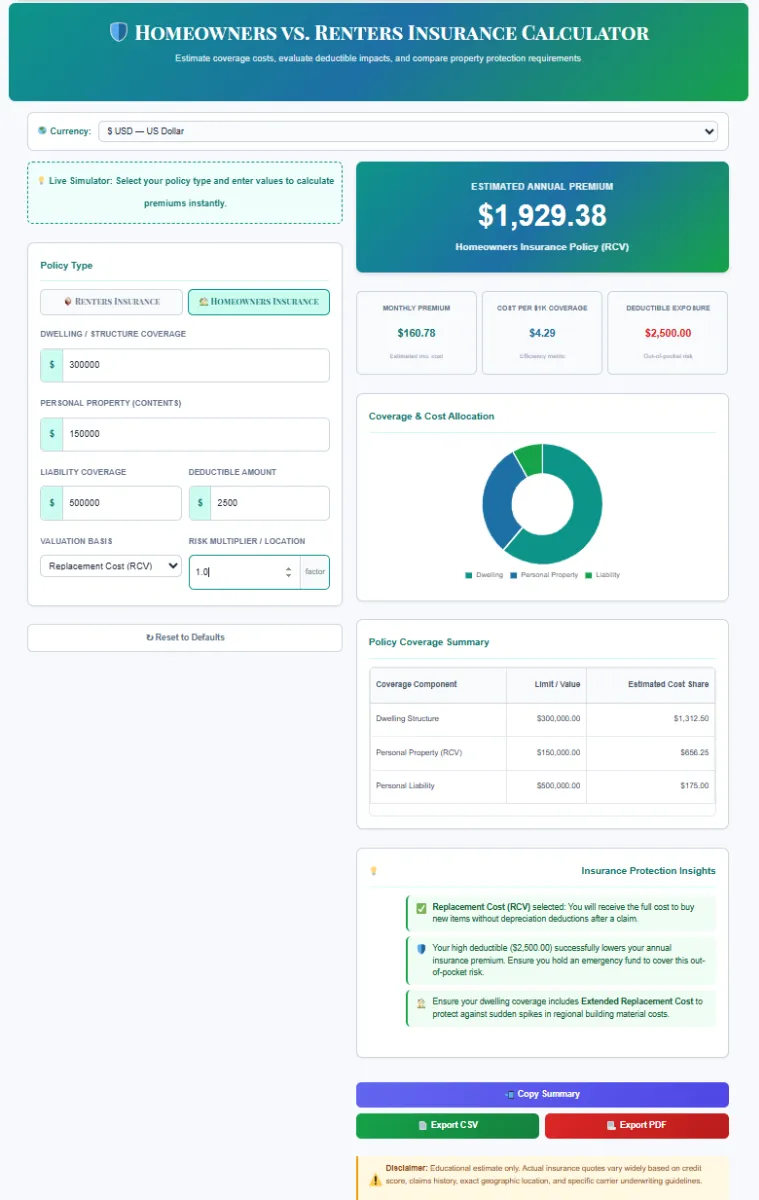
🏠 Compare Coverages — Homeowners vs. Renters Insurance Calculator
I ran scenarios through SaveXpert’s Homeowners vs. Renters Insurance Calculator to map out the cost-versus-coverage gap between landlord building policies and personal renters policies. It makes the two-risk picture visible with actual numbers instead of estimates.
Educational note: This calculator models insurance coverage scenarios for educational purposes and does not provide personalized insurance advice. Always review an actual policy before purchasing. Source: NAIC: Renters Insurance

See your target safety net and how close you are.
What the Data Shows Works
Based on what I found in HUD and NAIC materials, the approach the research consistently supports is separating the two risks clearly and treating them differently.
First:
HUD draws a hard line between the landlord’s building insurance and the renter’s personal property and liability coverage. These are two separate insurance relationships. A landlord’s policy covers the structure. It does not replace a renter’s laptop, clothing, or furniture — and it does not defend a renter in a negligence claim. (HUD Module 6.1)
Second:
The research supports treating personal liability as part of the analysis — not just furniture and electronics. HUD identifies defense costs and legal judgments connected to certain negligent-injury claims as coverage that renters’ insurance can address.
Third:
A written home inventory matters more than most renters expect. It helps establish property values before a loss and documents a claim after one. The NAIC recommends photos, purchase dates, prices, and receipts stored somewhere other than the apartment itself.
Fourth:
The actual cash value versus replacement cost distinction drives real money differences in a claim. Depreciation under an actual-cash-value policy can reduce a payout substantially for older electronics and furniture.
What the data doesn’t support:
Assuming flood and earthquake losses fall under a standard renters policy. HUD says those risks typically require separate coverage. The data also doesn’t support using a national average premium to predict any individual’s price.
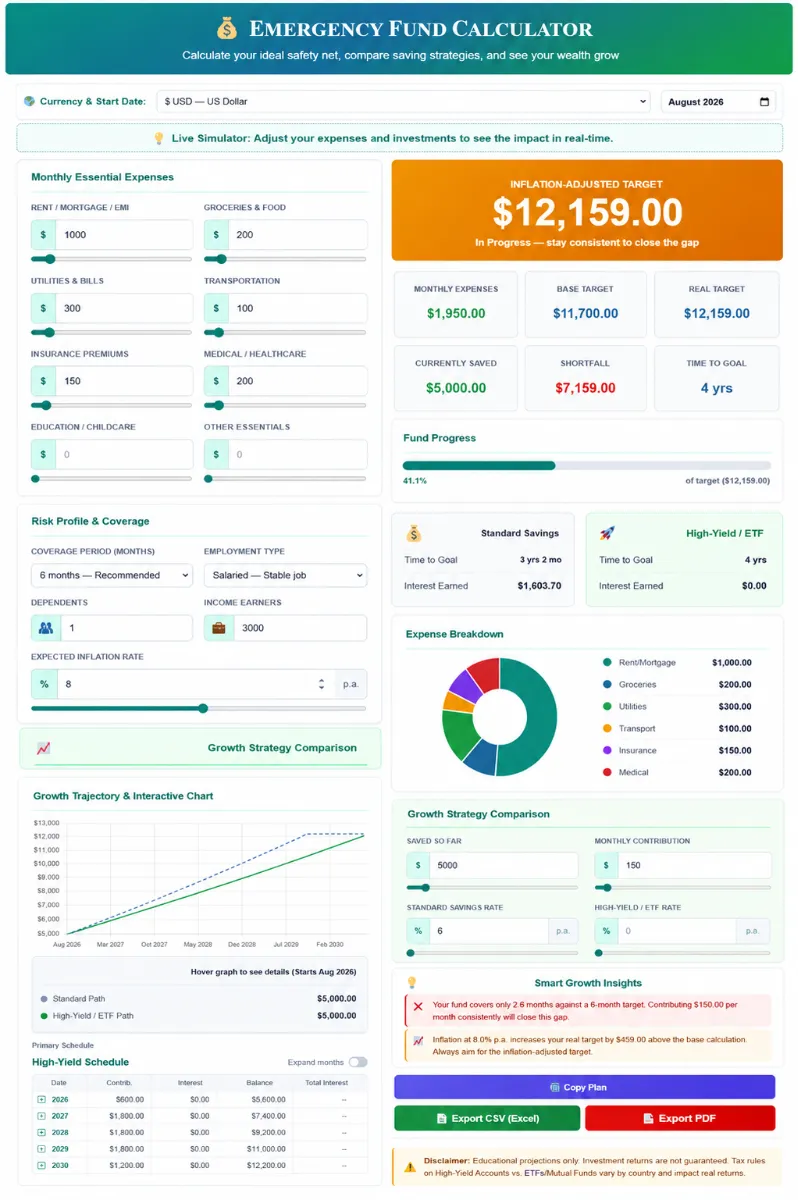
💰 Model the Uninsured Gap — Emergency Fund Calculator
I ran the broader risk scenario through SaveXpert’s Emergency Fund Calculator — specifically to quantify the cash reserve a renter might need when absorbing a deductible, replacing belongings not fully covered, or covering temporary-displacement costs that insurance doesn’t touch.
Educational note: This calculator helps model cash-reserve scenarios and does not predict actual claim outcomes or insurance payouts. Source: Federal Reserve: Economic Well-Being of U.S. Households
Three Myths the Research Clears Up
Based on what I found across IRS and Investor.gov materials, here is what the research consistently supports:
Myth 1: My landlord’s insurance covers my stuff
This is the most common misunderstanding in the research. HUD is explicit: the landlord’s building coverage insures the structure, not the tenant’s possessions. If a covered event damages a renter’s furniture, electronics, or clothing, the landlord’s policy won’t pay for it. (HUD Module 6.1)
Myth 2: I don’t own enough valuable stuff for insurance to matter
NAIC addresses this directly. Policies cover electronics, clothing, furniture, and household appliances — not just high-value items. A minimal apartment’s contents can still add up to several thousand dollars to replace. The NAIC’s consumer guidance notes that “even a minimal number of items could add up to thousands of dollars’ worth of merchandise.” (NAIC: Protect Your Belongings)
Myth 3: Renters insurance is just about property
The liability piece gets overlooked. HUD identifies liability protection as a separate component — one that can cover defense costs or a legal judgment if a guest suffers an injury in the apartment due to the tenant’s negligence. A property-only view of renters insurance misses half the coverage.

Taxes, Federal Rules, and 2026 Changes
I checked the research for any tax angle. The reviewed IRS materials didn’t identify a general federal income-tax deduction for ordinary personal renters-insurance premiums. The brief flags this for taxpayer-specific verification rather than treating it as a universal rule.
I also found no CFPB, FCRA, or Federal Reserve rule establishing national renters-insurance premiums, coverage limits, or deductibles. Insurance regulation is primarily state-based.
The research identified no nationwide federal renters-insurance rule change for 2025 or 2026 in the reviewed IRS, CFPB, Federal Reserve, HUD, BLS, SSA, SEC, or FCRA-related materials. BLS did release updated 2024 Consumer Expenditure data on December 19, 2025 — that release produced the spending figures cited above, but it didn’t create any insurance law or premium change. (BLS Consumer Expenditures 2024)
BLS also published a tenants’ and household insurance CPI factsheet dated May 20, 2026. That factsheet explains that the index forms part of the CPI shelter index and is published at the U.S. city-average level. It’s a measurement tool, not a coverage or pricing rule. For state-specific insurance changes, the research points to each state’s insurance department as the correct source.
Your 5-Step Renters Insurance Action Plan
1. Build your home inventory first:
Before shopping for a policy, photograph your belongings, note purchase dates and prices, and store the list somewhere outside your apartment. This step determines the coverage amount you actually need.
2. Choose replacement cost over actual cash value if you can:
Actual cash value policies apply depreciation, which can pay out far less than what it costs to replace items. The higher premium on a replacement-cost policy is often worth the difference.
3. Check the policy’s special limits:
Ask specifically about sub-limits for jewelry, electronics, art, and antiques. If you own items in those categories that exceed the sub-limit, ask about scheduling them separately (a rider).
4. Understand the flood and earthquake gap:
Standard renters insurance won’t cover flood or earthquake damage. If you live in a risk zone, research separate coverage — and check your state’s insurance department for guidance.
5. Size your emergency fund alongside the policy:
Insurance covers specified risks — it doesn’t cover your deductible, sub-limit gaps, or displacement costs above any ALE coverage. Use the Emergency Fund Calculator above to quantify the cash buffer you still need.
“What surprised me most when I went through HUD’s training materials is that renters insurance isn’t just about replacing a couch. The liability protection piece — covering legal defense costs if a guest gets hurt in your apartment — is the part most renters never think about until they need it.”
— Kevin Brown, Lead Researcher at SaveXpert.com
Frequently Asked Questions
Ans: According to HUD housing-counselor data, renters insurance addresses two financial risks that a landlord’s policy never covers: personal property replacement and personal liability claims. The NAIC reports the average cost at $15 to $30 per month. No federal formula defines a universal “worth it” threshold — the answer depends on the value of a renter’s possessions, their liability exposure, and the specific policy terms. For most renters, the research suggests the math favors coverage.
Ans: The NAIC — a state regulatory association — reports an average monthly cost of $15 to $30. NerdWallet’s January 2026 analysis, using its own stated assumptions, estimated an average of $151 per year, or about $13 per month. Neither is a federally standardized rate. Actual premiums vary based on location, rental size, coverage limits, deductible, and the value of the insured belongings. The only reliable number is an actual quote based on a personal inventory.
Ans: According to HUD housing-counselor training materials, standard renters insurance covers personal possessions against events including fire, smoke, lightning, theft, vandalism, windstorm, and certain water damage. The NAIC confirms it also includes personal liability protection, which can cover legal defense costs if a guest suffers an injury due to the tenant’s negligence. Some policies also include additional living expenses if a covered loss makes the apartment temporarily uninhabitable.
Ans: The NAIC confirms that theft can fall within standard renters insurance protection even when it occurs away from the rental unit. However, the research explicitly notes that specific coverage limitations, exclusions, and special sub-limits apply based on individual policy terms. Certain categories — electronics, jewelry, art — often carry lower sub-limits. Checking the actual policy language is the only way to confirm coverage for a specific off-premises theft situation.
Ans: HUD data shows that standard policies typically exclude damage from floods and earthquakes — those require separate coverage. Renters policies also never cover the building’s physical structure (that’s the landlord’s coverage) or damage from the renter’s own intentional acts. The NAIC also notes that high-value items like fine jewelry, art, and antiques can have special sub-limits within a standard policy, meaning full replacement may not be covered without a separate rider.
Ans: Some renters insurance policies include additional living expenses (ALE) coverage, which can help pay for hotel stays and similar costs when a covered loss makes the apartment uninhabitable. The NAIC notes this as a policy-specific feature rather than a universal standard — meaning it depends entirely on whether the individual policy includes it and up to what limit. Always check the ALE section of any policy before purchasing, and don’t assume it’s automatic.