

ⓘ Educational Disclosure:
This article is for educational and informational purposes only. It does not constitute financial, legal, tax, lending, student-loan, or insurance advice. SaveXpert and its authors are not licensed financial aid professionals. Always consult a qualified professional before making financial decisions.
What goes on an open enrollment 2026 health insurance checklist? Verify the enrollment dates, estimate your total yearly cost (not just the premium), and confirm your doctors and prescriptions are covered before the December 15 deadline. Research from the Centers for Medicare & Medicaid Services (CMS) shows that deductibles, prescriptions, and subsidies matter more than comparing monthly premiums on their own.
Key Takeaways
- Problem: Many Americans struggle to estimate total healthcare costs and verify doctor networks during the rushed open enrollment window.
- Solution: An open enrollment 2026 health insurance checklist helps you confirm key deadlines and compare total annual expenses, not just monthly premiums.
- Result: Data shows that checking provider networks and drug formularies before you enroll can head off surprise out-of-network bills.
- Source: CMS 2026 Open Enrollment Fact Sheet, HealthCare.gov
- Time To Read: 6 Minutes
Table of Contents
1. Critical Dates for the 2026 Checklist
2. Compare by Total Cost, Not Premium Alone
3. Household Information, Income, and Financial Help
4. HMO, PPO, HSA, and Marketplace Cost Rules
7. Realistic Expectations for Open Enrollment 2026
23.0 million people signed up for 2026 Marketplace coverage by January 28, 2026. That number stopped me. It shows how large the Marketplace stays, even as the rules keep shifting. If you’re pulling together an open enrollment 2026 health insurance checklist, that scale is exactly why the details matter so much. (CMS 2026 Marketplace OEP Report)
Critical Dates for the 2026 Checklist
Here’s the part that creates the most confusion. The federal Marketplace Open Enrollment Period for 2026 coverage ran from November 1, 2025, through January 15, 2026. A plan picked by December 15 could start January 1. A plan picked between December 16 and January 15 could start February 1, as long as the first premium got paid. (CMS 2026 Open Enrollment Fact Sheet)
The window opening in late 2026 is a different one. CMS materials currently schedule the federal-platform period for November 1 through December 15, 2026 — about 6.5 weeks under that schedule. And that window generally selects coverage for 2027, not 2026.
Federal regulation frames the outer limits. It says the annual Marketplace Open Enrollment must begin no later than November 1 and end no later than December 31 before the coverage year. (eCFR §155.410)
💡 Research note: If you’re searching for a “2026” checklist right now, use it to prepare for the late-2026 window. That window mostly buys 2027 coverage. Same checklist, different plan year.
⚠️ Confirm before you rely on it: Enrollment dates can shift, and state-based Marketplaces set their own deadlines. Check the exact window for your state on HealthCare.gov before you plan around it.

Compare by Total Cost, Not Premium Alone
I spent time going through the Marketplace comparison guidance, and one point showed up again and again: the monthly premium doesn’t tell the whole cost story. HealthCare.gov says your estimated yearly cost includes premiums, deductibles, copayments, coinsurance, and the out-of-pocket maximum. (HealthCare.gov: Your Total Costs)
Picture two plans. One costs less each month but hands the household a bigger deductible and higher cost sharing. The research doesn’t support calling either plan “cheaper” until you look at the full yearly picture.
The comparison also covers doctors and prescriptions. HealthCare.gov lets you check specific physicians, facilities, and drugs while you compare Marketplace plans. (HealthCare.gov: Comparing Plans)
Here’s a practical example. A household spots a plan with a very low monthly premium. But the family takes a regular prescription and likes a specific doctor. If that doctor sits outside the network, or the drug isn’t on the covered list, the low premium tells only part of the story.
💡 Research note: The official comparison points are the same every year — total annual cost, providers, facilities, prescriptions, deductibles, coinsurance, copayments, and out-of-pocket limits. A side-by-side view beats scanning premiums.
What is the difference between a deductible and an out-of-pocket maximum?
The research shows these figures do different jobs. The deductible is the threshold you pay before the plan starts paying. The out-of-pocket maximum is the ceiling on what you pay for covered care in a plan year.
For HSA-qualified high-deductible health plans, IRS Publication 969 lists 2026 minimums and maximums you can check against any plan you’re weighing:
| 2026 HDHP / HSA figure (IRS) | Self-only | Family |
|---|---|---|
| Minimum annual deductible | $1,700 | $3,400 |
| Maximum out-of-pocket (deductibles + other expenses, excludes premiums) | $8,500 | $17,000 |
| HSA contribution limit | $4,400 | $8,750 |
Source: IRS Publication 969, IRS Revenue Procedure 2025-19 (§223, 26 U.S.C.)
⚠️ Handle this one carefully: A separate CMS methodology figure lists $10,600 as the 2026 ACA Marketplace self-only maximum annual cost-sharing limit. The final applicability and the family amount need verification for a specific plan, so don’t apply that number to your plan without checking the plan’s own documents. (CMS Marketplace)
How do I check whether my doctor is in-network?
The official comparison process gives you a way to search for specific doctors and facilities before you pick a plan. (HealthCare.gov: Comparing Plans)
Networks are plan-specific. They can differ between plans, so keeping the same insurer’s name doesn’t guarantee every doctor you like stays covered.
Say someone has used the same primary-care doctor for years. A plan with a lower premium can still be a poor fit if that doctor doesn’t participate in its network. The same logic applies to prescriptions, because drug formularies vary between plans too. (HealthCare.gov: See Plans)
Enter your income and top expenses to see where you stand.

Household Information, Income, and Financial Help
The research turned up another common trap: people assume Marketplace financial help works the same way for everyone. It doesn’t. IRS guidance says the premium tax credit depends on household income, family size, the applicable poverty-line percentage, benchmark premiums, and your enrollment premiums. (IRS Premium Tax Credit)
Under the standard IRS rule, premium-tax-credit eligibility generally covers household income from 100% to 400% of the federal poverty line, with exceptions and later statutory changes. (IRS Premium Tax Credit, 26 U.S.C. §36B)
⚠️ Not settled — check current IRS guidance: A temporary expansion applied for tax years 2021 through 2025. The 2026 treatment needs confirmation against final IRS material. I wouldn’t treat that as decided without checking. (IRS Premium Tax Credit Q&A)
There’s a tax-year wrinkle worth knowing. If you estimate advance premium-tax-credit payments without an accurate annual household income, you can end up with a mismatch between the advance payments and the final credit on your return. IRS rules make you reconcile that at tax time. (IRS Premium Tax Credit Q&A)
HealthCare.gov’s own estimator exists for exactly this — to help you estimate plan prices and financial help based on your circumstances. (HealthCare.gov Plan Estimator)
Model the numbers before the window opens
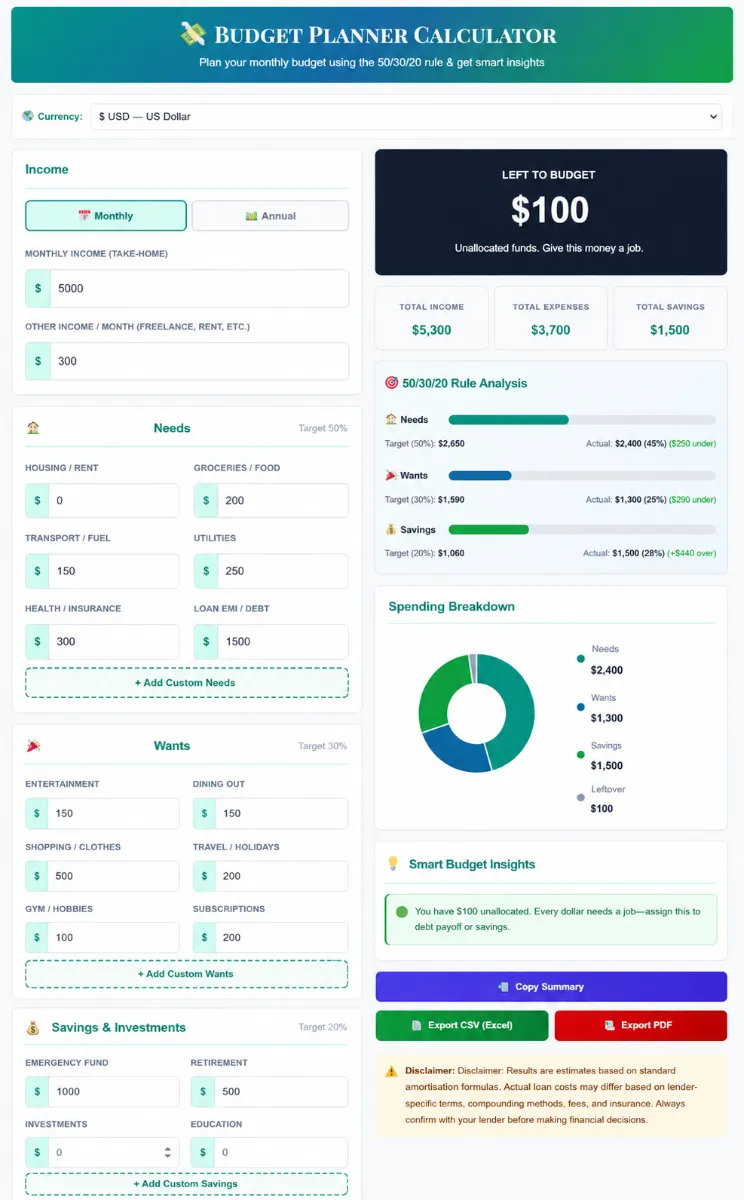
I ran a household healthcare-cost scenario through SaveXpert’s Budget Calculator. Here’s what it’s built to show: recurring premiums and expected medical costs sit alongside your normal household cash flow, instead of getting judged as one lonely premium figure.
💰 Try the SaveXpert Budget Planner Calculator
I ran a few household scenarios through it — premiums plus expected out-of-pocket costs, mapped against monthly income. Here’s what came out when healthcare stops being a single line and joins the whole budget.
Educational note: This calculator helps you model budgeting scenarios and does not provide personalized financial advice. For a deductible-vs-savings view, the Emergency Fund Calculator pairs well with it. Source: HealthCare.gov: Your Total Costs
HMO, PPO, HSA, and Marketplace Cost Rules
The research doesn’t hand over a full technical face-off between HMO and PPO structures. What it does establish: you need to check the actual network and plan-specific costs before you compare coverage.
So an HMO-versus-PPO call can’t rest on the label alone. A research-backed comparison starts with the real network, facilities, prescriptions, premiums, deductibles, cost sharing, and out-of-pocket limits shown for the plan in front of you.
The HSA side deserves attention too. IRS Revenue Procedure 2025-19 set the 2026 HSA contribution limits at $4,400 for self-only coverage and $8,750 for family coverage. (IRS Revenue Procedure 2025-19)
CMS also reported a 2026 design change: more plans — including all Bronze and Catastrophic plans — could pair with HSAs, subject to the applicable requirements. That’s a real shift, but the implementation details need checking against the specific plan. (CMS 2026 Open Enrollment Fact Sheet)
💡 Research note: A broad category label (“Bronze,” “PPO,” “HSA-eligible”) doesn’t tell the full story. Plan-level verification does.
What the Data Shows Works
Based on what I found across CMS, HealthCare.gov, IRS, and HHS materials, the approach the data keeps supporting is pretty plain.
First:
Compare estimated total yearly costs, not monthly premiums alone. HealthCare.gov spells out that its total-cost view includes premiums, deductibles, copayments, coinsurance, and out-of-pocket maximums. (HealthCare.gov: Your Total Costs)
Second:
Check doctors, facilities, and prescriptions for each plan. The official comparison process supports those checks before you enroll. (HealthCare.gov: Comparing Plans)
Third:
Enter your household and income information to get location-specific prices and a financial-help determination. That’s part of the official process, not an optional extra. (HealthCare.gov Plan Estimator)
Fourth:
Tell the difference between actively picking a plan and getting automatically re-enrolled. CMS tracks both. Automatic renewal doesn’t prove your premium, network, formulary, or subsidy stayed the same. Read your renewal notice before you assume nothing changed. (CMS 2026 Marketplace OEP Report)
Fifth:
Know that information gaps and paperwork slow people down. HHS ASPE’s evidence review names lack of information, administrative barriers, and enrollment difficulty as reasons eligible people stay uninsured — and finds outreach and consumer assistance help. (HHS ASPE)

Realistic Expectations for Open Enrollment 2026
The current timeline gives a defined federal-platform window from November 1 through December 15, 2026 for 2027 Marketplace coverage. That’s roughly 6.5 weeks under the CMS schedule.
Research shows plan costs, subsidies, provider networks, prescription coverage, and plan availability all depend on your household, location, and Marketplace. National averages can’t predict your final price.
On penalties: the federal government has had no individual-mandate tax penalty since 2019. Some states run their own mandates or penalties, though, so your state matters. (IRS Individual Shared Responsibility Provision)
On scale: CMS reported 24.2 million plan selections for 2025 and 23.0 million for 2026 by January 28, 2026. Big participation — but those totals don’t tell you whether you’ll qualify for a subsidy or find a specific plan. (CMS 2026 Marketplace OEP Report)
⚠️ One legal item to watch: The research set flags the effect of City of Columbus v. Kennedy against the underlying court order. Rules affected by ongoing litigation can change, so treat any point tied to it as provisional until confirmed.
Your 5-Step Open Enrollment Checklist
1. Lock the dates:
Confirm your state’s exact window on HealthCare.gov, and note that December 15 usually decides a January 1 start.
2. Add up total cost:
Compare premium plus deductible, copays, coinsurance, and the out-of-pocket maximum — not the premium alone.
3. Verify your care:
Search each plan for your doctors, facilities, and prescriptions, since networks and formularies reset every year.
4. Enter real income:
Use accurate household and income details so your subsidy estimate holds up at tax-time reconciliation.
5. Don’t auto-pilot the renewal:
Read the renewal notice — a re-enrolled plan can still change its premium, network, or drug list.
Treat the late-2026 window as your run-up to 2027 coverage. The checklist works best when you model the premium and healthcare costs against your cash flow first, then open the plan finder with your numbers already in hand.
“When I went through the HealthCare.gov comparison guidance, the same message kept coming back: the premium is the number people see first, and it’s the number that fools them the most.”
— Kevin Brown, Lead Researcher at SaveXpert.com
Frequently Asked Questions
Ans: According to HealthCare.gov, review your open enrollment 2026 health insurance checklist before the deadline. The data shows you should update household income, compare total annual costs including deductibles, and confirm your preferred doctors stay in-network for the upcoming year to avoid coverage gaps.
Ans: CMS data shows applicants generally need Social Security numbers for all household members, employer and income information such as W-2s or pay stubs, and current policy numbers if you have them. Accurate documentation helps the Marketplace calculate your premium tax credit correctly.
Ans: HealthCare.gov guidance says comparison means looking past the monthly premium. The data shows you should weigh total estimated yearly costs — deductibles, copayments, coinsurance, and out-of-pocket maximums — while checking each plan’s provider directory and prescription drug formulary.
Ans: IRS and CMS material shows these are different cost thresholds. A deductible is the amount you pay for covered services before the plan starts paying. The out-of-pocket maximum is the highest total you’ll pay for covered services during the plan year.
Ans: According to HealthCare.gov, you can use the official plan comparison tool to search for specific providers and facilities during your checklist process. The data shows networks change every year, so verifying your doctor’s participation before you finalize a plan matters.
Ans: IRS guidance shows the federal individual-mandate tax penalty has been $0 since 2019, so there’s no federal penalty for going without coverage. Some states run their own coverage mandates and penalties, so the answer can depend on where you live. Check your state’s rules alongside the federal position.