

ⓘ Educational Disclosure:
This article is for educational and informational purposes only. It does not constitute financial, legal, tax, or insurance advice. SaveXpert and its authors are not licensed financial advisors. Health coverage rules, deadlines, and eligibility requirements can change. Always verify current enrollment windows and your specific eligibility at HealthCare.gov, Medicare.gov, or with a licensed insurance professional.
The number that caught my attention when I went through the CMS data was 23.1 million. That’s how many consumers selected or were automatically re-enrolled in Health Insurance Marketplace coverage for 2026. But CMS specifically notes that plan selections and effectuated coverage aren’t the same thing — the first premium generally needs to be paid before coverage becomes active.
Key Takeaways
- Problem: Americans often miss critical healthcare deadlines because the enrollment calendar for 2026 coverage actually began late in 2025 — not in 2026 — and different programs follow entirely different timelines.
- Solution: Federal ACA Marketplace open enrollment for 2026 coverage ran from November 1, 2025 to January 15, 2026. The December 15, 2025 deadline triggered January 1 coverage. November 1, 2026 opens enrollment for 2027 coverage — not 2026.
- Result: Missing the regular January 15 deadline means relying on a Special Enrollment Period, Medicaid, or CHIP for any remaining 2026 coverage. The next Marketplace open enrollment — for 2027 coverage — opens November 1, 2026.
- Source: HealthCare.gov — Key dates and deadlines · Centers for Medicare & Medicaid Services (CMS)
- Time To Read: 8 Minutes
Table of Contents
1. When Does Health Insurance Open Enrollment Start 2026? ACA Dates Explained
2. 2026 Enrollment Calendar at a Glance
3. Why the 2026 Dates Create So Much Confusion
4. What Happens If You Miss Health Insurance Open Enrollment?
5. Can You Change a Marketplace Plan After Open Enrollment Ends?
6. How Long Is Medicare Open Enrollment in 2026?
7. What Changes for 2027 Health Insurance Enrollment
When does health insurance open enrollment start 2026? The standard federal ACA Marketplace period for 2026 coverage officially opened on November 1, 2025, and concluded on January 15, 2026, according to the Centers for Medicare & Medicaid Services. General enrollment is currently closed for 2026 coverage unless you qualify for a Special Enrollment Period, Medicaid, or CHIP. The next Marketplace open enrollment — for 2027 coverage — opens November 1, 2026.
I went through the CMS, HealthCare.gov, Medicare, eCFR, U.S. Code, and IRS materials on this. The biggest finding was straightforward: the coverage year and calendar year don’t always match, and that mismatch is what causes most of the deadline confusion.
When Does Health Insurance Open Enrollment Start 2026? ACA Dates Explained
According to CMS, federal Marketplace Open Enrollment for 2026 coverage ran from November 1, 2025, through January 15, 2026 — roughly 76 calendar days. The Affordable Care Act requires exchanges to provide initial enrollment, annual enrollment, and Special Enrollment Periods under 42 U.S.C. §18031(c)(6). Federal regulations establish the Marketplace timing rules under 45 C.F.R. §155.410.
The Two Key Deadlines Inside That Window
There were two separate deadlines inside the 2026 enrollment window, and they produced different coverage start dates.
A person who selected a plan by December 15, 2025 generally received coverage beginning January 1, 2026 — assuming the first premium was paid. Someone who selected a plan between December 16 and January 15 generally received a February 1, 2026 coverage start date instead.
That timing matters because January 15 was not the deadline for January 1 coverage. December 15 was. Those are two distinct deadlines with two distinct outcomes.
⚠️ Plan selection ≠ active coverage: CMS specifically cautions that plan selection totals don’t mean coverage became active. The first premium must generally be paid for effectuated coverage to begin. Nearly 1.5 million HealthCare.gov consumers had APTC or coverage ended in 2025 after CMS identified ineligibility or unauthorized enrollment. Automatic re-enrollment also doesn’t guarantee coverage is effectuated without premium payment.
2026 Enrollment Calendar at a Glance
Health coverage deadlines run on at least three separate calendars — the ACA Marketplace, Medicare, and employer-sponsored plans — and they don’t align. Here’s a consolidated view of the key 2026 dates.
| Enrollment Event | Key Date(s) | What It Means |
|---|---|---|
| 2026 ACA Marketplace OE opens | November 1, 2025 | First day to select a 2026 Marketplace health plan |
| Jan 1, 2026 coverage deadline | December 15, 2025 | Enroll by this date for coverage starting January 1, 2026 |
| 2026 ACA Marketplace OE closes | January 15, 2026 | Last day for standard 2026 Marketplace enrollment; Feb 1 coverage for this window |
| Medicare Advantage OEP | January 1 – March 31, 2026 | Existing Medicare Advantage enrollees can switch plans |
| Medicare General Enrollment | January 1 – March 31, 2026 | Late Part A/B enrollment for those without a Special Enrollment Period |
| Medicare Annual OE 2026 | October 15 – December 7, 2026 | Medicare beneficiaries change health and drug plans for 2027 (54 calendar days) |
| 2027 ACA Marketplace OE opens | November 1, 2026 | First day to select a 2027 Marketplace plan — not 2026 |
| 2027 ACA Marketplace OE closes | January 15, 2027 | Per July 2026 CMS statement — verify at HealthCare.gov before publishing |
Source: HealthCare.gov — Key dates and deadlines · Medicare.gov · CMS. The 2027 ACA closing date is per a July 2026 CMS statement; an older 2025 CMS training document cited December 15, 2026. Treat as current research position and verify before publication.

Why the 2026 Dates Create So Much Confusion
Health coverage deadlines operate on several different calendars simultaneously. The ACA Marketplace uses one schedule. Medicare uses another. Employer-sponsored plans can follow an entirely employer-set period. Someone searching for “when does health insurance open enrollment start 2026” late in the year can easily see November 1, 2026, listed as an enrollment date and assume it applies to 2026 coverage.
It doesn’t. According to CMS’s latest available guidance, November 1, 2026, starts the federal Marketplace period for 2027 coverage — not 2026. The 2026 Marketplace enrollment period ended on January 15, 2026.
State rules add another layer. CMS reported that the 2026 Marketplace enrollment report covered 30 states using HealthCare.gov and 20 states plus the District of Columbia operating their own enrollment platforms. State-based exchanges may use different enrollment deadlines from the federal exchange. The federal dates provide the national baseline — state-specific rules can shift the exact calendar.
What Happens If You Miss Health Insurance Open Enrollment?
As of August 25, 2026, the regular 2026 Marketplace Open Enrollment period has already ended. Missing it doesn’t automatically close every coverage route — but it does change what’s available.
Special Enrollment Periods
Federal rules provide Special Enrollment Periods for qualifying life events. HealthCare.gov describes a typical 60-day window before or after a qualifying life event — including losing qualifying coverage, getting married, having a child, adopting, or moving. Someone who simply missed the January 15 deadline doesn’t automatically receive the same opportunity as someone experiencing a qualifying event. The SEP rules apply specifically to defined qualifying circumstances.
💡 Research note: If you lose job-based coverage after the regular Marketplace period, the federal Special Enrollment rules identify loss of qualifying coverage as a qualifying event. The 60-day SEP window applies around that event. Missing Marketplace open enrollment doesn’t block this path if the qualifying event genuinely occurred. See HealthCare.gov’s SEP list for all qualifying circumstances.
Medicaid and CHIP: Year-Round Applications
Medicaid and CHIP operate differently from the Marketplace. According to HealthCare.gov, applications for Medicaid and CHIP can be submitted any time of year — they don’t use the annual Marketplace enrollment window. Missing the ACA open enrollment deadline doesn’t close the Medicaid or CHIP route for households that may qualify.
What Doesn’t Change After the Deadline
The research does not support a general post-deadline Marketplace switching period for everyone. Someone who missed January 15 without a qualifying life event can’t simply enroll in a new Marketplace plan. Waiting until November 1, 2026, is the next standard enrollment opportunity — and that opens coverage for 2027, not for the remaining months of 2026.

Can You Change a Marketplace Plan After Open Enrollment Ends?
Changing a Marketplace plan after January 15, 2026, generally isn’t permitted without a qualifying life event. The eCFR regulations describe events such as marriage, birth, adoption, moving, and losing qualifying coverage as triggers for a Special Enrollment Period — which then provides the typical 60-day enrollment window.
This creates an important distinction. An automatic re-enrollment doesn’t equal effectuated coverage, and it doesn’t create a new switching opportunity either. CMS notes that plan selections and effectuated coverage represent different measures — and specifically cautions that selection totals don’t mean coverage became active without the first premium payment.
The IRS material confirms that the federal individual shared-responsibility payment is $0 for applicable months beginning after December 31, 2018. So there is currently no federal tax penalty for lacking health coverage.
See your target safety net and how close you are.
How Long Is Medicare Open Enrollment in 2026?
Medicare follows a separate annual enrollment calendar — and it shouldn’t be confused with ACA Marketplace enrollment. The timelines differ, and the enrollment periods serve different populations.
According to Medicare.gov, the 2026 annual Open Enrollment Period runs exactly 54 calendar days: October 15 through December 7, 2026. This applies to existing Medicare beneficiaries who want to adjust their health and drug plans for 2027 coverage. The relevant regulation appears in 42 C.F.R. §422.62.
Medicare also has a separate Medicare Advantage Open Enrollment Period — January 1 through March 31, 2026 — for people already enrolled in Medicare Advantage who want to switch plans. Federal law further establishes the Medicare General Enrollment Period from January 1 through March 31 each year, for eligible people who missed initial Part A or Part B enrollment and don’t qualify for a Special Enrollment Period.
💡 Research note: Medicare enrollment and ACA Marketplace enrollment are two separate systems with different dates, populations, and coverage mechanics. Someone approaching Medicare eligibility at 65 follows Medicare enrollment timelines — not the ACA Marketplace calendar. Don’t mix these two when planning around coverage transitions.
What Changes for 2027 Health Insurance Enrollment
This is where the calendar becomes especially important in 2026. CMS’s July 27, 2026 statement gives the federal Marketplace Open Enrollment period for 2027 coverage as November 1, 2026, through January 15, 2027.
The research brief flags a conflict between an older 2025 CMS training document that referenced December 15, 2026, and the newer July 2026 CMS statement giving January 15, 2027. The newer statement is treated as the current research position — but this date should be verified directly against HealthCare.gov before this article is published.
The practical point is this: November 1, 2026, opens the window for 2027 coverage. If you’re researching enrollment dates late in 2026 and see November 1 listed, that’s not a second chance at 2026 health coverage. It’s the standard start of the next annual cycle.
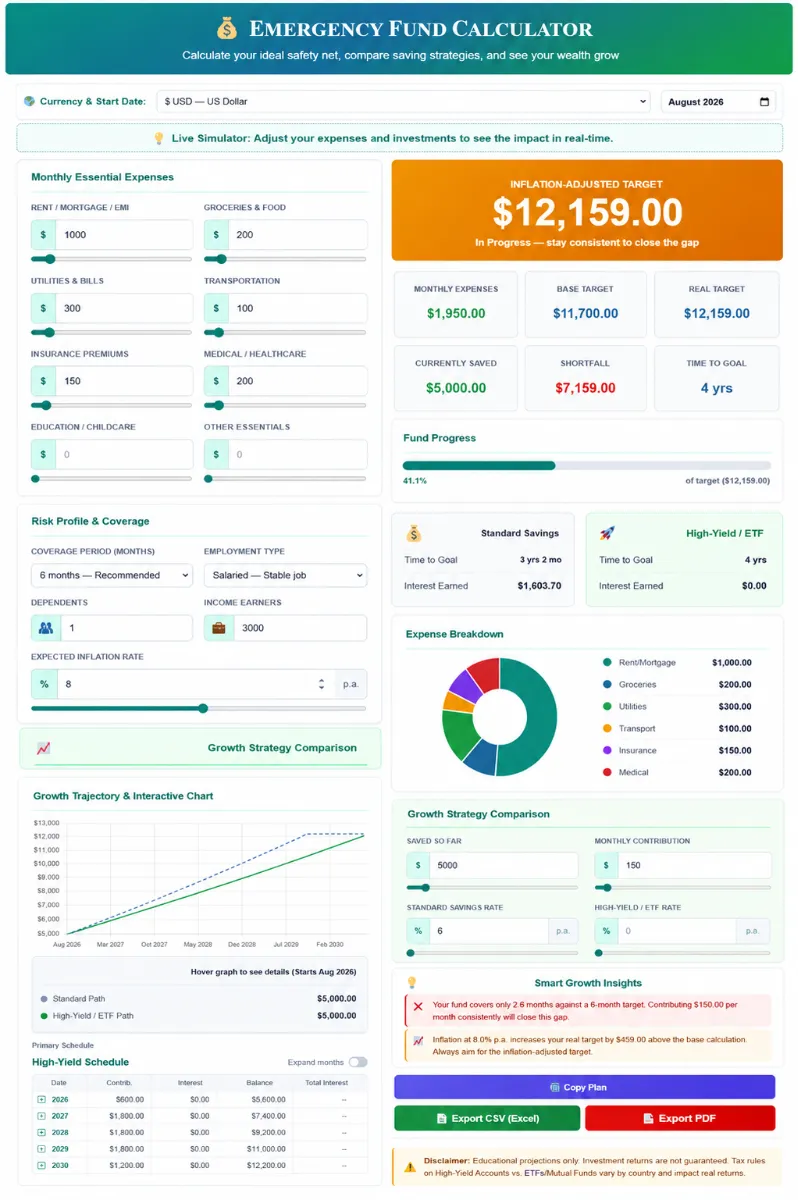
💰 Plan Around Coverage Gaps with the SaveXpert Emergency Fund Calculator
I ran a simple coverage-gap scenario through SaveXpert’s Emergency Fund Calculator. A gap can occur between losing coverage, qualifying for a Special Enrollment Period, and the effective date of a new plan. Connecting the enrollment timeline to your available cash reserve — knowing how many months of healthcare costs your emergency fund can cover — is the most practical thing to model while you’re waiting for a new plan to start. Enter your monthly expenses and current savings to see where you stand.
Educational note: This calculator models savings scenarios and does not determine health insurance eligibility or calculate coverage costs. For official enrollment guidance, visit HealthCare.gov.
The Bottom Line: 5-Step Coverage Action Plan
What should you do right now, in August 2026? Here’s what the CMS and HealthCare.gov data points toward — matched to your current position in the calendar:
1. Check whether you currently have 2026 coverage:
If you enrolled during the Nov 1, 2025 – Jan 15, 2026 window and paid your first premium, your 2026 coverage should be active. Confirm plan status directly with your insurer — not just the HealthCare.gov confirmation email.
2. Check for SEP eligibility if you don’t have coverage:
Review the HealthCare.gov SEP list for qualifying life events. If you experienced a qualifying event within the past 60 days — losing job-based coverage, getting married, moving — you may still be able to enroll in a 2026 Marketplace plan now.
3. Check Medicaid and CHIP eligibility:
HealthCare.gov accepts Medicaid and CHIP applications year-round. If your household income has changed since open enrollment, your eligibility may have changed too — especially given the 2026 affordability threshold of 9.96% of household income for job-based plan affordability.
4. Set your 2027 calendar now:
Mark November 1, 2026, as the first day of 2027 Marketplace Open Enrollment — and December 15, 2026, as the likely deadline for January 1, 2027 coverage. The next cycle opens in less than three months. Don’t miss it again.
5. Model your coverage gap with the Emergency Fund Calculator:
If there’s a gap between now and your next plan’s start date, model how many months of out-of-pocket healthcare costs your emergency fund can cover. A healthcare gap is one of the most expensive unexpected costs a household faces — knowing the dollar impact ahead of time lets you plan for it.
Understanding the ACA enrollment calendar — and knowing that November 1, 2026, opens coverage for 2027, not 2026 — protects against the most common healthcare deadline mistake. Check HealthCare.gov’s dates and deadlines page regularly, since CMS can update guidance during the year.
“When I went through the CMS, HealthCare.gov, and Medicare data, the most important finding was the calendar mismatch. The 2026 ACA enrollment period started in 2025. November 1, 2026 belongs to the next cycle — for 2027 coverage. That one confusion explains most of the missed-deadline mistakes I found in the research.”
— Kevin Brown, Lead Researcher at SaveXpert.com
Frequently Asked Questions
Ans: According to CMS, standard federal ACA Marketplace open enrollment for 2026 coverage officially started on November 1, 2025. That period has already closed. November 1, 2026, marks the beginning of the enrollment period for 2027 coverage, not 2026. The calendar shift between the enrollment year and the coverage year is the most common source of confusion.
Ans: The standard federal Open Enrollment period for 2026 ACA Marketplace coverage ended on January 15, 2026. After that date, standard Marketplace enrollment routes closed. Acquiring new Marketplace coverage for 2026 now generally requires qualifying for a Special Enrollment Period through a specific qualifying life event — or applying for Medicaid or CHIP, which remain open year-round.
Ans: You may still secure 2026 coverage if you meet specific criteria. The CMS data shows enrollment remains open for those who qualify for a Special Enrollment Period due to a qualifying life event — such as losing job-based coverage, getting married, or moving. Additionally, Medicaid and CHIP applications are accepted year-round through HealthCare.gov regardless of the Marketplace calendar.
Ans: The eCFR regulations show that changing a Marketplace plan after the January 15 deadline is generally not permitted without a qualifying life event. According to HealthCare.gov, events such as marriage, birth, or losing qualifying coverage trigger a Special Enrollment Period — typically providing a 60-day window to select a new plan.
Ans: According to Medicare.gov, the annual Medicare Open Enrollment Period for 2026 runs exactly 54 calendar days — October 15 through December 7, 2026. This period applies specifically to existing Medicare beneficiaries looking to change their health and drug plans. Medicare’s enrollment calendar is separate from the ACA Marketplace calendar.
Ans: CMS specifically cautions that plan selection totals and effectuated coverage represent different measurements. Selecting a Marketplace plan during open enrollment — or being automatically re-enrolled — does not confirm that coverage became active. Coverage generally becomes effectuated only after the first premium is paid. CMS reported that nearly 1.5 million HealthCare.gov consumers had APTC or coverage ended in 2025 after CMS identified ineligibility or unauthorized enrollment — a figure that illustrates why confirmed payment matters, not just selection.